The Clock That Never Stops: What Carbon-14 Reads in Bone, Tooth, and Hair
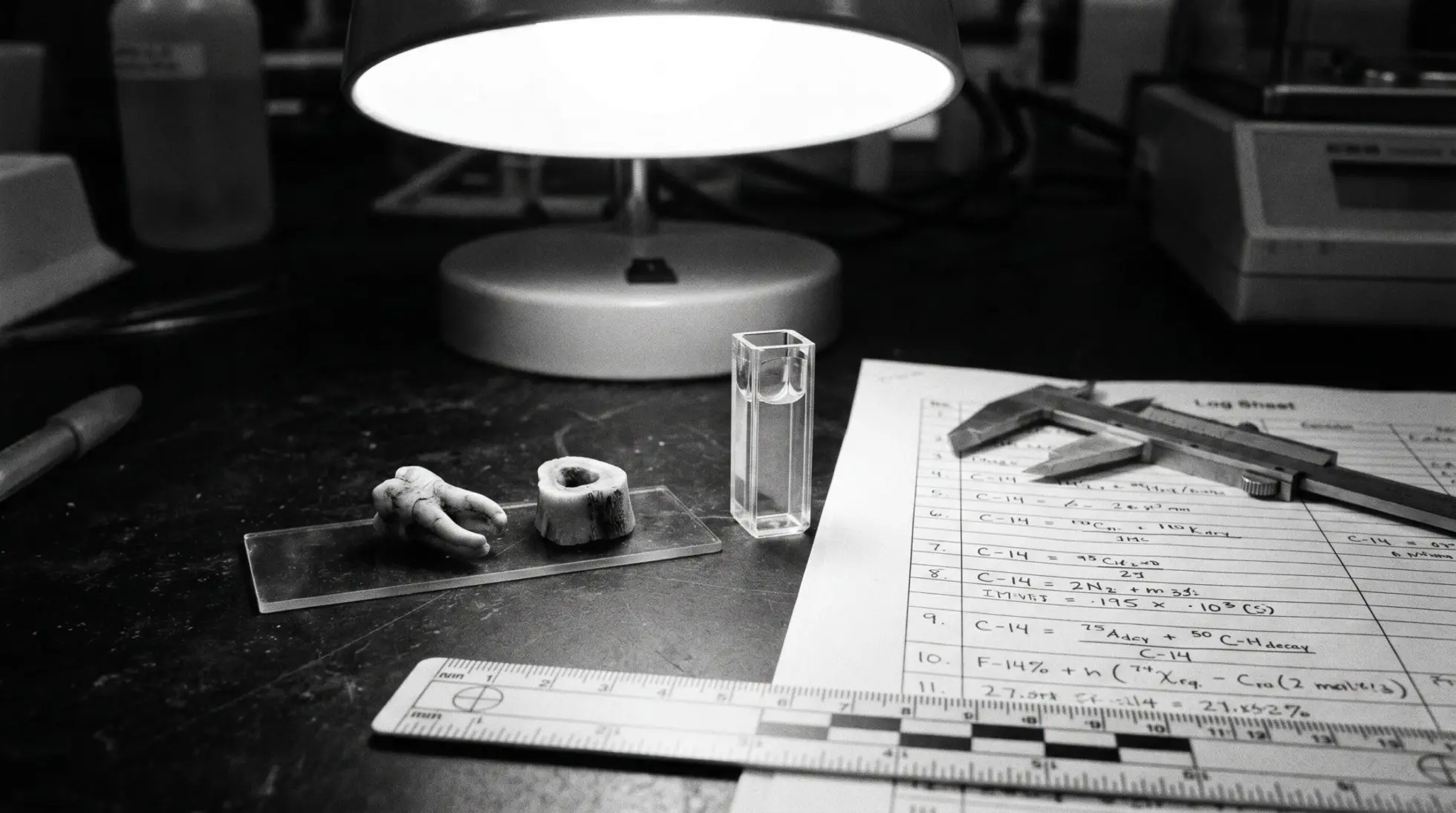
From the physics of radioactive decay to the Cold War’s accidental forensic gift, how a mummy roughly 2,700 years old anchors the method’s historical range, and what dental enamel remembers about the year you were born.
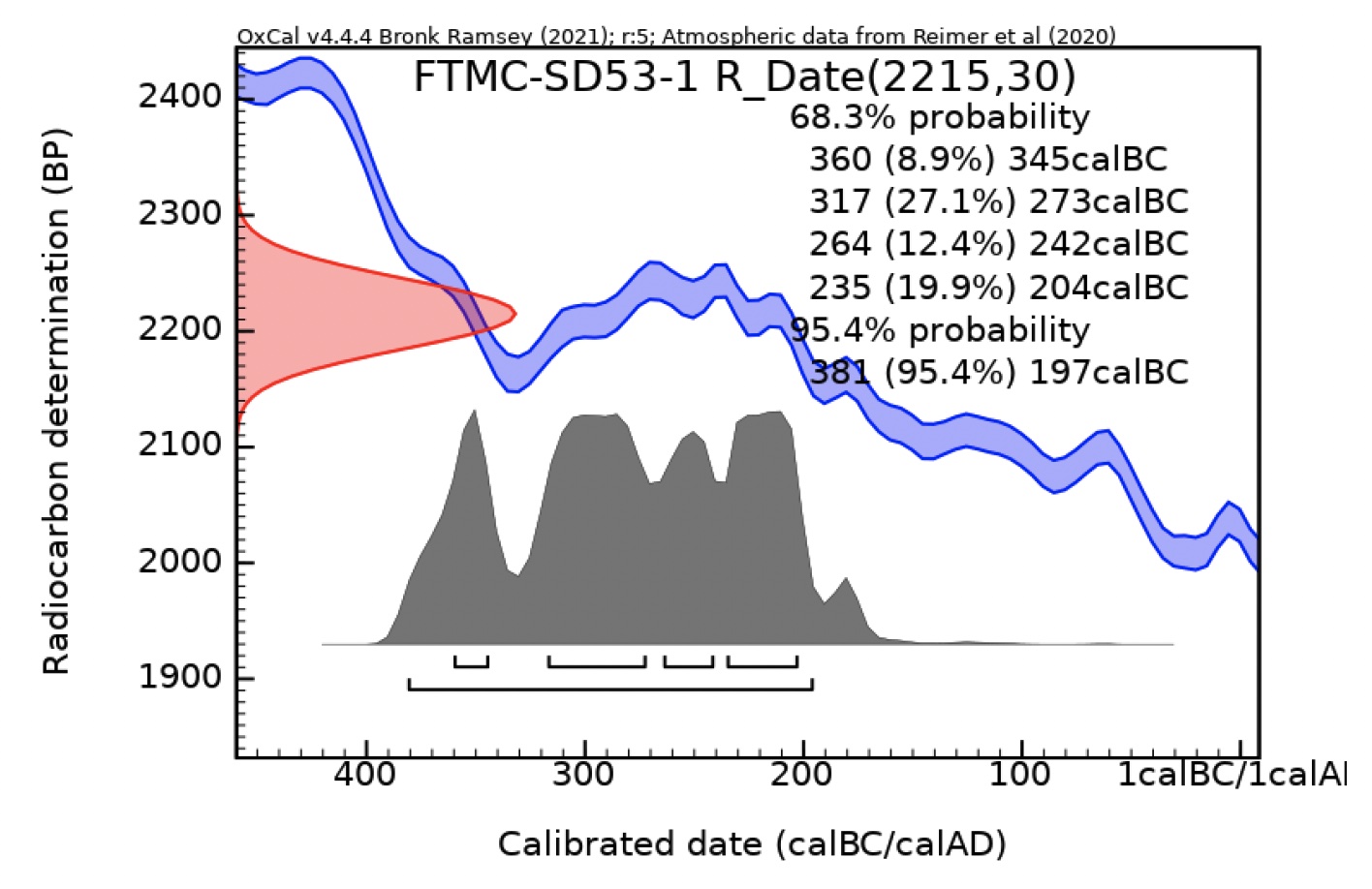
The mummy arrived at the laboratory the way they always arrive: horizontal, wrapped, and carrying a provenance story its original owners had crafted with considerably more imagination than documentary evidence. The sample designation reads „Female mummy 215, Thebes 1877″, and the material sampled was a maxillary molar. The conventional radiocarbon age that came back was 2517 plus minus 31 BP. Calibrated, that yields 3 separate ranges at 95.4 percent probability, namely 788 to 720, 708 to 662, and 653 to 543 BC. The individual therefore lived in the Third Intermediate Period or the early Late Period of Egypt, long before the Ptolemaic era that most people think of first when Egyptian mummies come up.
The forger, whoever had assembled this piece for the 19th-century collector market, had done skilled work on the exterior preparation. The carbon disagreed with nothing except the claimed origin, which it demolished without ceremony. The provenance narrative was a fabrication, the mummy itself was not.
What interests me is not the forgery itself, commonplace enough in the antiquities trade, but the precision of the disagreement. We did not return a result saying „old.” We returned a calibrated probability distribution that placed the sampled tooth firmly in the first millennium BC, incompatible with the 19th-century manufacture the buyer had been promised. Carbon-14 renders no opinions whatsoever. It reports isotope ratios, and we interpret those ratios within a characterized uncertainty framework. That is the entirety of the method, and that simplicity is also its power.
Mummified remains referenced in the radiocarbon dating discussion.
The Physics of the Unassuming Isotope
Carbon-14 forms in the upper atmosphere through the interaction of cosmic radiation with nitrogen-14. A neutron from cosmic secondary radiation is captured, a proton is knocked out, and the nitrogen nucleus becomes a carbon-14 nucleus. It oxidizes to carbon dioxide, mixes into the atmospheric carbon pool, and enters the biosphere through photosynthesis and the food chains that follow. Every living organism continuously exchanges carbon with its particular reservoir, which is why the ratio of carbon-14 to stable carbon-12 in living tissue reflects the ratio of that reservoir at the time the tissue formed.
Death ends this exchange abruptly. From that moment nothing is replenished, and the carbon-14 present decays through beta decay back to nitrogen-14. A convention belongs here that regularly causes confusion. Willard Libby determined the half-life as 5568 years, and the entire early literature calculated with that value. More precise measurements later put it at about 5730 years with an uncertainty of roughly 40 years, published by Harry Godwin in Nature in 1962 and known since then as the Cambridge half-life. Laboratories still calculate deliberately with 5568, because the conventional radiocarbon age has to be calibrated anyway and the half-life cancels out again. Anyone attributing 5730 to a work by Libby is confusing the 2 values.
For samples of archaeologically relevant age, spanning roughly 300 to about 50,000 years, the method operates with well-understood accuracy, qualified by calibration against independently dated archives from dendrochronology and further series.
The result of a radiocarbon measurement is not a year but a probability distribution. It is reported as a calibrated range, customarily at the 68.3 and 95.4 percent levels, and frequently it consists of several separate sections. That is exactly what the measurement on our mummy shows. At 68.3 percent the ranges are 774 to 749, 687 to 666, and 641 to 569 BC, at 95.4 percent they are 788 to 720, 708 to 662, and 653 to 543 BC. These sections belong to one single distribution and must not be merged into a continuous span. A notation giving a mean with an error bar behind it would be inadmissible for a calibrated date, because calibrated results are given as ranges with probabilities.
Plateaus in the calibration curve, where the curve runs almost horizontally and several calendar years map to the same radiocarbon value, produce broad and multimodal distributions. Our sample sits in the older part of the Hallstatt plateau, and that is where the 3 ranges come from.
Three Forensic Questions and How C14 Addresses Them
In forensic practice, radiocarbon analysis is useful to the extent that it can distinguish between 3 categories of remains: ancient remains, remains from the pre-modern period, and modern remains whose death range falls within the window of criminal investigation and missing persons work.
A great age does not thereby end all relevance automatically. War graves, historical identifications, colonial acquisition contexts, repatriation claims and unexplained grave disturbances stay open even for very old finds, and crimes under the German Code of Crimes Against International Law never become time-barred under its Section 5. What dating achieves is therefore not a sorting into important and unimportant, but a clarification of which jurisdiction and which line of inquiry applies. For practical investigative work, the prospect of living suspects, of witnesses and of contemporaneous missing person reports does drop off sharply as the time gap grows.
For remains in the range of roughly 1650 to 1950, the method meets a technical limit. The Suess effect, the dilution of atmospheric carbon-14 by C14-depleted carbon dioxide from the combustion of fossil fuels, reduces the sharpness of date assignment for this period. Remains from this window can be placed approximately, but separating 1850 cleanly from 1920 is usually beyond radiocarbon alone.
For remains after 1950 the situation reverses, and carbon-14 becomes one of the most powerful tools available, through a mechanism that has nothing to do with natural radiocarbon chemistry.
The Cold War’s Accidental Gift to Forensic Science
From the early 1950s onward several nuclear powers conducted atmospheric weapons tests, and the most intense series fell in the 1950s and early 1960s. These explosions released quantities of artificial carbon-14 that nearly doubled the global atmospheric concentration against the preindustrial baseline. The maximum was reached in the Northern Hemisphere in 1963, the same year the Partial Test Ban Treaty was signed. That treaty ended atmospheric testing only for its parties at the time, and individual states continued for more than a decade longer.
Since then this anthropogenic bomb pulse has been declining again, diluted by exchange with the oceanic carbon reservoir and the terrestrial biosphere. This decline has a characteristic time constant of roughly 16 years, determined by Ingeborg Levin and Bernd Kromer from the measurement series at the Schauinsland. It is expressly a decay time constant and not a half-life, because the decline rests on exchange and not on radioactive decay.
Dental enamel is the most powerful application of this principle. Enamel does not remodel after its formation in childhood and adolescence. The crown of a first permanent molar, which mineralizes between roughly ages 3 and 6, takes up carbon-14 at the atmospheric level of those years and retains that signal permanently. Measure the bomb pulse content of enamel from a specific tooth, compare it against the bomb curve and account for the known formation time, and you have the year of birth. Kirsty Spalding and colleagues give an accuracy of 1.6 years for this in Nature in 2005. Rebecka Teglind and colleagues report in Biomolecules in 2021 an average absolute error of 1.2 plus minus 0.8 years for tooth crowns in 9 identified cases, and 2.3 plus minus 2.5 years for tooth roots. For comparison, classical morphological age estimation in adults achieves 5 to 10 years.
Comparing bomb pulse signals in enamel and in bone from the same individual permits a temporal bracket. The enamel dates its formation period and from that the year of birth, the bone dates a later period averaged across years, and the difference allows an estimate of age at death with a quantifiable uncertainty.
What Bone Knows That Muscle Forgets
The differing turnover rates of human tissues create a hierarchy of forensic information. Dental enamel is the most temporally fixed, recording its formation period and nothing later.
Bone is the most restless of these clocks, and here a figure needs correcting that persists stubbornly in popular accounts. Cortical bone does not turn over at 10 percent per year. Robert Hedges and colleagues modeled turnover at the femoral mid-shaft in 67 individuals in the American Journal of Physical Anthropology in 2007 and arrive at about 4 percent per year at age 20 falling to about 3 percent at 80 in women, and 1.5 to 3 percent in men. During the growth phase between 10 and 15 the rate rises to 5 to 15 percent. Femoral collagen therefore reflects a person’s diet over considerably more than 10 years, including a substantial share formed already during adolescence.
Trabecula-rich regions such as ribs, vertebrae and parts of the pelvis turn over faster on average than the compact femoral shaft. Their collagen does not become point-accurate either, there too it remains a signal integrated across years, and the rates fluctuate substantially with person, age, sex and disease. Soft tissue renews itself within months. Scalp hair grows on average about 1 centimeter per month and can be measured segment by segment, though individual growth rates and hair cycles shift the assignment.
The identification of the remains of King Richard III, the last Plantagenet king of England, who fell at the Battle of Bosworth Field in August 1485, began with the discovery of a skeleton beneath a Leicester car park in 2012. His spine showed severe scoliosis and the skull bore perimortem injuries. Radiocarbon dating of the bones confirmed an age consistent with the late 15th century and supplied the chronological anchor for the identification through mitochondrial DNA that Turi King and colleagues published in Nature Communications in 2014. The archaeological excavation itself was described by Richard Buckley and colleagues in Antiquity in 2013.
The Chauvet cave paintings in the Ardèche of southern France posed a different question, not identity but epoch. The paintings were dated through charcoal from the same site context to roughly 32,000 to 36,000 years before present, published by Jean Clottes and colleagues in 1995. Chauvet therefore belongs among the oldest known figurative cave art, though the question of which example is the oldest has been reopened since the finds in Spain and Indonesia.
What the Method Cannot Do, and Why Stating That Matters in Court
A C14 date is not a date of death. It dates the end of carbon exchange in the material examined, and depending on the tissue, years to decades lie between the two. Formaldehyde fixation, museum conservation, archaeological consolidants and natural geochemical processes can all introduce carbon of a different age and shift the measured date, and they can do so in both directions.
The calibration curve is not uniform in its resolution. It is also not a mere stringing together of measurement series but a statistically constructed model of that data, published by Paula Reimer and colleagues in 2020 as IntCal20. Plateaus and reversals produce periods in which several calendar years map to indistinguishable radiocarbon values.
The method cannot determine cause of death, cannot identify a specific individual without additional biological evidence, and it does not give a person’s age but the period in which that person lived. These are not limitations to apologize for, they are the precise scope of what radiocarbon analysis delivers.
Accelerator Mass Spectrometry and the Infrastructure of Precision
Accelerator mass spectrometry represents the current state of radiocarbon measurement. Where older decay counting methods required grams of carbon and counting times of days to weeks, accelerator mass spectrometry counts the carbon-14 atoms present directly, needs milligrams and delivers results in hours. Automated sample graphitization prepares the samples for this and converts sample carbon into graphite targets with high reproducibility.
The IIFE C14 Dating Service
The International Institute of Forensic Expertise offers C14 dating to forensic agencies, scientific institutions and accredited organizations, and supports the sampling process from the outset. For bone the preferred quantity is more than 2 grams, with a minimum of 600 milligrams. For teeth, 1 to 2 teeth are preferred and 1 tooth is the minimum. The full material overview with quantities for charcoal, leather, wood, carbonates and cremated bone is on the radiocarbon dating page.
This practice does not arrange dating of manuscripts, artworks or other culturally significant objects unless they are commissioned and financed by recognized governmental agencies, accredited museums or state institutions conducting multidisciplinary scientific investigations with an established chain of custody. We do not date art objects, artifacts or antiques originating from private individuals, antique dealers, auction houses or private collections. This policy reflects the requirements of the UNESCO Convention on the Means of Prohibiting the Illicit Trade in Cultural Property.
What Teeth Know That Bones Do Not
Each tissue type records a different window of time in a person’s life, and reading those windows in combination is the real core of bomb pulse dating.
Tooth enamel is the most stable record in the human body. The crown of each permanent tooth forms in a well-documented period during childhood, that of the first molar between roughly ages 3 and 6, that of the second between 7 and 10, with canines and premolars in between. Because enamel does not remodel after formation, it preserves the atmospheric signal of exactly those years and keeps it far beyond decomposition.
With dentine a distinction is needed. Primary dentine forms together with crown and root, secondary dentine is deposited slowly for life, and the cementum of the root also contains collagen and continues to be laid down into adulthood. A bulk sample from a tooth can therefore predominantly reflect the formation period or contain appreciable later fractions, depending on the region sampled. Andrea Czermak and colleagues pointed out in 2020 that horizontal sections through tooth halves or quarters mix several growth layers and can include unwanted cementum or secondary dentine. Anyone who wants the year of birth sharp samples enamel or primary dentine at a precisely defined location.
The practical workflow with unidentified modern remains therefore takes several tissues with different formation and turnover times wherever possible. Tooth enamel narrows the year of birth, rapidly turned over tissues such as hair or nails sit closest in time to the death, and trabecula-rich bone rounds out the picture but likewise yields no precise year of death. This bracket, combined with sex and stature estimates from skeletal morphology, can shrink the pool of matching missing person cases considerably.
The Mummy Project: What the X-Rays and the Chemistry Tell Together
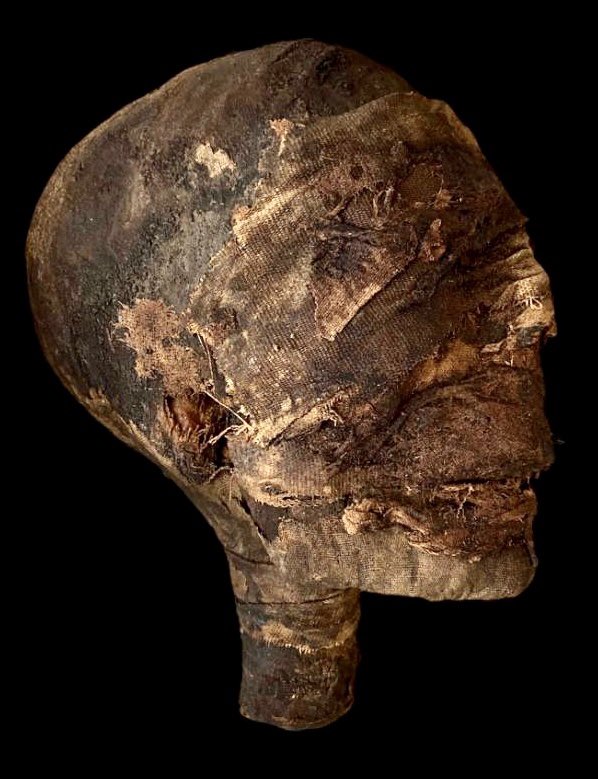
Macroscopic preservation state and quality of the external preparation.
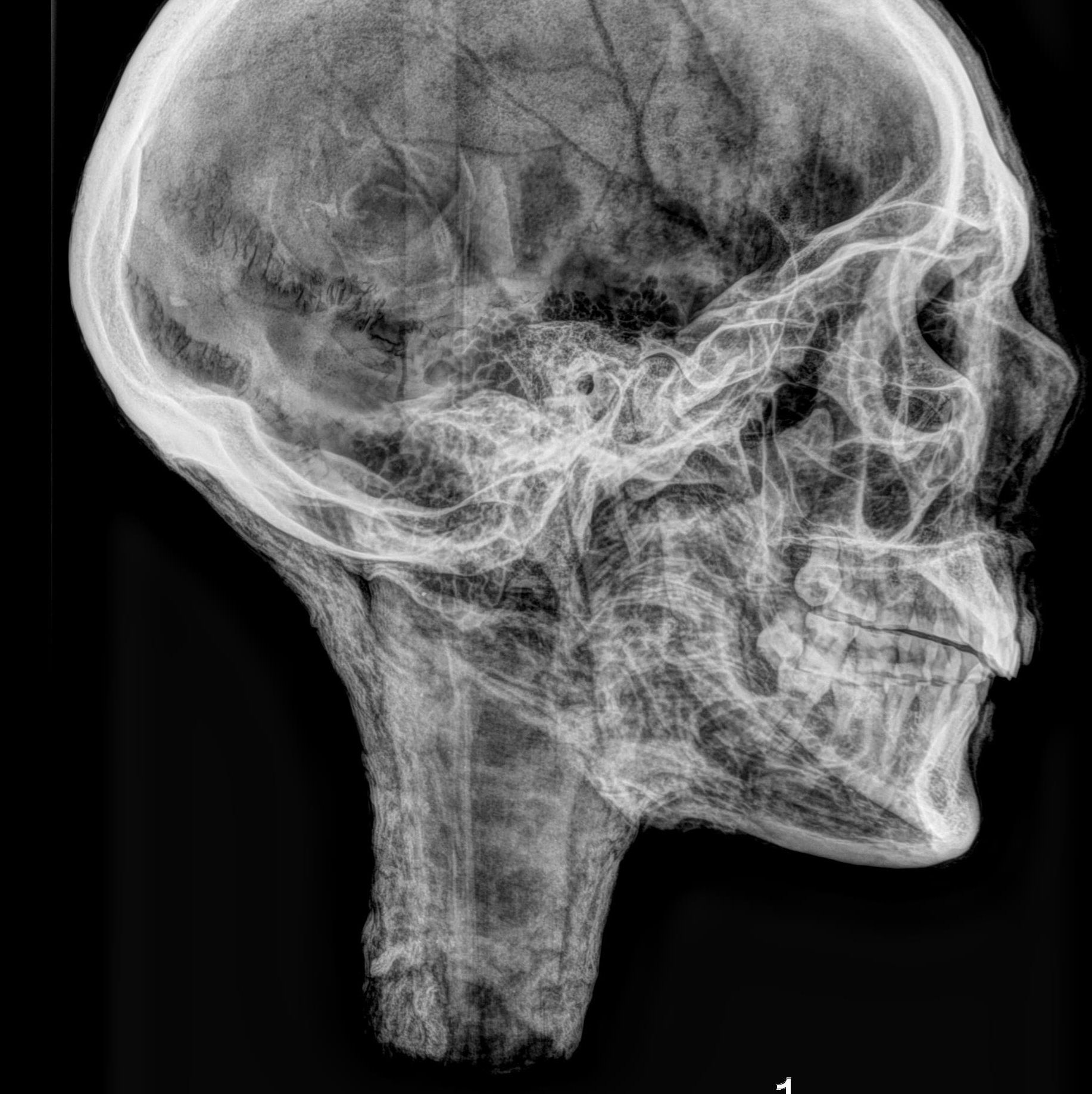
Non-destructive survey of the internal skeletal architecture of the mummified head.
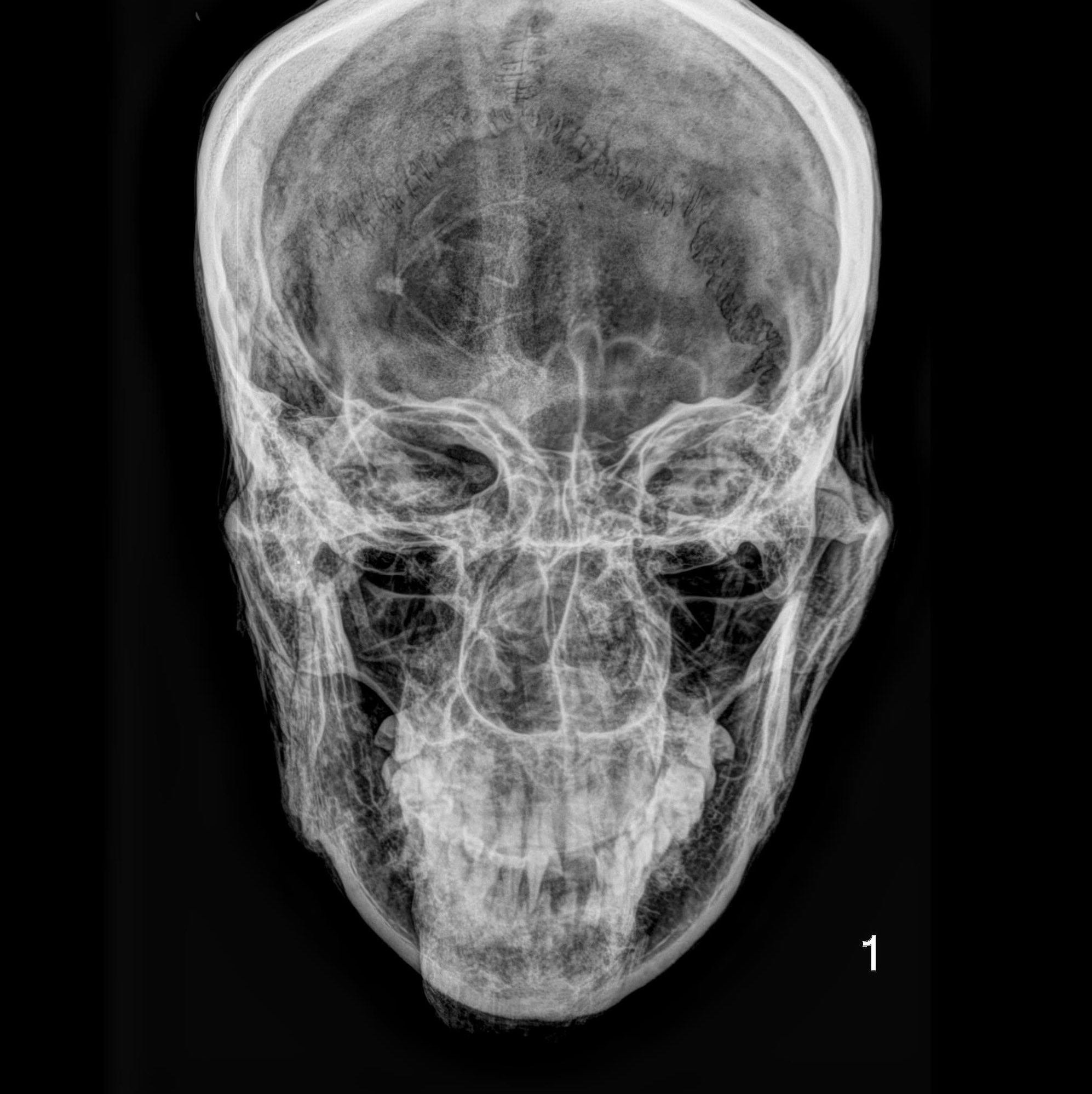
Frontal projection for cranial sutures, dentition and sinus pneumatization.
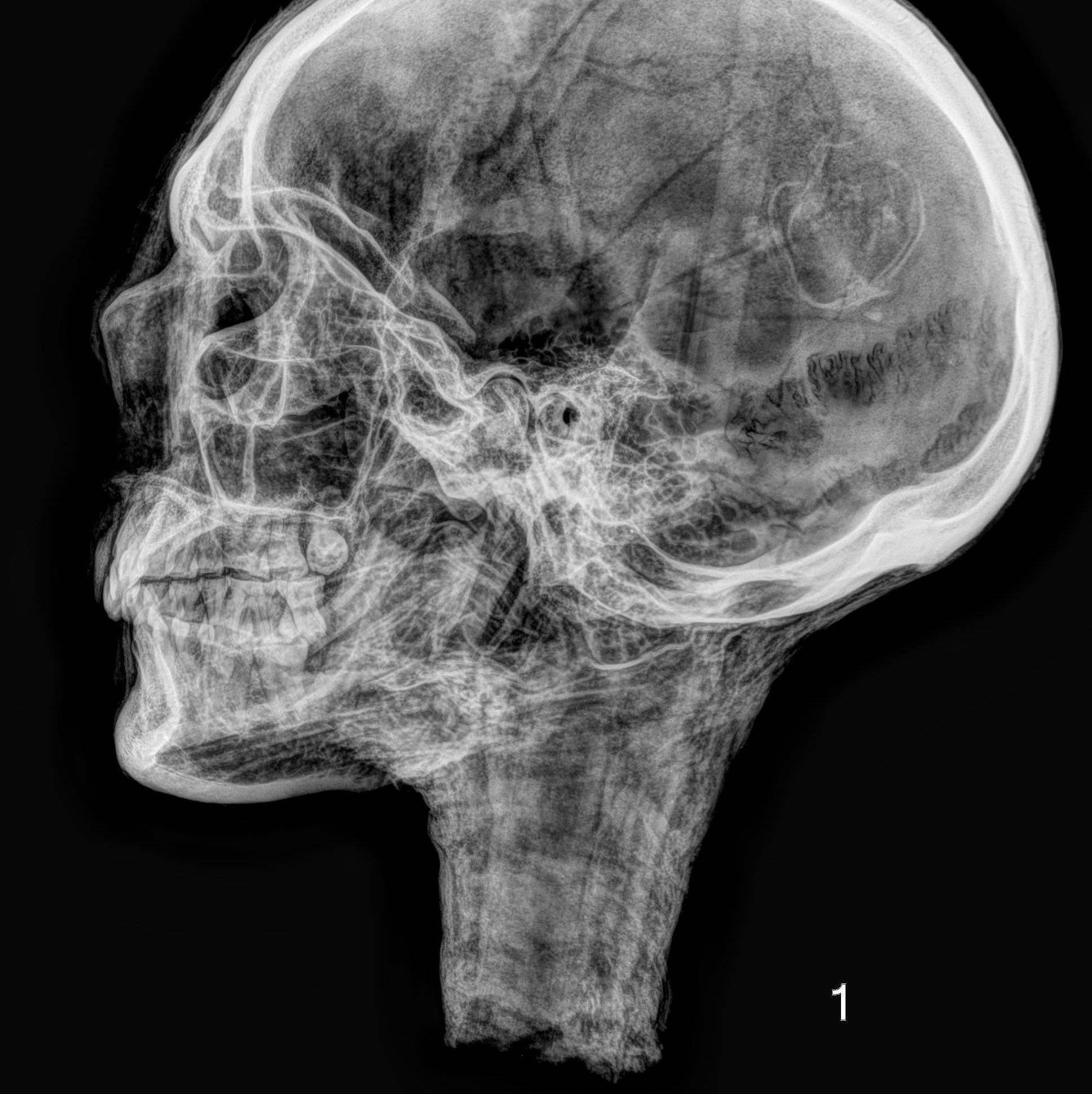
Additional projection for preservation quality and sample selection.
The 4 images accompanying this article, 1 color photograph of the mummified head and 3 X-ray images in lateral and frontal projection, represent a documentation workflow that is standard in our examination practice for mummified remains. The photograph records the macroscopic preservation state and the quality of the external preparation. The X-rays provide a non-destructive survey of the internal skeletal architecture, including the state of the cranial sutures, the dental eruption pattern and wear, the degree of sinus pneumatization, and any perimortem or postmortem bony trauma.
This internal survey informs the interpretation of the C14 result. The age at death estimated from skeletal indicators sets the frame within which the date is read. Caution is required here, however, and more of it than the original version of this article showed. The material sampled was collagen from a maxillary molar, and collagen does not sit in the enamel but in the dentine and the cementum. The result therefore reflects the formation period of that organic dental fraction and not the moment of death directly. If the sample contained predominantly primary dentine, the center of gravity lies in childhood and adolescence, and the actual death would then lie years to decades later again. Calculating a year of birth to within a decade from a calibrated range and an estimated age at death, as the earlier version did, is therefore not possible.
The X-ray series additionally permits assessment of preservation quality, which affects sample selection. Dense cortical bone with intact internal architecture is preferred over porous or weathered sections that may have taken up environmental carbon over millennia.
The Reservoir Effect, Contamination, and Why Sample Selection Is Not Trivial
The reservoir effect is the systematic deviation in baseline C14 levels affecting organisms whose dietary carbon comes from sources with a different C14 concentration than the atmospheric baseline.
Marine organisms are the first example. Because the deep sea mixes with the atmosphere only slowly, marine carbon is depleted in C14, and everything living from it appears several hundred radiocarbon years older than contemporaneous terrestrial samples. In people with a substantial marine component in their diet, this effect displaces the apparent date accordingly, and the marine share has to be estimated from the isotopes.
The freshwater effect is more treacherous, because it turns out completely differently from place to place. Carbonate rock is the most common cause but not the only one, since old organic carbon, groundwater and geothermal sources can produce substantial offsets as well. Bente Philippsen collected the evidence in 2013 that age differences of up to 2,000 radiocarbon years can occur within a single river.
Contamination is the second major source of error, and it works in both directions. Biogenic or young substances such as certain shellacs make a sample younger. Petroleum-based paraffins, acrylates and synthetic resins consist of fossil, practically C14-free carbon and make it older instead. With historical collection pieces, often nobody knows anymore which product was even used. The extraction protocol used in the laboratory is therefore not a detail one may skip over in an expert report. A reported C14 date without traceably documented sample preparation carries no forensic weight.
An Honest Archive, and Nothing More
Carbon-14 dating does not arrive at conclusions. It arrives at probability distributions, calibrated against atmospheric records assembled over decades by the international research community, and interpreted within the context of each sample’s preservation history, its tissue type, and the question the investigation wants answered. That precision of scope is not a weakness. It is the attribute that makes the method useful in court, where feigned certainty is far more dangerous than accurately described uncertainty.
The mummy from Thebes taught me nothing about C14 analysis that I did not already know from the physics. What it confirmed, as every well-executed measurement does, is that organic matter is an honest archive, that it records in chemical form what happened to it, and that reading that archive correctly demands the same discipline as any other form of evidence: a clear question, an appropriate method, and an explicit account of what the result establishes and what it does not.
Anyone who wants the method explained in full technical detail, with a real laboratory certificate read line by line, will find that in What Is Radiocarbon Dating.
This version has been revised against the original publication of February 1, 2025. The dating, the tissue turnover rates and the source citations have been checked against the primary literature and against the original laboratory record, and corrected. Editorial status: July 31, 2026.
References
- Buckley, R., Morris, M., Appleby, J., King, T., O’Sullivan, D., & Foxhall, L. (2013). „The king in the car park”: New light on the death and burial of Richard III in the Grey Friars church, Leicester, in 1485. Antiquity, 87(336), 519 to 538.
- Clottes, J., Chauvet, J.-M., Brunel-Deschamps, E., Hillaire, C., Daugas, J.-P., Arnold, M., Cachier, H., Evin, J., Fortin, P., Oberlin, C., Tisnerat, N., & Valladas, H. (1995). Les peintures paléolithiques de la grotte Chauvet-Pont d’Arc. Comptes rendus de l’Académie des Sciences, 320, 1133 to 1140.
- Cook, G. T., Dunbar, E., Black, S. M., & Xu, S. (2006). A preliminary assessment of age at death determination using the nuclear weapons testing 14C activity of dentine and enamel. Radiocarbon, 48(3), 305 to 313.
- Czermak, A., Fernández-Crespo, T., Ditchfield, P. W., & Lee-Thorp, J. A. (2020). A guide for an anatomically sensitive dentine microsampling and age-alignment approach for human teeth isotopic sequences. American Journal of Physical Anthropology, 173(4), 776 to 783. https://doi.org/10.1002/ajpa.24126
- Godwin, H. (1962). Half-life of radiocarbon. Nature, 195, 984. https://doi.org/10.1038/195984a0
- Hedges, R. E. M., Clement, J. G., Thomas, C. D. L., & O’Connell, T. C. (2007). Collagen turnover in the adult femoral mid-shaft: Modeled from anthropogenic radiocarbon tracer measurements. American Journal of Physical Anthropology, 133(2), 808 to 816. https://doi.org/10.1002/ajpa.20598
- Johnstone-Belford, E. C., & Blau, S. (2020). A review of bomb pulse dating and its use in the investigation of unidentified human remains. Journal of Forensic Sciences, 65(3), 676 to 685. https://doi.org/10.1111/1556-4029.14227
- King, T. E., Fortes, G. G., Balaresque, P., Thomas, M. G., Balding, D., Maisano Delser, P., Neumann, R., Parson, W., Knapp, M., Walsh, S., Tonasso, L., Holt, J., Kayser, M., Appleby, J., Forster, P., Ekserdjian, D., Hofreiter, M., & Schürer, K. (2014). Identification of the remains of King Richard III. Nature Communications, 5, 5631. https://doi.org/10.1038/ncomms6631
- Levin, I., & Kromer, B. (1997). Twenty years of atmospheric 14CO2 observations at Schauinsland station, Germany. Radiocarbon, 39(2), 205 to 218.
- Libby, W. F. (1955). Radiocarbon dating (2nd ed.). University of Chicago Press.
- Lynnerup, N., Kjeldsen, H., Heegaard, S., Jacobsen, C., & Heinemeier, J. (2008). Radiocarbon dating of the human eye lens crystallines reveal proteins without carbon turnover throughout life. PLoS ONE, 3(1), e1529. https://doi.org/10.1371/journal.pone.0001529
- Philippsen, B. (2013). The freshwater reservoir effect in radiocarbon dating. Heritage Science, 1, 24. https://doi.org/10.1186/2050-7445-1-24
- Reimer, P. J., et al. (2020). The IntCal20 Northern Hemisphere radiocarbon age calibration curve (0 to 55 cal kBP). Radiocarbon, 62(4), 725 to 757. https://doi.org/10.1017/RDC.2020.41
- Schwarcz, H. P., & Skog, G. (2007). New applications of radiocarbon dating in forensic science. Forensic Science International, 167(2 to 3), 134 to 137.
- Spalding, K. L., Buchholz, B. A., Bergman, L.-E., Druid, H., & Frisén, J. (2005). Forensics: Age written in teeth by nuclear tests. Nature, 437(7057), 333 to 334. https://doi.org/10.1038/437333a
- Stuiver, M., & Polach, H. A. (1977). Discussion: Reporting of 14C data. Radiocarbon, 19(3), 355 to 363. https://doi.org/10.1017/S0033822200003672
- Teglind, R., Dawidson, I., Balkefors, J., & Alkass, K. (2021). Analysis of 14C, 13C and aspartic acid racemization in teeth and bones to facilitate identification of unknown human remains: Outcomes of practical casework. Biomolecules, 11(11), 1655. https://doi.org/10.3390/biom11111655
- Ubelaker, D. H. (2014). Radiocarbon analysis of human remains: A review of forensic applications. Journal of Forensic Sciences, 59(6), 1466 to 1472. https://doi.org/10.1111/1556-4029.12535
- Völkerstrafgesetzbuch (VStGB), Section 5, non-applicability of limitation. Bundesministerium der Justiz. https://www.gesetze-im-internet.de/vstgb/__5.html
Disclaimer: This article reflects the author’s own research and opinion as of the publication date shown above; later findings or legal changes may have overtaken it, so always check that date. Sources are cited for independent verification, and no liability is accepted for third-party studies. This is general information, not medical, legal, or professional advice: for medical questions see a doctor, for legal questions a lawyer, and in an acute crisis contact emergency services or a crisis helpline.
About the header image: it is AI-generated. Cheaper than a photo shoot, and I have made my peace with the age of AI. Everything inside the article is real, the diagrams, the skulls, the findings, and every word. The machine gets the opening shot and not one inch past it.

What Is Radiocarbon Dating? Everything About the Method That Decides Between a Murder Case and an Archaeological Find
Radiocarbon dating measures remaining carbon-14 to determine when carbon exchange ended. This article explains the method from atmospheric…

Is It Legal to Own a Real Human Skull? Yes, Subject to 3 Conditions
Private possession of a real human skull is not prohibited in Germany. Three conditions decide the question, and…

The Science and Ethics of Age-Gap Attraction: Why Older Men Are Drawn to Younger Women, and Where the Line to Crime Runs
A forensic examiner lays out the evolutionary psychology and the data from 130 countries: the algorithm of age-gap…