The Skull in the Garden: Hidden Corpses Unveiling Centuries-Old Secrets and Why Modern Forensics Brings the Truth to Light
How a pool project in a quiet Bavarian suburb became a forensic case, why a single C14 measurement can determine the difference between archaeology and homicide, and what the nuclear weapons tests of the 1950s inadvertently gave forensic anthropology
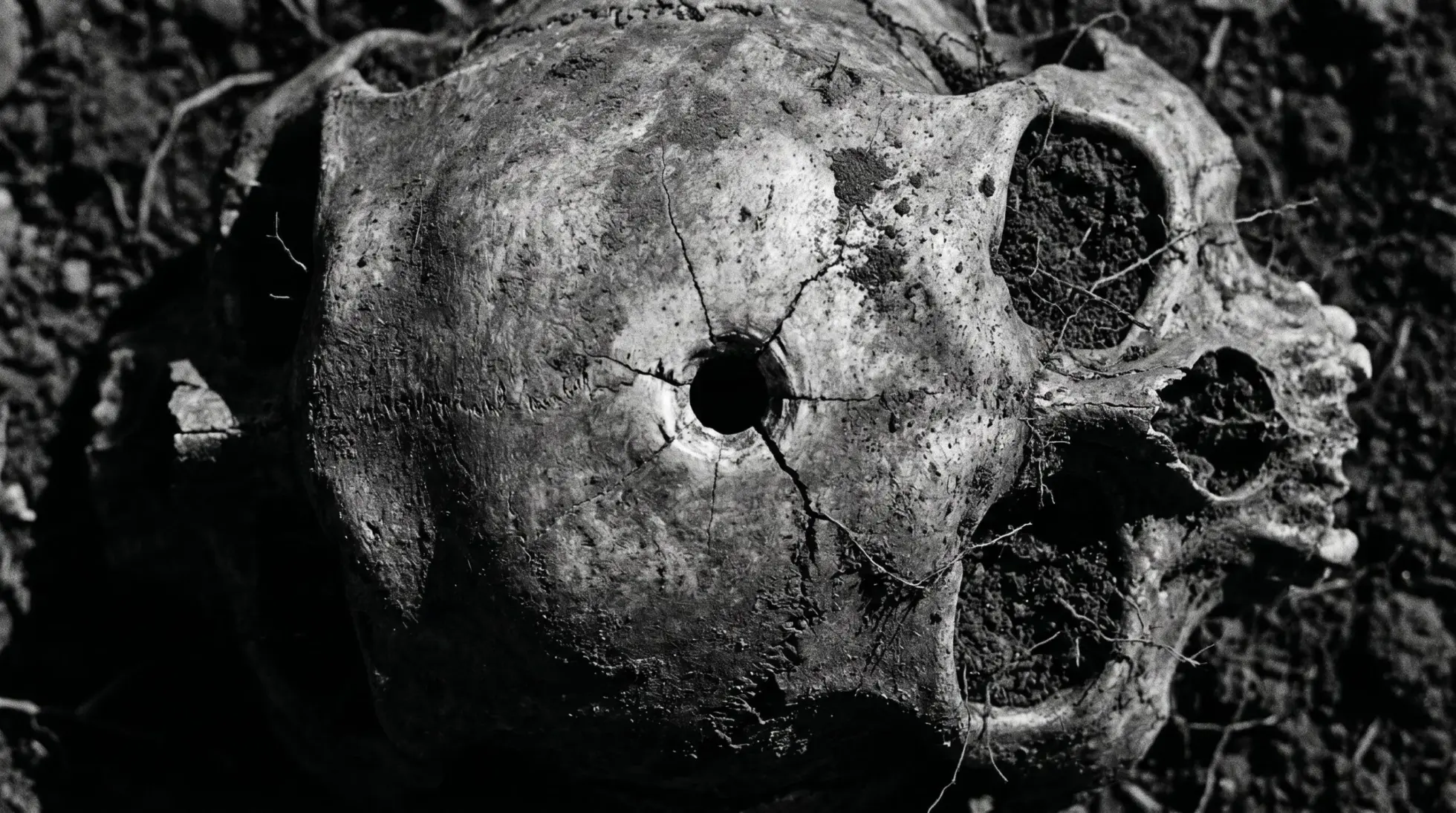
It was one of those warm summer afternoons when the air was heavy and the heat oppressive. In an idyllic suburb at the edge of town, where most gardens were blooming oases of tranquility, a new homeowner had big plans. The old garden, which until then had been little more than a collection of wild bushes and patches of grass, was to give way to a chic pool. A dream project meant to give the property the final polish. The dream quickly turned into a nightmare when the excavator’s bucket suddenly hit something hard, and the earth receded to reveal the exposed relic: real human skull legal.
The construction worker cut the engine and stared at what the earth had given up. The skull, slightly discolored and weathered by time, showed clearly recognizable traces of a bullet hole. At the back of the skull gaped an exit wound that unmistakably suggested the thought of a crime, and the thought that spread through the neighborhood in the minutes that followed had four letters. Shock ran through the area as the news traveled. The police arrived quickly, a white crime scene tape soon fluttered in the wind, and neighbors stared incredulously over their fences while the homeowner, who had moved in just a few months earlier, wondered what on earth was happening in his new garden. Where did this skull come from? Was it a murder committed years or even decades ago? Had a brutal crime taken place right here, where a harmless pool was meant to be built?
Before the excitement escalated further, one suggestion cast the entire scenario in a different light. The site, the property, had once belonged to a well-known archaeologist, a man who had spent his professional life collecting historical artifacts and skeletal remains, the kind of collector whose private holdings often rivaled what smaller regional museums had on their shelves. The idea that this skull might simply be a relic from an old collection became the new working hypothesis. But how could this be proven, and proven to a standard that a prosecutor, a defense attorney, and a judge would each accept without residual doubt?
The answer lay in a technique that Willard Frank Libby and James Arnold published in the journal Science in December 1949, and for which Libby received the Nobel Prize in Chemistry eleven years later in 1960: radiocarbon dating (Arnold & Libby, 1949, Science, 110, 678-680). The question of whether the skull represented a current homicide or a centuries-old historical artifact would be settled not by the examining magistrate, not by the morphological impressions of the attending investigators, and not by the anxious speculation of the neighborhood, but by physics.
The First Question I Ask
Before the question of age could be answered, a prior question had to be addressed with equal care: what exactly does this skull show, and what does it not show? The bullet hole was visible, unmistakable, and immediately interpreted by everyone present as evidence of violent death. This interpretation is understandable and almost certainly correct in a general sense, but it requires qualification that the situation in the garden did not allow for.
Bone trauma is classified in forensic anthropology as perimortem, occurring at or near the time of death when bone still retains its organic properties and responds to force in a characteristic way, or postmortem, occurring after death when bone has dried and lost its flexibility and responds to force quite differently. The distinction matters enormously, because a bullet hole that appears in fresh bone, in bone that has been shot through while the skull still belonged to a living person, looks different from damage sustained much later. The entrance wound in a perimortem gunshot typically shows an internal beveling pattern on the inner table of the skull, and the exit wound shows external beveling, a pattern that reflects the mechanical properties of living bone and the physics of a projectile traveling through it at speed. Postmortem damage, by contrast, tends to produce irregular, straight-edged fracture margins without the radiating crack patterns associated with projectile trauma in living tissue.
The skull in the garden showed characteristics consistent with perimortem gunshot trauma. This did not mean a murder had been committed last year, or last decade, or even last century under circumstances that German law would treat as a criminal matter. It meant that whoever this person was, they had, at some point in history, been shot through the head. The forensic question was whether that point in history fell before or after the statute of limitations, which in Germany under §78 Abs. 2 of the German Criminal Code does not apply to murder, meaning theoretically no case is ever too old to investigate. Practically, however, a skull that carbon dating places firmly in the seventeenth century is a skull that generates no criminal proceedings, because there are no living perpetrators, no surviving witnesses, and no investigative thread that connects to anyone currently drawing breath.
The age of the skull was therefore not merely an academic curiosity. It was the single piece of information that determined whether the homeowner’s garden remained a construction site or became a crime scene for the foreseeable future.
What Carbon-14 Does and Why It Matters
Every living organism, humans included, maintains a specific ratio of carbon isotopes in its tissues throughout its life. Carbon exists in 3 naturally occurring forms: carbon-12 and carbon-13, which are stable and make up the vast majority of all carbon on earth, and carbon-14, which is radioactive and is produced continuously in the upper atmosphere when cosmic radiation strikes nitrogen-14 nuclei, converting them to carbon-14 through neutron capture and proton emission. This atmospheric carbon-14 enters the biosphere through carbon dioxide, is taken up by plants through photosynthesis, and moves through the food chain to every organism that eats those plants or eats organisms that ate those plants. As long as an organism is alive, it is continuously exchanging carbon with its environment, and the ratio of carbon-14 to stable carbon in its tissues reflects the ratio present in the atmosphere at any given time.
At the moment of death, this exchange stops. The organism no longer takes up new carbon from the environment, and the carbon-14 it contains at the moment of death begins to decay at a constant, well-characterized rate. After approximately 5,730 years, half of the original carbon-14 has decayed into nitrogen-14, a period known as the half-life of carbon-14, a value that Libby originally estimated as 5,720 years in his 1949 paper and which was subsequently refined through more precise measurements to the currently accepted value (Arnold & Libby, 1949; Libby, 1960, Nobel Lecture, Nobel Prize in Chemistry). By measuring the residual carbon-14 content in a sample and comparing it against calibrated reference curves for known atmospheric carbon-14 concentrations across time, a laboratory can calculate with reasonable precision when the organism died.
For a skull approximately 390 years old, as was eventually determined to be the case in this garden, the carbon-14 content has decayed by a calculable fraction of the original. The measurement is not trivially simple: the isotope is present in trace quantities, and detecting those quantities requires instrumentation that operates at the boundary of what analytical chemistry can achieve. The method most commonly used today is Accelerator Mass Spectrometry, or AMS, which physically separates and counts individual carbon-14 ions using a particle accelerator to achieve the sensitivity necessary to detect the vanishingly small C14 concentrations in aged samples. An AMS system capable of forensic-grade measurements costs between 2 and 10 million euros depending on specification and configuration, which explains why there are relatively few facilities worldwide capable of providing the service and why the turnaround time for a forensic radiocarbon dating request typically runs to days or weeks rather than hours.
The results are expressed not as a single date but as a probability distribution, a range of years within which the measured carbon-14 content is statistically consistent with the known atmospheric C14 curve for that period. This calibration is necessary because the atmospheric carbon-14 concentration has not been constant across history: solar activity, volcanic eruptions, and, most consequentially for modern forensics, the atmospheric nuclear weapons tests of the mid-twentieth century, have all caused deviations from a simple exponential decay baseline that must be corrected for before dates can be reported with confidence (Bronk Ramsey, 2008, Radiocarbon Dating: Revolutions in Understanding, Archaeometry, 50(2), 249-275).
The Bomb Pulse: Nuclear Testing Changed Forensic Anthropology
The section of this story that most people who encounter radiocarbon dating in popular media have not heard about is, forensically speaking, the most important. Between 1955 and 1963, atmospheric testing of nuclear weapons by the United States, the Soviet Union, and the United Kingdom roughly doubled the concentration of carbon-14 in the atmosphere. This event, known in the literature as the bomb pulse, created a spike in atmospheric C14 that was then incorporated by every living organism on the planet during that period, and by every organism that lived through any part of the period between the mid-1950s and the present, when the atmospheric C14 concentration has been declining back toward pre-bomb levels as the initial pulse disperses through the carbon cycle.
The forensic consequence of this is both elegant and practically decisive. A skeleton or skull from any period before approximately 1955 will show carbon-14 levels consistent with the pre-bomb atmospheric baseline. A skeleton belonging to a person who was alive at any point after 1955 will show elevated carbon-14 levels, reflecting the bomb pulse that was incorporated into their tissues during life. This distinction is binary and unambiguous: either the remains predate the bomb pulse, or they do not, and in the latter case, the elevated C14 signature is as distinctive as a biological timestamp.
Ubelaker’s 2014 review in the Journal of Forensic Sciences summarizes the situation directly: radiocarbon analysis can reveal whether remains relate to the modern, post-1950 era and, if so, can provide information needed to evaluate both the date of death and the year of birth, with the precision available depending on which tissues are sampled and what bone remodeling rates are assumed (Ubelaker, 2014, Radiocarbon Analysis of Human Remains: A Review of Forensic Applications, Journal of Forensic Sciences, 59(6), 1466-1472). For forensic purposes, the bomb pulse has converted what was purely a geological and archaeological dating technique into a tool that can resolve questions about individuals who died within living memory, to a precision that, in some cases using tooth enamel, approaches plus or minus 1 to 2 years of birth date.
In the skull found in that Bavarian garden, none of this complexity applied, because the carbon-14 levels placed the remains firmly in the pre-bomb era, a period centuries before nuclear testing existed as a concept, let alone a practice. But the bomb pulse is worth understanding precisely because it defines the boundaries of the method’s forensic relevance: it is not only old bones that radiocarbon dating can speak to, but potentially anyone who died since the mid-twentieth century whose remains require temporal localization.
Accelerator Mass Spectrometry and the Price of Precision
The practical process of dating the skull proceeded as follows. A small sample of bone tissue, typically from the dense cortical bone of a long bone or, if only the skull is available, from the petrous portion of the temporal bone, which tends to preserve organic material better than other cranial elements, is extracted and cleaned to remove contaminants introduced by burial, soil chemistry, or conservation treatments. The organic collagen fraction is isolated through a chemical extraction process. That isolated collagen is then combusted to carbon dioxide, reduced to graphite, and pressed into a target that is loaded into the ion source of an accelerator mass spectrometer.
The AMS system accelerates the carbon ions to very high energies, passes them through a stripper that removes electrons and allows the carbon-14 atoms to be distinguished from carbon-12 and carbon-13 by their mass-to-charge ratio, and counts the individual carbon-14 ions against a reference standard. The result is a fraction modern value, the ratio of the sample’s carbon-14 content to the carbon-14 content expected in a sample from 1950, and this fraction modern value is then converted to a conventional radiocarbon age using the Libby half-life of 5,568 years, which is the agreed convention for reporting radiocarbon ages for historical consistency, even though the more accurately measured half-life is 5,730 years (Bronk Ramsey, 2008). Calibration against the IntCal reference curve then converts this conventional age into a calendrical date range, expressed as a probability distribution.
For a skull approximately 390 years old, the measurement requires careful attention to contamination control, because the older the sample, the smaller the residual carbon-14 signal and the greater the relative impact of any modern carbon introduced during burial, excavation, or handling. A 390-year-old skull has lost a relatively small fraction of its original carbon-14, since only about 4.7 percent of the original carbon-14 has decayed in that time, making the measurement relatively straightforward technically. The uncertainty in the reported date range reflects both the analytical precision of the AMS measurement and the shape of the IntCal calibration curve in the relevant time period, which can have plateaus where a range of calendrical dates produces nearly identical radiocarbon values, making precise calendar year assignment more difficult. For the 17th century, the IntCal curve has some such plateaus, which is why results from this period are typically reported as ranges of several decades rather than single years.
What the Bullet Hole Was Telling Me Before the Science Spoke
The bullet hole deserves its own examination, independent of the question of age, because it encapsulates the way forensic analysis operates in practice and why experience cannot be replaced by a laboratory report. When I examine a skull with an apparent gunshot wound, the morphological analysis precedes and frames everything that follows. The exit wound at the back of this skull showed the characteristic external beveling pattern consistent with a projectile exiting the cranial vault, which confirms perimortem trauma. What it cannot confirm, from morphology alone, is the nature of the projectile, the range at which the weapon was discharged, or the cultural and historical context in which the wound was inflicted.
A gunshot wound from a seventeenth-century firearm looks different from a gunshot wound from a nineteenth-century rifle, which looks different from a gunshot wound from a twentieth-century handgun, and these differences are visible to a trained eye in the diameter of the entrance wound, the extent and pattern of radiating fractures, and the internal beveling characteristics of the bone at the wound margins. The wound on this skull was consistent with a period weapon of earlier construction, with an entrance diameter and fracture pattern that did not suggest the high-velocity rounds characteristic of post-nineteenth-century military or civilian firearms. This morphological reading was a first estimate, not a definitive dating, and it needed scientific confirmation, which the AMS analysis provided. But it was a directional signal that informed the hypothesis from the outset.
What the skull was telling me, before the science spoke, was: you are looking at a person who was shot, at close to medium range, with a weapon that would not be manufactured today, and who has been in the ground for a very long time. That morphological reading preceded the laboratory, and the laboratory confirmed what the bone had already said.
The Result, the Relief, and What Remains
The carbon-14 measurement placed the skull at approximately 390 years before the date of analysis, with a date range spanning several decades of the seventeenth century. The radiocarbon result was consistent with the previous owner’s profile as a collector of historical materials, and consistent with the morphological reading of the wound characteristics. The skull was archaeology and not a homicide that concerned anyone still living. The homeowner’s pool project resumed after the skull and any associated skeletal material were properly documented, recorded, and turned over to the relevant authorities for archival. The crime scene tape came down and the neighbors returned to their gardens with the particular mixture of relief and mild disappointment that arrives when a murder story resolves as a history lesson.
The investigative relief was justified. But the case raises questions that extend well past the specific garden and the specific skull, questions about how we handle the materials of the dead and about the obligations that come with finding them.
Provenance, the Law, and Why “I Found It in the Attic” Is Not an Answer
A skull in a garden, when discovered by excavation, triggers an automatic police response and a forensic investigation. That process has a clear procedural path. What is less clearly understood, and what generates recurring problems in forensic casework, is the situation of skeletal material held privately, inherited along with household contents, purchased at auction, or acquired through the networks that have historically moved anatomical specimens between collectors, medical schools, and private individuals. The previous owner of this property had, apparently, accumulated materials through a professional lifetime of archaeological and anthropological fieldwork, and whatever the legal status of those acquisitions at the time, the skull’s presence in the garden at the time of excavation created a forensic event regardless of its actual age.
German law is clear on 1 point that is worth stating explicitly: murder carries no statute of limitations. Under §78 Abs. 2 of the German Criminal Code (Strafgesetzbuch, StGB), the crime of murder is exempt from the standard limitation periods that apply to lesser offenses. This means that a homicide committed in 1980, in 1950, or in principle at any point in recorded history, remains legally actionable under German criminal law if the circumstances can be established and perpetrators or their estates identified. In practice, a skull determined to be 390 years old is not the subject of criminal proceedings, because no living perpetrator can be prosecuted and no surviving victim’s family has a legal claim that the courts can adjudicate. But the principle matters, because it establishes that the age of skeletal material is not merely a scientific curiosity but a legally determinative fact.
For anyone holding historical skeletal material, whether acquired through inheritance, purchase, or the kind of casual accumulation that characterized earlier generations of natural history enthusiasts, the practical obligation is straightforward and does not require a forensic expert to explain: provenance matters, and the absence of provenance creates a problem that does not resolve itself with the passage of time. A skull with documented acquisition from a medical school collection, a licensed archaeological excavation, or a properly catalogued natural history acquisition is a skull with a legal context. A skull without that documentation is a potential forensic event waiting for an excavator to trigger it. The difference between those 2 situations is paperwork, and the paperwork exists precisely to prevent the kind of anxious reconstruction that occupied the investigators, the homeowner, and the neighbors in this garden on a warm summer afternoon.
The Unasked Question That Was Actually the Right One
What this case illustrates, beyond the mechanics of radiocarbon dating and the legal framework for skeletal finds, is something about how forensic investigation actually proceeds when it is done carefully. The default interpretation, established within minutes of the skull’s discovery, was that a crime had been committed. The exit wound was visible, the context was a garden recently acquired by a new owner who did not know its history, and the cognitive machinery that the human brain applies to skulls with bullet holes produced the same output it reliably produces: someone killed this person, and that person’s killer needs to be identified.
That interpretation was not wrong as a first hypothesis. It was wrong as a conclusion reached before the evidence was examined. What converted a reasonable hypothesis into a demonstrably incorrect one was the same process that converts any forensic hypothesis into a finding: systematic application of method, selection of the appropriate analytical technique, interpretation of results against calibrated reference standards, and willingness to allow the data to override the initial narrative when the data and the narrative point in different directions.
Radiocarbon dating, in this case, did not discover a new fact. It eliminated an incorrect interpretation of an existing one. The skull was always 390 years old. The bullet hole was always a seventeenth-century wound. The previous owner’s collection was always the most probable origin. The laboratory measurement did not change the skull; it changed what we were permitted to claim about it. That is what forensic science does, and it is worth saying plainly because the popular understanding of forensic science frequently inverts the process, treating the laboratory as the source of dramatic revelation when it is, more precisely, the filter through which premature certainty is removed from the equation.
Anyone who finds a skull, in a garden or an attic or inherited in a box with a deceased relative’s possessions, is looking at a problem that has a correct solution and an incorrect one. The correct solution involves contacting the relevant authorities and, in parallel, engaging expert analysis to establish provenance, age, and context before any interpretation of the find hardens into a claim. The incorrect solution is any combination of waiting, hoping the question resolves itself, and assuming that age confers immunity from scrutiny. In Germany, the last of those assumptions is legally wrong, and the first 2 are practically dangerous.
If you find a skull, contact us. We will determine whether it is archaeology or evidence. We will do so with methods that a court can accept and a prosecutor cannot reasonably challenge. And we will do it before the excavator moves on to the next layer.
References
- Arnold, J. R., & Libby, W. F. (1949). Age determination by radiocarbon content: Checks with samples of known age. Science, 110(2869), 678-680.
- Bronk Ramsey, C. (2008). Radiocarbon dating: Revolutions in understanding. Archaeometry, 50(2), 249-275.
- Libby, W. F. (1960). Radiocarbon dating. Nobel Lecture, Nobel Prize in Chemistry. Nobel Foundation.
- Stuiver, M., & Polach, H. A. (1977). Discussion: Reporting of 14C data. Radiocarbon, 19(3), 355-363.
- Ubelaker, D. H. (2014). Radiocarbon analysis of human remains: A review of forensic applications. Journal of Forensic Sciences, 59(6), 1466-1472.
- Ubelaker, D. H., & Buchholz, B. A. (2005). Complexities in the use of bomb-pulse radiocarbon to determine time since death of human skeletal remains. Forensic Science Communications, 8(1).
- §78 Abs. 2 Strafgesetzbuch (StGB). Verjährungsfrist bei Mord. Bundesministerium der Justiz.
Disclaimer: This article reflects the author’s own research and opinion as of the publication date shown above; later findings or legal changes may have overtaken it, so always check that date. Sources are cited for independent verification, and no liability is accepted for third-party studies. This is general information, not medical, legal, or professional advice: for medical questions see a doctor, for legal questions a lawyer, and in an acute crisis contact emergency services or a crisis helpline.
About the header image: it is AI-generated. Cheaper than a photo shoot, and I have made my peace with the age of AI. Everything inside the article is real, the diagrams, the skulls, the findings, and every word. The machine gets the opening shot and not one inch past it.

I have never been afraid of the gun
A forensic expert on why the knife, not the gun, is the weapon he watches for in a…
The Sketch That Sat Unused for Ten Months
A large manhunt in Louisiana chased a white suspect for ten months while a survivor's sketch of the…
What Is Radiocarbon Dating? Everything About the Method That Decides Between a Murder Case and an Archaeological Find
Radiocarbon dating measures remaining carbon-14 to determine when carbon exchange ended. This article explains the method from atmospheric…