DNA and Forensic Anthropology: A Symbiotic Duo in Criminology
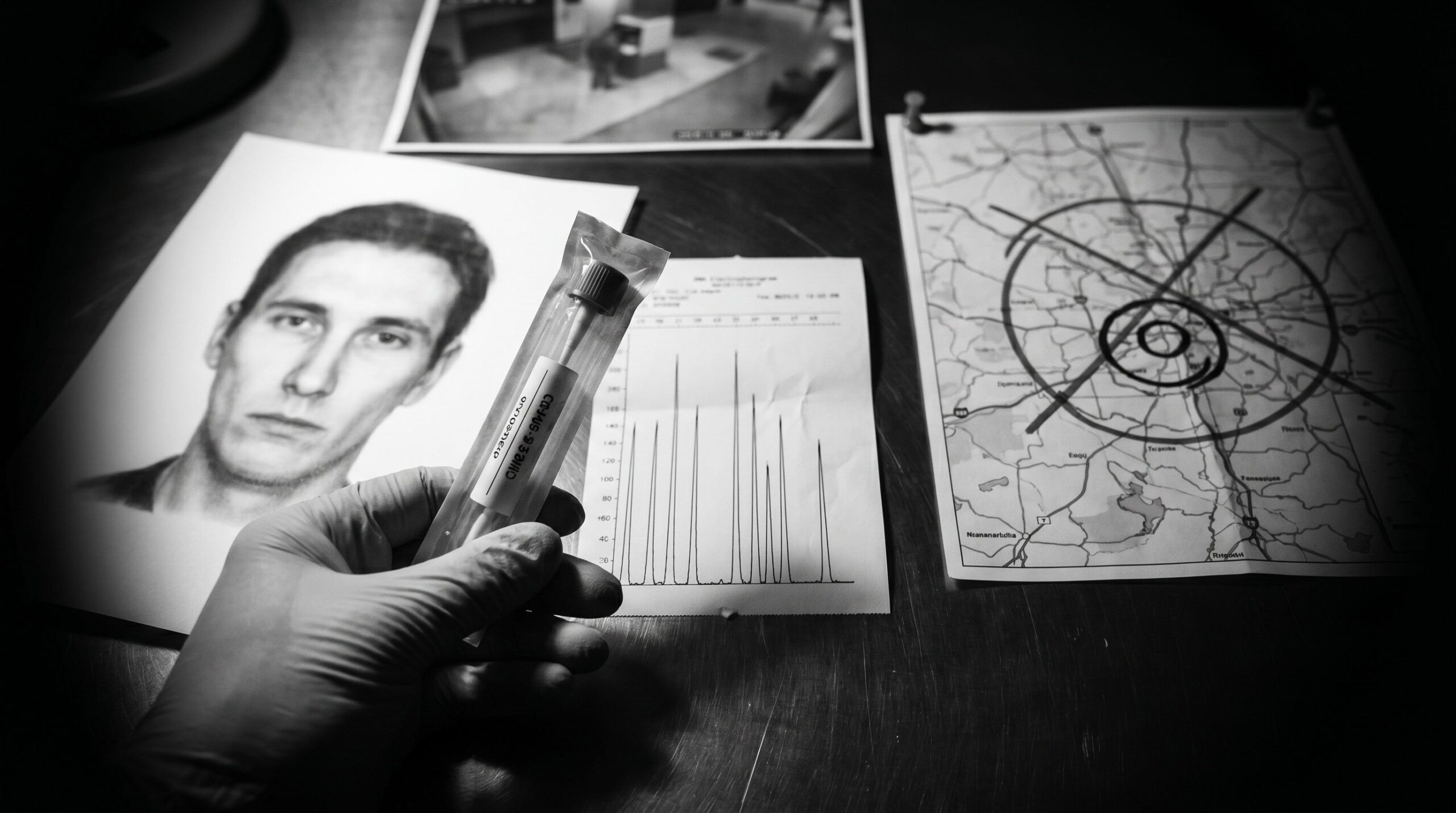
For more than a year, the largest manhunt in the modern history of southern Louisiana was looking for the wrong man. Not the wrong individual. The wrong category of human being entirely.
In the summer of 2002 the FBI, the Baton Rouge police, and a task force that eventually counted around 40 investigators were hunting a serial killer who had murdered women in their own homes, with no forced entry and no eyewitness worth the name (CBS News, 2002; UPI, 2002). The profile said white male, 25 to 35, physically strong. A composite sketch went out showing a white man with a long face. Tips described a white pickup truck seen near the places where bodies had been dumped, first a white single cab General Motors model, later a white Chevrolet step side (WAFB, 2002; CNN, 2003). So the investigators did the logical thing. They went looking for a white man in a white pickup, and they collected DNA from more than 1,000 Caucasian males to find him (Wired, 2007).
They found nothing. While they swabbed the cheeks of 1,000 innocent white men, the killer struck again.
In March 2003 the task force did something most American police forces of the day would not have touched with tongs. They sent the crime scene DNA to a molecular biologist named Tony Frudakis, at a small Florida company called DNAPrint Genomics, who claimed he could read the suspect’s ancestry out of the sample (Wired, 2007; Wikipedia, n.d.). The detectives did not believe him. So they tested him. They sent him 20 DNA samples from people of known background, blind, and asked him to sort them. He got all 20 right. Then he told them what their killer’s DNA said: the man they were hunting was of overwhelmingly African ancestry, on the order of 85 percent, with no realistic chance of being the pale face in the composite sketch (ABC News, 2006; Smith, 2020). African American or Afro-Caribbean, was how he framed it on the conference call. By the account of people who were on that call, the line went very quiet.
The white pickup was real. The man behind the wheel was simply not the killer the profile had invented. One of the prosecutors who later tried the case, a Black man, gave the lesson a bluntness I have never managed to improve on. Without that test, he conceded, they would still have been hunting “the white guy in the white pickup” (Wired, 2007). He also said that if he could push a button and make the technology vanish, he would. Sit with that for a second. The tool that saved his investigation was the same tool he wished did not exist. We will come back to why a sane man holds both thoughts at once.
The person arrested in May 2003 was a 34 year old man, born in 1968, already carrying a long record of prior run ins with the law (Smith, 2020). He was eventually tied to 7 killings and convicted of 2. None of it became possible until the investigation stopped trusting the eye and started trusting the molecule.
I open with this case because it is the cleanest illustration I know of the most useful and most misunderstood idea in modern forensic identification. DNA does not tell you who the perpetrator is. In a case like this one, where the man sat in no database anywhere, it cannot hand you a name. What it can do is the precise thing the eyewitness, the profile, and the sketch all failed to do here. It shrinks the pool. It takes “somewhere in Louisiana” and turns it into “not the entire category of people you have been chasing for a year.” That is not a small thing. In Baton Rouge it was the distance between a closed case and another funeral.
When the profile is wrong, the molecule is not impressed
What Frudakis read out of that sample has a proper name, and the name matters, because almost everyone gets it wrong, including the version of this article I wrote years ago. The DNA did not reveal the killer’s race. It revealed his biogeographic ancestry, and those 2 things are not the same animal.
Biogeographic ancestry is simply the geographic region or regions from which a person’s biological ancestors came. It says nothing about culture, language, religion, nationality, or the social category we call race, all of which are shaped by a crowd of factors that have nothing to do with the sequence in your cells (Schneider et al., 2019). The genetics underneath are not mystical. Across the long human story, mutation, migration, isolation, and local selection left certain DNA markers common in one part of the world and rare in another. Read enough of these ancestry informative markers and you can place a person’s deep roots on the map at the level of broad continental regions: Europe, sub Saharan Africa, East Asia, South Asia, Oceania, the Americas (Schneider et al., 2019). You are naming a region of origin, not a guilt, and certainly not a character.
How the cells carry that information is worth a sentence, because it explains both the power and the ceiling. Ancestry informative markers ride down 3 separate channels. The autosomal markers, inherited from both parents, record the mixed origins of someone whose ancestors came from different regions. The Y chromosome markers travel only father to son and report only the purely paternal line. The mitochondrial markers travel only mother to child and report only the purely maternal line (Schneider et al., 2019). Combine all 3 and you can sketch an admixed background, but coarsely, and mostly at the level of continents. Push for a subcontinental answer, this valley rather than that province, and the signal thins fast, because people have spent the whole of human history moving and mixing (Schneider et al., 2019). Newer sequencing methods, massively parallel sequencing among them, can sometimes push past the continental answer toward a subcontinental one, but the resolution is still bought marker by marker and fades with every generation of mixing (Schneider et al., 2019). The honest output is a region, broad and probabilistic, not a passport. I labor the point because the temptation, the instant a continent appears on the printout, is to hear a stereotype where the science offered only a coordinate. The Louisiana sample said African ancestry. It said nothing else whatsoever about the man, and everything that mattered for catching him still had to be done with ordinary police work.
This sits inside a wider toolkit that forensic geneticists call forensic DNA phenotyping. From a crime scene sample it can predict 3 kinds of thing: externally visible characteristics, mainly eye, hair, and skin color; biogeographic ancestry; and, through methylation patterns, a rough age (Schneider et al., 2019). The pigmentation predictions are genuinely good for the easy categories and honestly mediocre for the hard ones. Validated systems such as HIrisPlex and HIrisPlex-S report accuracy values, measured as area under the curve, in the range of 0.74 to 0.99 for eye color, 0.64 to 0.94 for hair color, and 0.72 to 0.99 for skin color (Schneider et al., 2019). Blue eyes and brown eyes predict well. The in between eyes, the gray green hazel muddle that half of Europe carries, predict badly. Black hair and red hair are easy. Blond and brown are a mess, partly because so many blond children turn into brown haired adults that the model cannot tell the 2 apart from the DNA alone (Schneider et al., 2019). Anyone who sells you DNA phenotyping as a photograph of the suspect is selling you a horoscope with footnotes.
That is the correction I owe the original version of this piece, and it is worth making cleanly rather than burying. The Louisiana sample did not announce a race. It announced a continental ancestry that was wildly incompatible with the white man the task force had spent a year and a thousand swabs chasing. The investigative value was enormous precisely because the predicted ancestry was rare among the suspects they were actually looking at. A prediction that merely confirms what everyone already assumes moves nothing. A prediction that detonates the central assumption of the whole investigation moves everything.
What the molecule cannot do, and never could
Now the part the television dramas leave out, because it is undramatic and therefore inconvenient.
DNA only helps when DNA is there. That sounds obvious until you stand in an actual case. The sample has to exist, it has to be connected unambiguously to the crime rather than to the pizza delivery driver who touched the doorframe last Tuesday, and there has to be enough of it. Modern skin contact traces, the few cells left when a hand brushes a surface, often hold so little material that the whole sample is consumed just producing a standard profile, with nothing left over for phenotyping (Schneider et al., 2019). Mixed samples from 2 or more people frequently cannot be untangled into a clean phenotype at all.
There is a deeper limit, and it is the one investigators forget in their excitement. Standard forensic DNA profiling, the short tandem repeat comparison that has been the backbone of the field for decades, identifies a specific person only by direct comparison. The crime scene profile has to match either a named suspect’s sample or a profile already sitting in a national database (Schneider et al., 2019). No match, no name. That is why the Louisiana task force could swab 1,000 men and learn nothing: none of those thousand was the donor, so there was nothing to match. Phenotyping does not fix that. It is an investigative tool, a way to narrow the field, never a courtroom identification of an individual (Schneider et al., 2019). The molecule can tell you which haystack to search. Only the match tells you which straw. An STR search is run first in every case for a simple reason: in Germany only about every third or fourth comparison against the national database even returns a hit (Schneider et al., 2019). When it returns one, the work is done. When it does not, phenotyping is what remains, and only when the trace is clean, from a single person, and tied without ambiguity to the crime rather than to a passing bystander (Schneider et al., 2019).
This is also where the molecule quietly outperforms the witness, and the numbers are brutal. The same crime scene DNA that needs a match to convict produces, in the meantime, an error estimate you can actually use. A predicted 95 percent probability of brown eyes carries a stated 5 percent error rate; you can weigh it. A frightened witness at 3 in the morning carries an error rate nobody can state at all, and history is not kind here. In the United States, the Innocence Project found that of 350 wrongful convictions later overturned by DNA, roughly 70 percent had rested on mistaken eyewitness identification (Schneider et al., 2019). 70 percent. The Baton Rouge witnesses were not lying about the white pickup. They saw a white pickup. The truck was simply not attached to the man they thought was driving it, and the human eye, unlike the marker, has no error bar printed on the side.
There is a postscript to the Louisiana story that says a great deal about how this field actually moves. The company that read that sample, DNAPrint Genomics of Florida, was a tiny operation, founded in 1997 on ancestry markers worked out by the population geneticist Mark Shriver, and it never really turned a profit. Its forensic product, the one used in Baton Rouge, went on to appear in roughly 200 investigations, and yet a single basic test cost more than 1,000 US dollars, and most police forces kept their distance from the whole uncomfortable subject (Wired, 2007; Wikipedia, n.d.). The company folded in 2009. The technology it could not sell did not die with it. The same continental ancestry inference is now a validated module that sits beside standard profiling in modern forensic kits (Schneider et al., 2019). The tool the police would not touch in 2003 is the tool they quietly run today. That is usually how a method graduates from scandal to standard, not by winning the argument but by outliving it.
The German paradox: the eyes yes, the origin no
Here is where my own country does something that would be funny if it were not quietly costing investigations their best lead. Since the end of 2019, after a fight that ran for years, German law permits what it calls extended DNA analysis. Under the amended Section 81e of the Code of Criminal Procedure, when investigators hold an unknown trace and have no database match, they may have the eye color, the hair color, the skin color, and the approximate age of the unknown donor inferred from the DNA (Section 81e StPO; Schneider et al., 2019). They may compute, in other words, almost everything Frudakis computed in Louisiana. Almost. The one thing the German legislature deliberately left out, against the explicit recommendation of forensic scientists and the police themselves, is biogeographic ancestry (Schneider et al., 2019).
Read that again slowly. A German investigator may lawfully ask the cells what color the suspect’s eyes were. He may not ask the same cells where that suspect’s ancestors came from. The eyes, yes. The origin, no. The single question that broke Baton Rouge open is the single question the German statute forbids you to put to the molecule.
The reason is not stupidity, and I want to be fair to it, because the concern is real. Germany of all countries has cause to be nervous about a state laboratory sorting people by ancestry and feeding the result into a criminal file. The fear is discrimination: that a printout reading sub Saharan African, attached to an open murder case, becomes a license to lean on a whole minority rather than a tool to find one man (Schneider et al., 2019). That is the same nerve the Louisiana prosecutor was touching when he said he would push a button to make the technology vanish even as it saved his case. A sane person can hold both halves of that. The fear of the misuse is legitimate. So is the lead. The worries the European VISAGE project catalogued are not exotic ones: discrimination against minorities, invasion of privacy, collision with data protection, and inflated expectations of what the method can actually deliver (Schneider et al., 2019). And the tool cuts both ways. In a Dutch rape and murder case from 1999, an ancestry based prediction was precisely what lifted an unfounded suspicion off a local minority group (Schneider et al., 2019). The lead that can point at a group can also clear one, which is the half of the story the alarmed side never tells.
What makes the German compromise scientifically incoherent rather than merely cautious is a detail the debate mostly skips. The pigmentation models the law does allow were built and calibrated largely on European reference data, and the accuracy of a color or age prediction depends on how well the tested person’s ancestry is represented in that reference set (Schneider et al., 2019). Strip out ancestry and you do not protect the suspect of non European origin. You degrade the very eye, hair, and skin predictions the law permits, for exactly the people the models handle worst. The combined analysis of appearance and ancestry yields more than appearance alone, which is precisely why the scientists recommended keeping the 2 together (Schneider et al., 2019). The lawmakers kept the half that works least well on its own and threw away the half that props it up.
There is something almost circular in the prohibition. Some appearance traits are simply ancestry wearing a disguise. Blond hair with blue eyes and pale skin belongs, always, at least partly to European ancestry. Brown eyes with black hair and mid toned skin turn up among the indigenous populations of Europe, Asia, and the Americas alike, and the only clean way to tell those 3 apart is the very biogeographic ancestry the German law refuses to read (Schneider et al., 2019). So the statute lets the investigator infer features that quietly smuggle ancestry back in through the side door, while forbidding him to name it at the front. A rough age, read from the methylation pattern of the DNA, may be added to the picture as well (Schneider et al., 2019). The origin, the one variable that would calibrate all the others, stays off limits.
And the line on the map is absurd when you stand back from it. As of that 2019 review, biogeographic ancestry inference was lawful or in active forensic use in the Netherlands, Slovakia, the United Kingdom, Poland, the Czech Republic, Sweden, Hungary, Austria, and Spain (Schneider et al., 2019). The same molecule, read by the same method, is a lawful investigative fact in Rotterdam and a forbidden one in Cologne. The DNA does not know which side of the border it is sitting on.
I watch the public version of this argument from the first row with a bag of popcorn, because it is so reliably useless. The moment the words DNA and ancestry appear in one sentence, 2 megaphones come out. One side hears race science and reaches for the alarm. The other side hears political correctness strangling police work and reaches for its own. Both of them sail straight past the only sentence that matters, the one the science actually supports: the test names a continent of origin, never a culprit, and never a character. Everything useful and everything dangerous about it lives in the gap between those 2 things.
When there is no DNA, there is sometimes a camera
Everything above assumes a usable biological trace. A great many crimes leave none. The robber wears gloves. The assault happens on open pavement. The hit and run driver never touches a surface you could swab. What these crimes increasingly do leave behind is a recording, and that is the gap where my own field, the forensic analysis of images, earns its keep.
The image can come from a fixed traffic enforcement camera, the kind that fires on a speed violation, a following distance offense, or a red light run. It can come from the silent surveillance eyes bolted above every bank counter, gas station forecourt, jewelry display, supermarket till, and gaming hall door, and over the turnstiles where the occasional subway brawl plays out. It can come from a dash cam, the small witness on the windshield that records traffic offenses, collisions, and now and then a crime its owner never expected to capture. Every one of these produces still frames, and a still frame can be worked.
What an image gives you, and where it quietly lies
Here I have to be as hard on my own discipline as I was on the molecule, because forensic image analysis gets sold to juries with a confidence the underlying science has not always earned.
The validated, court relevant version of the work is comparison. You have a questioned image from the scene and a known image of a suspect, and you ask whether the 2 can be the same person. The method accepted for that task, endorsed by both the Facial Identification Scientific Working Group and the European Network of Forensic Science Institutes, is morphological analysis: a trained examiner compares the face feature by feature and reaches a reasoned conclusion about similarity (ENFSI, 2018). The older trick of photo anthropometry, measuring the distances and angles between fixed points on the face, has been largely abandoned for real world images, because those measurements wobble with every shift of camera angle, lens, and distance, and the working groups now caution against leaning on it (ENFSI, 2018).
Two things wreck this work, and both are routine rather than exceptional. The first is image quality. A clean comparison in good light is one thing. The smeared, badly angled, low resolution frame from a genuine gas station camera at 2 in the morning, the subject in a brimmed cap and the lens half blind, is another, and the error rate climbs to meet it. The second wrecker sits inside the examiner’s own skull. Forensic confirmation bias has been documented in precisely this task: tell an examiner that the police already favor a particular suspect, and the comparison drifts obligingly toward agreement (Heyer and Semmler, 2013). The eye sees what the file tells it to see. That is not a slander against examiners. It is a fact about brains, mine included, and the only defense against it is method and blinding, not confidence.
Let me be blunt about how thin the validation underneath even the accepted method is. Morphological analysis is in essence a structured, expert version of what your own brain does when it decides that 2 snapshots show the same cousin, and the studies that have tried to measure its reliability on real surveillance footage keep landing in the same place. With clean images, trained examiners do reasonably well. With the degraded frames that actual crimes produce, accuracy drops and the disagreement between examiners climbs (ENFSI, 2018). The method is admissible in many courts. That is not the same statement as fingerprint grade or DNA grade certainty, and any examiner who lets a jury hear it that way has wandered well past the edge of what the evidence supports.
Now the harder claim, the one my original version of this article stated with too straight a face. Can you read a stranger’s origin off a surveillance still the way Frudakis read it off the DNA? Not with anything close to the same confidence, and never as proof. What an image offers is apparent features: an apparent ancestry, a build, a hairline, a set of facial proportions. Accumulate enough of them and you can sometimes narrow the pool, the same logic the DNA follows, but with a far softer instrument and no error bar stamped on the side. It is an investigative lead, a way to say this group is likelier than that one, and it has to be held exactly that loosely. A face on a screen is not a fingerprint. The instant anyone treats an apparent origin from a blurred frame as an identification, you are back in the white pickup, trusting the eye over the evidence, and you already know how that ends.
Not rivals: a pair of pliers needs both jaws
The old framing, the one I want to bury here, is that DNA analysis and forensic image work compete, that one is the real science and the other the poor relation. They do not compete. They cover different holes. DNA speaks when there is a biological trace and goes silent when there is none. The image speaks when there is a recording and goes silent when there is none. The cases where both exist are the rare, rich ones, and there the 2 methods reinforce each other instead of arguing.
The traffic flows in one direction more than the other. The softer method, the image or the broader anthropological read, is usually what substantiates an early suspicion and builds a first profile. That profile is what can justify a targeted DNA mass screening, the procedure German law allows under Section 81h of the Code of Criminal Procedure, in which the men who fit the narrowed description are asked for comparison samples (Schneider et al., 2019). And that screening is what finally produces the biological material that, on a match, names an actual person. The soft method feeds the hard one. The hard one closes the case.
I think about it the way I think about Bandit, my Malinois, working a track across a field. The dog never tells me the name of the man who walked there. He tells me which direction to stop wasting my afternoon in. DNA ancestry does that from a cell, image analysis does it from a frame, the dog does it from the scent, and not one of the 3 is a verdict. They are 3 different ways to shrink a search until the one method that does name a person, the direct comparison match, finally has a small enough space to work in.
What shrinks the haystack is not what names the straw
The Baton Rouge witnesses were not lying. They saw a white pickup, and there really was a white pickup. The FBI profile was confident, professional, and wrong. The molecule was modest and right, and notice what it actually did. It never named the killer. It emptied out a year of wrong assumptions, pointed at a smaller field, and then a database comparison did the naming. Every honest tool in this story did the same humble job: it shrank the pool. None of them, on its own, convicted a man.
That is the whole discipline in one sentence. What shrinks the haystack is not what names the straw, and the worst errors in forensic history come from confusing the two. The prosecutor who wanted to push a button and make the ancestry test disappear was not a fool, and neither was he wrong to be uneasy. He was holding both true things at once: that the tool saved his case, and that the same tool, handled by careless hands, could put a whole category of people under suspicion for the act of one man. The cell does not protect against that. The camera does not protect against that. Only the discipline of remembering what each method can and cannot say protects against it.
Keep that line bright, between the pool you have narrowed and the person you have not yet named, and DNA analysis and forensic image work are the most honest help an investigation has ever had. Blur it, in either direction, from the molecule or from the lens, and you have built something far worse than an old fashioned mistaken eyewitness. You have built a machine that does the eyewitness’s oldest job, convicting the wrong man, and does it faster, with a lab coat on.
References
- ABC News. (2006, January 6). DNA may change killer profile. https://abcnews.go.com/GMA/story?id=125079
- CBS News. (2002, August 1). Serial killer stalks Baton Rouge. https://www.cbsnews.com/news/serial-killer-stalks-baton-rouge/
- CNN. (2003, January 1). Sketch released in Louisiana killings. https://edition.cnn.com/2003/US/01/01/serial.killer.louisiana/
- ENFSI. (2018). Best practice manual for facial image comparison (ENFSI-BPM-DI-01). European Network of Forensic Science Institutes. https://enfsi.eu/wp-content/uploads/2017/06/ENFSI-BPM-DI-01.pdf
- Heyer, R., and Semmler, C. (2013). Forensic confirmation bias: The case of facial image comparison. Journal of Applied Research in Memory and Cognition, 2(1), 68-70. https://doi.org/10.1016/j.jarmac.2013.01.008
- Schneider, P. M., Prainsack, B., and Kayser, M. (2019). The use of forensic DNA phenotyping in predicting appearance and biogeographic ancestry. Deutsches Aerzteblatt International, 116(51-52), 873-880. https://doi.org/10.3238/arztebl.2019.0873
- Smith, B. H. (2020, June 13). Derrick Todd Lee, Baton Rouge serial killer, linked to 7 murders. Oxygen. https://www.oxygen.com/mark-of-a-killer/crime-news/derrick-todd-lee-baton-rouge-serial-killer-murders
- Strafprozessordnung (StPO), Section 81e. https://www.gesetze-im-internet.de/stpo/__81e.html
- UPI. (2002, December 23). Fourth slaying linked to serial killer. United Press International. https://www.upi.com/Archives/2002/12/23/Fourth-slaying-linked-to-serial-killer/4881040619600/
- WAFB. (2002, November 15). Third witness claims to have seen infamous white truck driven by serial killer. https://www.wafb.com/story/1009599/third-witness-claims-to-have-seen-infamous-white-truck-driven-by-serial-killer/
- Wikipedia. (n.d.). DNAPrint Genomics. Retrieved June 2, 2026, from https://en.wikipedia.org/wiki/DNAPrint_Genomics
- Wired. (2007, December 20). A new DNA test can ID a suspect’s race, but police won’t touch it. https://www.wired.com/2007/12/ps-dna/
Is It Legal to Own a Real Human Skull? Yes, Subject to 3 Conditions
Private possession of a real human skull is not prohibited in Germany. Three conditions decide the question, and…

The Science and Ethics of Age-Gap Attraction: Why Older Men Are Drawn to Younger Women, and Where the Line to Crime Runs
A forensic examiner lays out the evolutionary psychology and the data from 130 countries: the algorithm of age-gap…
The Pressure Fallacy: What Pink Teeth in the Dead Really Reveal, and What They Do Not
A forensic investigation through 200 years of literature, prompted by three cases, two of which I examined myself,…