Is It Legal to Own a Real Human Skull? Yes, Subject to 3 Conditions

A forensic expert explains why German law does not prohibit the private possession of a real human skull, why criminal investigations are nevertheless opened in such cases again and again, and which features of the bone indicate a historical teaching specimen.
The phone rang on an afternoon when I was working on the final build of my software for facial reconstruction. On the other end was a young woman, polite, matter-of-fact, with that slight tremor in the voice that shows up whenever someone is speaking from a situation that has changed fundamentally over the past few days. She had ordered an anatomical teaching skull from a Dutch dealer. Not a curiosity, not a find, not a grave item, but exactly the sort of specimen with a removable calvarial cap, springs and screws that has passed through the hands of German medical students for more than a century without a single prosecutor ever finding anything remarkable in it.
The shipment never reached her. It was intercepted by customs, referred to the prosecutor’s office, and ultimately resulted in a criminal investigation against both her and the sender, complete with a file number and a request for a statement.
I knew the sender, because in this small field of historical anatomical specimens nearly everyone knows everyone. He runs an antiques business in the Netherlands, and according to the documents and statements presented to me, the skull came from the estate of his father-in-law, a physician who had acquired it decades earlier from a medical collection. There was no indication of grave robbing, theft or black-market dealing, but there was every indication of a teaching specimen with a traceable origin in a doctor’s holdings. The case was dropped, as I had expected from the first phone call onward. What lay in between, however, were months, legal fees and a young woman who had set out to deepen her knowledge of osteology and suddenly found herself listed as a suspect.
On the phone she asked me what everyone asks who lands in that position. She wanted to know whether what she had done was illegal at all.
Yes, possession is legal, and 3 conditions decide the question
Private possession of a genuine human skull is not prohibited in Germany. Neither the criminal code nor burial law makes possession as such an offense, and German law knows no separate possession offense for human remains of the kind that exists in weapons law or narcotics law. Anyone who keeps a historical anatomical skull on a shelf is committing no crime, and the discomfort many people feel at the thought changes nothing about that.
What criminal law protects is not the bone as an object. What it protects is the public’s sense of reverence for the dead and the deceased person’s posthumous personality rights, and this distinction governs everything that follows. A law meant to prohibit the bone itself would have to shut down every anatomical collection in the country.
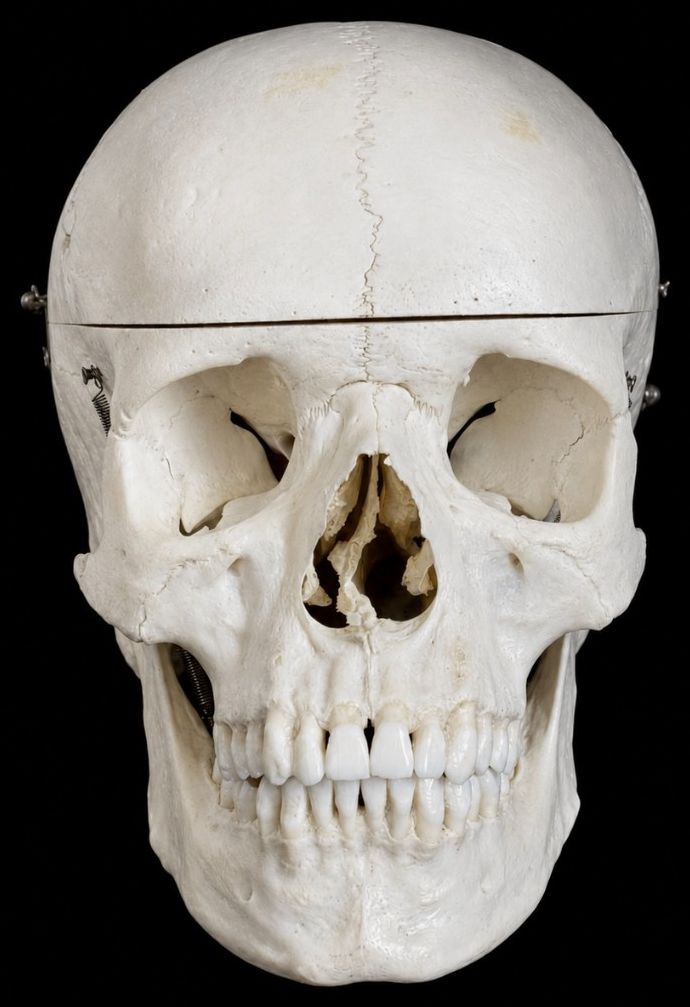
Typical anatomical teaching skull with a horizontally sectioned, removable calvarium and a spring-mounted mandible. Particularly remarkable is the complete permanent dentition. Such completeness is uncommon in teaching skulls because individual teeth are often lost after death, during preparation, or through decades of handling and storage.
Possession remains legal, however, only under 3 conditions, and every dispute in practice runs through those 3 conditions. One caveat belongs up front so that nobody misreads me: these 3 conditions are not a statutory and exhaustive catalogue of the statutory elements of an offense, they are my practical summary of the criminal, civil, burial law and import law questions that regularly turn out to be decisive with such pieces.
First, the specimen must not have entered circulation through a criminal act. Which provision applies depends on the individual case, and the common rule of thumb that anyone buying such an item is guilty of receiving stolen property does not hold, as I set out below. Anyone who looks away at an offer with no information about origin, one that looks conspicuously fresh or cheap, will still not be helped by the later protest that he thought nothing of it.
Second, the specimen must not have been removed without authorization from an existing burial, custodial or collection context. This is the point at which historical specimens differ from everything else, and it is finer than it first sounds. Even with an old specimen, custody may continue, for instance with an institute, a museum, a cemetery operator or a lawful possessor. The death of those who once held the right of care over the body does not by itself end any later relationship of custody.
Third, the specimen must have arrived lawfully where it now is, which covers not only the purchase but also export from the country of origin and import. This is the area of examination that is almost always missing from these discussions, even though it is the practically most important one for a shipment from a non-EU country.
These 3 conditions concern possession. Later use has to be kept separate from them, because a lawfully acquired skull can become the object of an offense through degrading treatment without acquisition or possession thereby becoming unlawful in retrospect. I return to that distinction below, because it regularly gets muddled.
I write this from a practice in which I have worked with human remains for decades, as a court-appointed expert witness and in a series of investigations in which precisely these questions had to be answered. Of the proceedings I have accompanied as an expert during that time, I cannot recall a single one that was not discontinued. That is my experience and not a statistic, and I know of no official survey that records the outcome of such proceedings nationwide. Anyone demanding a number from me here will not get one, because I do not have it.
What Section 168 of the German Criminal Code actually prohibits, and what it does not
The provision everything revolves around is Section 168 of the German Criminal Code, entitled „Störung der Totenruhe,” the disturbance of the peace of the dead. It is misquoted in comment threads and forums so consistently that a look at the actual wording is worth the effort.
Subsection 1 criminalizes the taking of the body or parts of the body of a deceased person, a dead fetus, parts of one, or the ashes of a deceased person from the custody of the person entitled to it without authorization, and likewise committing what German law calls „beschimpfender Unfug,” meaning grossly disrespectful or degrading conduct, on any of these. The sentencing range is imprisonment of up to 3 years or a fine. Subsection 2 protects places of laying out, burial sites and public memorials against destruction, damage and the same degrading conduct. Subsection 3 declares the attempt punishable.
Possession does not appear in this wording. No subsection, no clause, no variant of the offense attaches to the mere holding of a bone. What is punished is taking something from the custody of an entitled person and committing a degrading act, and anyone who confuses the one with the other is confusing theft with ownership.
That moves a concept into the center that is legally more demanding than it sounds. Custody of the entitled person requires an actual relationship of care and at the same time the legal authority to exercise it, and that authority follows from the right of care for the dead, which as a rule rests with the closest relatives or is governed by the wishes of the deceased. With a specimen that has traveled through institutes and collections as teaching material for generations, that path suggests it once entered legal circulation with the consent of an entitled person. Age alone, however, does not prove that this happened, and that is the honest version of the argument. What matters is not how old a piece is but whether a person with authority lawfully released it from that special care. Where nobody exercises such care any longer, the point of attachment for a taking is missing, and where an institution, an operator or a lawful successor in possession holds it, that care continues.
At this point I have to be honest, and more plainly than I would like. This reading is mine, resting on the wording of the provision and on the practice I encounter in cases. I know of no published high court decision expressly holding that historical anatomical specimens without a burial connection fall outside the protective scope of Section 168. The earlier version of this article stated that criminal law scholarship views the matter almost unanimously in this way, and I have removed that formulation because I cannot substantiate it. An author who works with claims whose source he cannot name, in a text about legal certainty of all things, has already lost the text.
What can be substantiated is the direction in which the Federal Court of Justice thinks about the scope of the provision. In a decision of June 30, 2015, the Fifth Criminal Division held that the ashes within the meaning of Section 168 subsection 1 include all residues remaining after cremation, and therefore also the dental gold that crematorium employees had removed from the combustion remains. In the same decision the panel expressly names the protected interests as the public’s sense of reverence for the dead and the deceased person’s posthumous personality rights. The case therefore concerns material that comes directly out of a burial process and that can be assigned to a specific deceased individual. A calvarial cap demonstrably circulating through teaching collections since the 19th century differs from that fundamentally. It does not follow, however, that every claim to reverence or personality protection has lapsed for it, since how far Section 168 reaches with historical specimens has not been conclusively settled by the higher courts. I return to this when the question becomes what may be done with such a piece.
A distinction belongs here, because it frequently gets muddled in practice. A skull surfacing during construction work or in one’s own garden is something entirely different from a collection piece. With a ground find, the reporting duties of the relevant state heritage law apply, and the moment a forensically relevant postmortem interval cannot be excluded, the police have jurisdiction anyway. Anyone simply keeping such a find acquires problems quite independently of Section 168. This text is not about ground finds but about specimens that entered circulation as specimens and have been moving through it for generations.
For acquisition, other provisions come into play, and here matters are less tidy than the usual rules of thumb suggest. Receiving stolen property under Section 259 gets cited readily, but it requires that the item stems from an unlawful act directed against another person’s property, and disturbing the peace of the dead is not a property offense. Added to that are the required intent to enrich oneself and the question whether the particular bone was a movable object belonging to someone at all, and to whom. Depending on origin, property offenses may apply alongside.
That leaves the question of degrading use, and here almost every discussion reaches for the wrong provision first. What gets cited is Section 189, disparagement of the memory of deceased persons, punishable by up to 2 years and prosecuted as a rule only upon application. As a rule, because Section 194 subsection 2 provides an exception for publicly committed acts where the deceased lost their life as a victim of National Socialist or another regime of violence and arbitrary rule and the disparagement relates to that. That provision, however, requires a connection to a specific deceased individual, and an anonymous historical specimen regularly does not supply one.
What applies first is Section 168 subsection 1, which criminalizes degrading conduct on the body or on parts of the body themselves. For that the individual connection is precisely not required, since the provision protects the public’s sense of reverence for the dead alongside posthumous personality rights. Anyone staging a human skull as a Halloween prop with a candle on top therefore has to be measured against Section 168 first, and whether the threshold of grossly disrespectful or degrading conduct is met depends on the specific presentation. The anonymity of the specimen certainly does not settle the question.
What burial law protects, and for how long
Alongside criminal law, Germany has a second body of rules that comes up regularly in discussions about skulls and is almost always misunderstood. Burial law falls to the federal states, and all 16 states have enacted their own statutes with sometimes considerable differences.
These statutes determine, among other things, the period of repose, meaning the span during which a grave site enjoys the special protection of burial law and during which reburial or removal without official permission is excluded. Baden-Württemberg, for instance, sets a minimum period of repose of 15 years in Section 6 of its burial statute, reduced to 6 years for children who died before completing their second year of life and to 10 years for children under 10. Bavaria has no statutory minimum period at all and leaves the determination to the bylaws of the cemetery operators, who orient themselves toward the expected decomposition time under local soil conditions. Other states fall between these poles, and anyone who wants to know the period for a particular location has to look at the bylaws of that specific cemetery rather than at an overview table somewhere online.
For the question of this article, one point in all of this matters, and I put it more cautiously than I would like rhetorically. The period of repose attaches to interment in a facility, it expires, and the Baden-Württemberg statute expressly regulates what comes afterward, namely that remains found later are to be buried within the cemetery or at sea. Burial law therefore covers considerably more than grave plots, and in Bavaria the statute names body parts and parts of corpses alongside bodies and ashes.
What follows is that a specimen long established in legal circulation as an anatomical specimen can lie outside these rules, not that it does so nationwide and by force of a single principle. Anyone arguing against possession of a historical skull by broadly invoking burial law is usually reaching for a rule written for a different situation. Whether it nonetheless applies in a given case depends on the relevant state law and on the history of the particular piece.
Possession law and import law are two different questions
There is a level that was missing entirely from the previous version of this article, and it was the largest gap in it, in a text that opens with a customs shipment of all things. The absence of a possession prohibition says nothing about whether a piece was lawfully imported.
The licensing and declaration procedures of Regulation (EU) 2019/880 on the introduction and import of cultural goods have applied in full since June 28, 2025, after the general prohibition on introduction took effect at the end of 2020. The regulation prohibits bringing cultural goods into the Union where they were unlawfully removed from the country in which they were created or discovered. In Germany the federal art administration issues the licenses, and whether the importer is a trade professional or an occasional collector makes no difference.
For human remains the exact wording matters, and it is narrower than a summary suggests. Cultural goods within the meaning of the regulation are only those objects that are of importance for archaeology, prehistory, history, literature, art or science and that also fall under one of the categories in the annex. The relevant category there reads „rare collections and specimens of fauna, flora, minerals and anatomy, and objects of palaeontological interest,” and the word rare is not decoration. An ordinary teaching specimen from a 20th-century workshop will as a rule not meet these criteria, while an anatomical piece of scientific or historical significance may.
The thresholds involved differ considerably from one another. The importer declaration under Part C applies only from 200 years of age and a value of 18,000 euros per item, which a teaching skull practically never reaches. The import license under Part B covers archaeological cultural goods from 250 years, regardless of value. The general prohibition on introduction under Part A, by contrast, applies regardless of age or value whenever a piece has been unlawfully removed from the country in which it was created or discovered.
What governs here is origin and not the place of dispatch, and that distinction gets overlooked constantly. That a shipment comes from the Netherlands says nothing about where the piece was created or discovered, and a specimen produced by a Calcutta workshop originates outside the Union regardless of which country it passes through on its way to Germany. A shipment within the Union does not trigger a fresh import procedure, but concluding from that alone that a piece falls outside consideration altogether would be wrong. For the teaching skull in the opening case there was, on the information available to me, no indication of a current import from a non-EU country, but the Dutch sender alone does not prove that.
One last point belongs here because it is often misunderstood. An import license expressly proves neither lawful origin nor ownership, it is a clearance and not a free pass.
That qualifies a sentence I leave standing further above and supplement here. The absence of old documentation is the normal state of affairs with historical collection pieces and is not in itself grounds for suspicion. With an import from a non-EU country, missing documentation can nonetheless be legally relevant, because the question there is not who owned the piece in the 19th century but whether it left its country of origin lawfully.
The American situation, briefly and without the legend
Because the question keeps washing back from the English-speaking world, a short look across the Atlantic, and one correction on my own account.
At the federal level in the United States, no law generally prohibits private persons from possessing human remains. The most important federal special rule concerns remains of indigenous origin, and there a distinction is needed that gets blurred almost everywhere. The inventory and repatriation duties of the Native American Graves Protection and Repatriation Act of 1990 address federal agencies and institutions receiving federal funds. The criminal trafficking prohibition in 18 U.S.C. Section 1170, by contrast, addresses any person who knowingly buys, sells or uses for profit the remains of a Native American without the right of possession, carrying up to 1 year and 1 day for a first violation and up to 10 years for a subsequent one. Private individuals therefore do not stand outside federal law, they stand only outside the repatriation duties.
Everything else is a matter for the individual states. In her 2023 survey, law professor Tanya Marsh of Wake Forest University counted 8 states with a broad and express prohibition on sale, plus more than 2 dozen further states with prohibitions under certain conditions that mostly attach to unlawful removal from a place of burial. Minnesota has since followed, which shows how mobile that count is. She also points out that not a single state has a provision expressly permitting the sale, which considerably qualifies the much cited American free-for-all.
The previous version of this article stated that 47 out of 50 states have no express prohibition, and that figure was wrong. It also appeared on the authority of Marsh, although Marsh wrote the opposite. I am writing this here rather than changing it silently, because an author who misrepresents a source forfeits the right to lecture others about diligence. The details of the state level picture belong in an article of their own in any case, because they keep changing.
Where exactly is the consent form signed by Ramesses II
Now to the demand that surfaces at some point in every conversation about this subject and that looks unassailable at first glance. The collector should please demonstrate the origin without any gaps, ideally with a declaration of consent from the deceased.
I have been putting this question to audiences for years, at training sessions, in lectures, to prosecutors and police officers, and the result is the same every time, namely a brief silence and the palpable jolt in the room when an argument that felt solid a moment earlier stops holding. The question is this: where is the written declaration of consent from Ramesses II?
It does not exist and never did. The man reigned until roughly 1213 BC and was buried with a ritual effort designed to guarantee exactly one thing, namely that no one would ever disturb him. Nobody asked him whether his mummy could be recovered from a hiding place in 1881, catalogued, flown to Paris in September 1976, received at Le Bourget airport with military honors, x-rayed and examined at the Musée de l’Homme, and finally displayed to the world public in a climate-controlled case at the National Museum of Egyptian Civilization in Cairo. There was also nobody who could have asked him, because his relatives have been dead for some 3,000 years and his heirs are not listed in the phone book.
A correction at this point, because it matters to me. In the previous version I described the widespread story that Ramesses was issued an Egyptian passport for this journey, with the occupation given as „king, deceased,” as demonstrably false, and in that sharpness the claim did not hold. What is demonstrably false is only the passport image circulating online, which is a reconstruction and is identified as such by the site distributing it. Whether a travel document was actually issued I could not establish. The sources asserting it are entertainment formats, and the source denying it is a blog post without any official counterevidence, so I would reject both sides in an expert report. The story therefore stands here as what it is, namely unresolved. That changes nothing about the argument, because a passport would be a footnote and not a consent.
The rest of the series stands, and it is long. Where is the consent of the man from the ice, whose radiocarbon dating places him between 3350 and 3105 BC and who has lain under glass in the South Tyrol Museum of Archaeology for years? Where is the consent of the bog bodies from Denmark, of the Roman dead from the excavation fields of northern Germany, of the plague victims from the opened mass graves of European cities, of the skeletons from medieval monastery cemeteries that are stacked in German university basements?
There is none, and there never will be.
Anyone wanting to turn that into a standard for private collectors should apply it first where the large holdings are. The British Museum states that it holds over 6,000 human remains. The Smithsonian Institution names more than 30,000, roughly half of which are the remains of indigenous individuals. In 2011 the Prussian Cultural Heritage Foundation took over around 7,700 skulls from the anthropological collection of the Charité hospital, the core of which is the collection assembled by Felix von Luschan with some 5,600 pieces, gathered between 1885 and 1920.
And here it becomes interesting, because this institution does something the debate badly needs. It researches its own holdings. In January 2023 the foundation published results on 1,135 examined skulls from the former German East Africa, of which 904 could be attributed to present day Rwanda, 202 to Tanzania and 22 to Kenya, mostly originating from burial sites. In April of this year the analysis of nearly 600 skulls from Togo and Cameroon followed. That is laborious, expensive, uncomfortable work, and it deserves respect.
It also shows the scale. A fraction of a single holding was processed over more than a decade, and even there the outcome is usually a region and not a name. When a foundation with staff, budget and archival access arrives at that result, demanding gapless provenance from a private individual who inherited a teaching specimen from a physician’s estate is no longer a legal requirement but a rhetorical device.
This distinction matters a great deal to me. Working through the history of colonial collecting is legitimate and overdue, and restitutions such as those to Namibia are right. A collection that systematically gathered skulls in subjugated territories under a colonial regime stands in an entirely different context of justification than a teaching skull from a medical estate. Anyone throwing both into the same pot helps neither cause.
So that nobody misunderstands me here, and because this is exactly where the usual evasive move begins: the Ramesses question is an argument against double standards. It is not an argument against checking origin, against questions of ownership, and certainly not against complying with export and import law. Anyone reading it that way has misread it deliberately. It is directed solely against a standard applied to the private individual and dropped for the institution, and it demands not leniency but equal treatment.
Alongside that, one legal sentence remains untouched. The burden of proving criminal origin lies with the prosecuting authority, and the possessor does not have to prove his innocence. The absence of old documentation proves no offense and is the normal state of affairs with historical teaching specimens. Combined with other irregularities, such as a fresh condition, contradictory statements from the seller, a conspicuous price or an unexplained import route, an unresolved origin can nonetheless give the authorities reason to look into the matter. That is the difference between a missing document and reasonable suspicion.
Amalgam, titanium and the nuclear tests, the markers by which I place a specimen
Because the question of origin is rarely settled by paperwork in practice, it gets settled on the object. A skull carries clues to the period from which it dates, and one only has to be able to read them.
The first look goes to the preparation. Historical anatomical skulls from the 19th and early 20th centuries show hand guided saw cuts at the calotte and skull base, drill holes in standardized positions for springs and screws, period-typical varnishes, and occasionally weights inserted in the base to stabilize the specimen. These features come from workshops that no longer exist, and faking them makes no sense, because the effort exceeds any possible return. What they establish is how a piece was worked and used, not automatically how old it is.
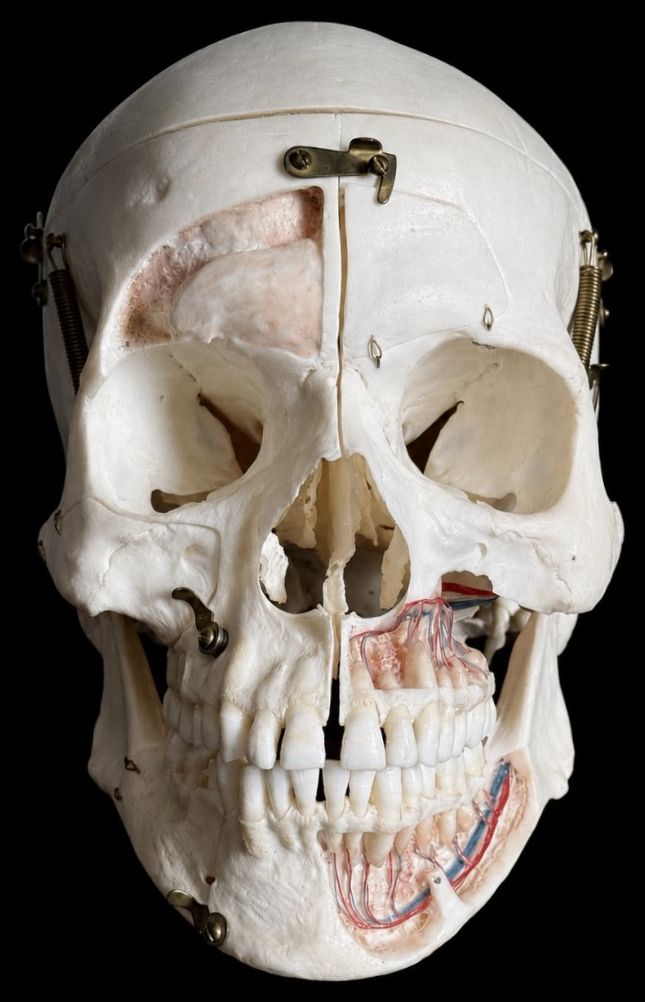
This anatomical teaching skull was divided into multiple removable sections for instruction and demonstration. The calvarium is sectioned horizontally and along the midline and secured with metal catches, springs, and additional fittings. Carefully prepared windows in the frontal bone, maxilla, and mandible expose internal bony spaces and the color-coded neurovascular structures of the jaws and teeth. Red and blue markings illustrate the vascular pathways. Such an elaborate specimen was designed not only for general osteology, but also for teaching topographic anatomy and structures of particular relevance to dentistry.
Then there is the condition of the bone substance. A skull consists of roughly 65 percent mineral by weight, essentially hydroxyapatite with the formula Ca10(PO4)6(OH)2, and the organic remainder is about 90 percent type I collagen. With increasing time in the ground, minerals are deposited into this structure and shift the color from cream-white into the darker range. A specimen that never lay in the ground looks different from a piece out of an excavation context. As a dating method the color is useless, though, because soil chemistry, moisture, bleaching, conservation and later treatment can all produce similar appearances.
The second look goes to the dentition, and this is where the marker sits that matters most to me in this article.
Amalgam sets a boundary in time, and a more precise one than I described in the previous version. As a filling material of western origin it goes back to the silver paste that Taveau presented in Paris in 1826 and to the Crawcour brothers, who introduced the material in the United States in 1833, where the dental professional society initially required its members to abstain from it in 1840. What an amalgam filling establishes is therefore not the time of death but the earliest possible time of the dental treatment, which cannot have taken place before the material was introduced in the early 19th century. Since the person survived the treatment, death shifts correspondingly later, but by how much the filling does not say.
From that follows my clearest recommendation in this text. A skull with amalgam fillings should generally be avoided, unless the origin is documented without gaps. The reason has nothing to do with aesthetics. An individual whose teeth were treated in the 20th century may have living descendants and may have lain in a burial whose period of repose has not expired, which brings the piece into exactly the range where questions of authority and burial connection turn sharp.
Great age lowers these risks but does not remove them. Even a very old skull may have been taken from a vault 2 years ago, stolen from a collection, or removed from its country of origin in breach of that country’s export law. The markers on the tooth answer the question of when, not the question of where from.
A titanium implant in the jaw provides an even narrower chronological boundary. The first titanium-based dental implant was placed by the Brånemark working group in Gothenburg in 1965, and broad clinical use followed in the 1980s. A titanium implant therefore establishes modern dental treatment and makes solid documentation of origin indispensable. On its own it proves neither removal from a grave nor criminal origin, since a modern implant can also sit in a lawfully donated or institutionally released specimen. For my own dealings a simple rule applies nonetheless, and it is purchasing policy rather than legal advice: when a specimen like that comes without reliable documentation, I pass.
Conversely, the absence of modern dental work also says something, though less sharply. A dentition without composites, without ceramics, without base-metal crowns and without amalgam belongs with reasonable probability to a person who died before these techniques spread. That is a statistical argument and not a proof, because not everyone in the 20th century received dental care and because teeth are lost postmortem. Anyone trying to turn that into a dating is overextending the finding.
The third marker sits not in the tooth but in the air, and it is the sharpest of them all. The extensive atmospheric nuclear weapons tests drove the level of radioactive carbon in the atmosphere up steeply from the mid 1950s onward, peaking in 1963, and that rise has been recorded in every organism that has lived since.
What follows from it gets presented too simply on a routine basis, including by people who ought to know better. A measurement is not a clock of death, because the result depends on which tissue was examined.
Tooth enamel forms in childhood and adolescence and is practically not remodeled afterward. A measurement on enamel therefore dates the period of its formation and allows an estimate of the year of birth, not the year of death. In a study of 95 teeth from 84 individuals, the mean absolute error of that birth dating was around 1.3 years for teeth formed after 1963. Someone born in 1935 who died in 2020 shows nothing of that rise in early-formed teeth and was a contemporary all the same.
Bone collagen, by contrast, is remodeled throughout life, which is why its value lags behind the date of death. Ubelaker, Thomas and Olson showed in 2015 that this lag increases with the age at death, up to roughly the sixtieth year of a person’s life. How large it turns out and how much it varies between bones was measured by a small follow-up study on 17 Brazilian adults in 2022: the mean there was 20.2 years, and the gaps between skeletal elements were vast, with a median of 29.5 years at the femur, 25.5 at the occipital bone, 23.5 at the parietal bone and only 8 at the vertebral body. For sample selection on a cranium that matters directly, because the skull bones measured there are among the slow ones. A general rule for every part of the skull cannot be derived from 17 cases, however.
What the method can show, depending on the tissue examined, is whether and when carbon from the nuclear tests was taken up during the formation or remodeling of that tissue. Tooth enamel yields an estimate of the year of birth from this, and suitable bone samples narrow down the possible period of death. A single negative measurement, by contrast, does not prove that someone died before 1950, and my own example above shows why not. Anyone turning a single figure into a date of death has either skipped the tissue question or is selling a number as a finding.
I have radiocarbon dating carried out regularly, and my own pieces are placed by this route. The youngest is over 300 years old, the oldest comes from Africa and falls in the range of several thousand years.
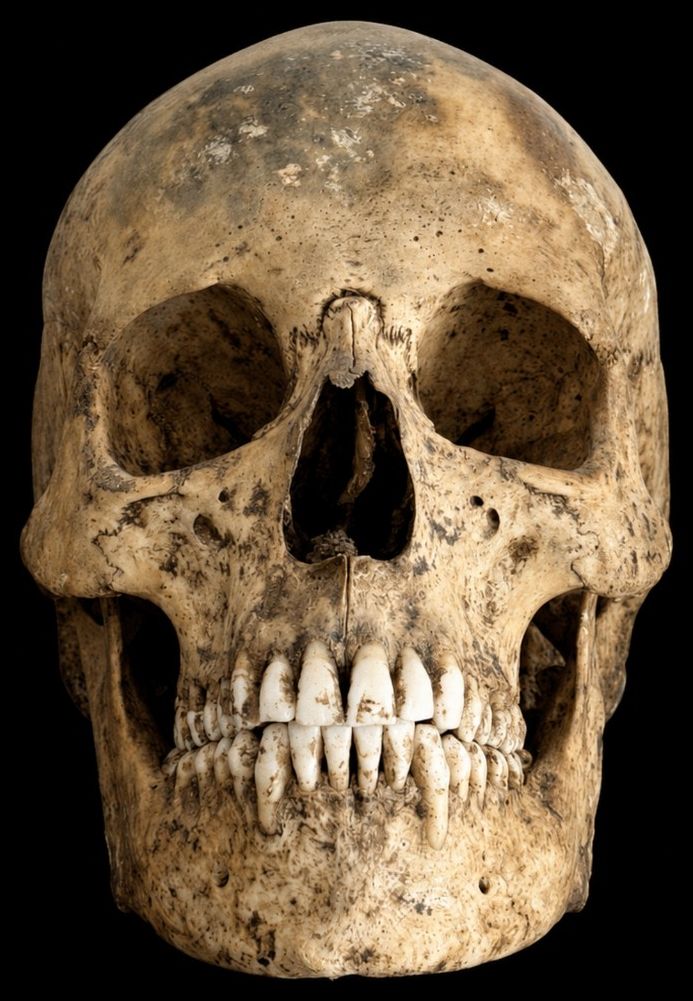
This human skull was recovered in the Volga region of Russia. Radiocarbon dating using 14C indicates an age of approximately 450 years. The precise calendar age depends on the calibrated probability range reported by the laboratory. In human remains from riverine environments, a possible freshwater reservoir effect must also be considered, depending on the individual’s diet.
What matters is that a laboratory result is not a date but a calibrated probability interval. The freshwater reservoir effect also has to be accounted for, and here too I was imprecise before: it does not hang on living beside a river but on the intake of old carbon through diet, meaning the share of freshwater fish and similar resources in the food supply, combined with local water chemistry. Someone who lived by a river and ate no fish is unaffected, someone who lived far away and sourced river fish may not be. The apparent ageing runs in documented cases from centuries into the range of several millennia.
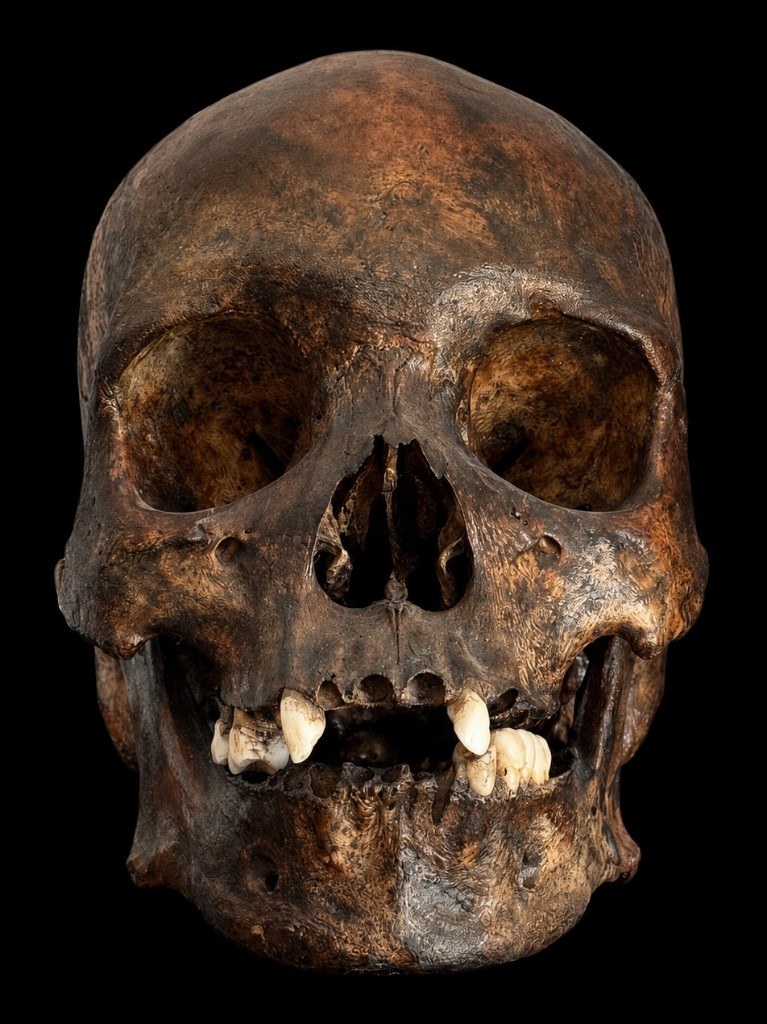
Radiocarbon dating using 14C places this human skull at approximately 2300 BC. It is therefore around 4,300 years old and dates to the late third millennium BC. The result does not represent an exact calendar year, but a calibrated archaeological date range. Its precise probability limits are recorded in the original laboratory report.
For an ordinary anatomical teaching skull, by contrast, I do not have dating done, and I am regularly asked why not. The answer is not a matter of convenience but of the question being asked. Dating is an instrument for one particular question, namely the approximate lifetime of the individual. If the open question is whether a piece is an old teaching specimen, the preparation features answer it faster, without destruction and without a laboratory invoice. If a forensically relevant postmortem interval is in play, dating is the instrument of choice, and then taking a sample is proportionate too.
That major collections do not routinely date their holdings does not, incidentally, prove that dating would be unnecessary for a single suspicious piece. It shows something else: the standard applied to the private individual is not applied elsewhere.
Though I have to admit that the reflex to demand a procedure reminds me of a certain kind of debate. When a question is uncomfortable, people call for a test, and when the test is expensive enough, the question takes care of itself. That works with skulls as reliably as it works anywhere else.
The Gerlach case, and why my name turned up in it
There is a point at which everything said so far comes to an end, and the case marking it ran through the international news at the start of this year.
Investigators in Pennsylvania arrested a 34-year-old man on the evening of January 6, 2026, as he was leaving Mount Moriah Cemetery. According to the authorities, human bones and skulls were visible in his vehicle, and a search of his home and a storage unit produced more than 100 skulls and sets of human remains. The district attorney of Delaware County, Tanner Rouse, described the scene by saying his detectives had walked into a horror movie. The indictment comprises around 500 individual counts, a figure that has shifted during the proceedings through added and dropped charges, and bail was set at 1 million dollars. The defendant waived the preliminary hearing in April 2026 and the formal arraignment in June, moving the case into its pre-trial stage. As of the editorial date I have no reliable information about the further course of the proceedings. The presumption of innocence applies, and everything stated here is allegation and not finding.
I was having breakfast when the report ran, holding a Leberkässemmel, and the roll landed on the plate because I recognized the face.
I had assessed a single skull for this man some time ago. The finding was a morphological trauma, meaning an alteration of the bone that can be described and classified by its form. He subsequently thanked me publicly on his Instagram profile. When his arrest went through the media, my name appeared in the search results by way of that thank you, and what followed were hundreds of inquiries from American newsrooms, angry emails, messages on social networks and the insinuation that I was part of an alleged skull mafia.
I am writing this down because otherwise somebody else will, and because the matter is exactly as simple as it sounds. An assessment of a single specimen says nothing about the origin of that specimen and nothing about the person who owns it. A thank you on somebody else’s profile is not a connection, not a contractual relationship and not complicity. Anyone moving in a field where nearly everyone knows everyone will sooner or later stand next to somebody who is later accused of serious offenses.
Professionally, one observation stayed with me that I consider the most important thing about this case. In the published images, a considerable portion of the seized pieces was recognizable to me as historical teaching material, with hand-guided saw cuts, with springs, with screws, with the varnishes of European workshops. Such pieces do not come out of a 19th-century American mausoleum, because nobody was interred there whose calvarium had been cut open and fitted with a hinge beforehand. That is my assessment based on image material and not an examination of the objects, and it does not replace a forensic triage.
That triage would be the point. With a holding drawn from several sources, origin must not be inferred from the place of discovery alone. Each piece has to be classified separately by its features, by any available documentation and, where it contributes something, by scientific examination. Whether the authorities are handling it that way in this case I do not know, because I have no access to the file. I only know what happens when it is not done.
Assigning the remains actually removed to individual deceased persons will be difficult, and that follows from the condition of the cemetery. Mount Moriah opened in 1855, covers around 160 acres and holds an estimated 150,000 grave sites according to the volunteer group maintaining the grounds. Regular operation ended years ago and the site is overgrown. That does not make the task hopeless, though, and here I correct a sentence from the previous version that was simply wrong and tactless toward the families. I had written that the descendants of those buried in the 19th century have long since died, and that sentence is nonsense. People interred 150 years ago have living descendants today, and in these proceedings such relatives appeared publicly and spoke about their broken open family vaults. Vault documentation, cemetery registers, coffin remains, nameplates, medical implants and genetic comparison with living descendants are methods that may assist identification.
Who should hold a skull, and who should not
That leaves the question criminal law does not answer, because it was never asked of it.
Anyone working professionally with human remains has an obvious interest in the real object. Plastic models are excellent today, but they show the ideal type and not the spectrum. The variation of the cranial sutures and the small anatomical oddities no textbook can depict, because a textbook has to generalize, exist only on the genuine specimen. That holds for physicians, anthropologists, anatomists, archaeologists and pathologists, and equally for serious private researchers.
At this point an argument applies that I consider the strongest in the entire debate. A medical student in the second semester holds a real skull in the teaching room, identifies insertion points of the masticatory muscles and measures cranial capacities, and nobody finds anything wrong with it. The same activity, the same object, the same care, the same expertise in the hands of a collector without a student ID suddenly becomes questionable. The line drawn here is not a line of knowledge and not one of respect. It runs along institutional affiliation, and I know collectors who ask me questions I do not get from students in their third semester.
And then there is the other side, where I have no tolerance. Anyone posting a human skull online as Halloween decoration with a candle on top has left the framework within which all of this can be justified. Whether such a staging is punishable under Section 168 depends on its specific presentation and on whether it qualifies as grossly disrespectful or degrading conduct. I offer no prediction on that, because I have none I could substantiate. Independently of the law, respect for the deceased does not lie in attaching mystical significance to the bone, it lies in the clean, careful, professional handling of what remains of a human being, and part of that is not turning him into a prop.
Incidentally, because I am asked this often and the question is meant more seriously than it sounds: no, no skull has ever spoken to me. Anyone working long enough with human remains does not lose the respect, he loses the mysticism, and that is a gain.
Anyone wanting to acquire something today should do 3 things. Document the acquisition cleanly, with date, seller, description and price. What those records achieve has to be judged correctly: they prove neither gapless provenance nor acquisition of ownership, because under Section 935 of the German Civil Code good-faith acquisition is generally excluded for stolen or otherwise lost property. An invoice does not turn stolen goods into property. What it documents are the circumstances of one’s own acquisition, and those are what matter when assessing whether someone knew of a tainted origin or thought it possible.
Second, prefer pieces with recognizable historical preparation features and avoid everything that looks fresh or carries modern dental work. And third, when in doubt, ask someone who can classify the piece before the purchase rather than paying a lawyer afterward.
When customs seizes a shipment, and what makes sense then
Most people reading this text are not asking the legal question out of academic interest. They are asking because an envelope was in the mailbox.
What typically happens follows a pattern. A shipment is opened on import, the contents are recognized as human remains, and from that moment the matter moves along a track for which no established route exists. Seizure follows, then a report, a file number and the request for a statement. At this interface I have seen a skull addressed to me passed on for species determination to the authority that otherwise rules on imported products from the animal kingdom, so that it could be clarified whether these might not be human bones after all. The finding came back as human, the fee came to around 100 euros, and I paid it too.
Anyone landing in such a situation should keep 3 things in mind, and none of them replaces legal advice.
First, do not give a spontaneous statement on the substance, but have access to the file requested first. Anyone explaining himself as a suspect before knowing what he is actually accused of is working against himself, here as in every other area of offenses.
Second, gather everything documenting the acquisition, meaning the invoice, the listing description, the correspondence, the payment record and the shipping documents. These papers do not prove provenance back into the 19th century, they document the circumstances of one’s own acquisition, and that is what matters when assessing whether someone knew of a tainted origin.
Third, a professional classification of the piece is often the faster route than a legal opinion. If the preparation features show that an object came from a historical workshop, one essential question is answered, though not every question. Such an assessment based on good photographs costs a fraction of what a running investigation generates in legal fees, and it takes days instead of months.
That leaves the question of what happens to the seized piece after discontinuation. The principle is that an item no longer needed goes back to whoever last held it, though procedural law knows exceptions, for instance where the claims of an injured party or a third party are obvious. Where release is refused solely because gapless proof of provenance is missing, however, that collides with the fact that such proof is equally absent for the vast majority of pieces in German university collections. What can actually be enforced in a specific case belongs in the hands of a lawyer.
Possession was never the crime
The young woman from the opening did not lose her case, because there was nothing to lose. It was discontinued because nothing could be derived from the statutory elements of the offense, which had been foreseeable on the very first day. What she did lose were months, money and the matter of course with which one previously considered oneself beyond reproach.
That is the actual finding of this text. Possession is not the problem, the gap is, the gap between what the law says and what becomes of it between the customs counter and the prosecutor’s office. A single phone call to someone who can classify such pieces would spare many a case that gets dropped anyway. That call costs nothing and still almost never happens.
To the officials reading this text, therefore, a request, and it is framed more narrowly than one would like. Examine first which specific act is supposed to fulfill which offense, rather than inferring a crime from the mere sight of a human bone. For Section 168 that means: was there an entitled person whose custody was broken, is there a connection to a specific burial, was there degrading conduct? If the answer to all three questions is no, Section 168 cannot support the charge.
That does not mean no avenue exists at all, since depending on the facts, property offenses, import and cultural property law or state-level provisions may come into play. It means only that in the cases I have accompanied involving historical teaching specimens, this provision did not support the facts, and that every hour flowing into such a case is missing from another in which somebody was actually harmed.
And to everyone else: the bone on the shelf is not the question. The question is how it got there, and whether one is prepared to answer that honestly. Only that answer determines whether one may keep it, and sometimes it says no.
Editorial note: This version replaces an earlier version of this article and has been corrected on several points of substance. These concern the account of radiocarbon dating, which had not distinguished between tooth enamel and bone collagen and had placed the onset of the rise from the nuclear tests too early, the treatment of receiving stolen goods, the handling of degrading use, which had been measured against Section 189 alone rather than against Section 168 first, the concept of custody, the American legal situation including the attribution to Tanya Marsh and the trafficking prohibition in 18 U.S.C. Section 1170, the scope of the EU import regulation, where origin and place of dispatch have to be kept apart, the significance of acquisition records in light of Section 935 of the German Civil Code, an incorrect statement about the descendants of those buried in the 19th century, and several figures without a reliable primary source. A section on import and cultural property law has been added. The editorial status of this version is July 2026.
References
- Alkass, K., Buchholz, B. A., Druid, H., and Spalding, K. L. (2011). Analysis of 14C and 13C in teeth provides precise birth dating and clues to geographical origin. Forensic Science International, 209(1-3), 34 to 41. https:/
/ doi. org/ 10. 1016/ j. forsciint. 2010. 12. 002 - Bavarian Burial Act, Article 10, periods of repose. Retrieved July 25, 2026, from https:/
/ www. gesetze- bayern. de/ Content/ Document/ BayBestG- 10 - British Museum. Human remains. Retrieved July 25, 2026, from https:/
/ www. britishmuseum. org/ our- work/ departments/ human- remains - Federal Court of Justice of Germany, Fifth Criminal Division. Decision of June 30, 2015, 5 StR 71/15, disturbing the peace of the dead, concept of ashes. Retrieved July 25, 2026, from https:/
/ www. hrr- strafrecht. de/ hrr/ 5/ 15/ 5- 71- 15. php - German Civil Code, Section 935, no good-faith acquisition of lost property. Retrieved July 25, 2026, from https:/
/ www. gesetze- im- internet. de/ bgb/ _ _ 935. html - Die Beauftragte der Bundesregierung für Kultur und Medien, the Federal Government Commissioner for Culture and the Media. EU import regulation, scope and procedure. Retrieved July 25, 2026, from https:/
/ www. kulturgutschutz- deutschland. de/ DE/ AllesZumKulturgutschutz/ Rechtsgrundlagen/ EURecht/ EinfuhrVO/ EinfuhrVO_ node. html - European Parliament and Council of the European Union. Regulation (EU) 2019/880 of April 17, 2019 on the introduction and the import of cultural goods. Official Journal L 151 of June 7, 2019, pp. 1 to 14. Retrieved July 25, 2026, from https:/
/ eur- lex. europa. eu/ legal- content/ DE/ ALL/ ? uri= CELEX:32019R0880 - Fratzl-Zelman, N. Bone mineralization and structure. International Society for Clinical Densitometry. Retrieved July 25, 2026, from https:/
/ theiscbh. org/ wp- content/ uploads/ 2023/ 07/ Bone- mineralization- and- structure. pdf - Generalzolldirektion, the German General Customs Directorate. Cultural goods from non EU countries, import license and importer declaration. Retrieved July 25, 2026, from https:/
/ www. zoll. de/ DE/ Fachthemen/ Verbote- Beschraenkungen/ Schutz- des- Kulturgutes/ Kulturgut- aus- Drittstaaten/ kulturgut- aus- drittstaaten_ node. html - Healy, J. (2026, April 17). Accused Pennsylvania grave robber waives hearing ahead of grisly summer trial. Courthouse News Service. Retrieved July 25, 2026, from https:/
/ www. courthousenews. com/ accused- pennsylvania- grave- robber- waives- hearing- ahead- of- grisly- summer- trial/ - State of Baden-Württemberg. Burial statute, § 6 period of repose. Retrieved July 25, 2026, from https:/
/ dejure. org/ gesetze/ BestattG/ 6. html - LancasterOnline (2026, June 3). Jonathan Gerlach waives formal arraignment in human remains thefts case. Retrieved July 25, 2026, from https:/
/ lancasteronline. com/ news/ local/ jonathan- gerlach- waives- formal- arraignment- in- human- remains- thefts- case/ article_ 94650bc3- cb70- 4b26- 8ecf- e6f09ad25573. html - Marsh, T. D. (2023). Is it legal to sell human remains? The Conversation. Retrieved July 25, 2026, from https:/
/ theconversation. com/ is- it- legal- to- sell- human- remains- 171192 - Minnesota Legislature. House File 3490, Session 2024, Sale of human remains. Retrieved July 25, 2026, from https:/
/ www. revisor. mn. gov/ bills/ 93/ 2024/ 0/ HF/ 3490/ versions/ 0/ - NBC10 Philadelphia (2026, April 17). Pennsylvania man accused of stealing skeletons from cemeteries waives preliminary hearing. Retrieved July 25, 2026, from https:/
/ www. nbcphiladelphia. com/ news/ local/ jonathan- gerlach- pennsylvania- stealing- skeletons- cemeteries- court/ 4387297/ - Smithsonian Institution. Reckoning with human remains in the Smithsonian collection. Retrieved July 25, 2026, from https:/
/ si. edu/ collections/ human- remains - Prussian Cultural Heritage Foundation (2023, January 18). Results of provenance research on skulls from German East Africa published. Retrieved July 25, 2026, from https:/
/ www. preussischer- kulturbesitz. de/ pressemitteilung/ artikel/ 2023/ 01/ 18/ ergebnisse- der- provenienzforschung- an- schaedeln- aus- deutsch- ostafrika- veroeffentlicht. html - Prussian Cultural Heritage Foundation (2026, April 22). Results of provenance research on skulls from West Africa published. Retrieved July 25, 2026, from https:/
/ www. preussischer- kulturbesitz. de/ pressemitteilung/ artikel/ 2026/ 04/ 22/ ergebnisse- der- provenienzforschung- an- schaedeln- aus- westafrika- veroeffentlicht- provenienzforschung- an- fast- 600- schaedeln- abgeschlossen. html - German Criminal Code, Section 168, Störung der Totenruhe, disturbance of the peace of the dead. Retrieved July 25, 2026, from https:/
/ www. gesetze- im- internet. de/ stgb/ _ _ 168. html - German Criminal Code, Section 189 disparagement of the memory of deceased persons and Section 194 criminal complaint. Retrieved July 25, 2026, from https:/
/ www. gesetze- im- internet. de/ stgb/ _ _ 194. html - German Criminal Code, Section 259 receiving stolen property. Retrieved July 25, 2026, from https:/
/ www. gesetze- im- internet. de/ stgb/ _ _ 259. html - Ubelaker, D. H., Plens, C. R., Soriano, E. P., Diniz, M. V., de Almeida Junior, E., Daruge Junior, E., Francesquini Junior, L., and Machado, C. E. P. (2022). Lag time of modern bomb-pulse radiocarbon in human bone tissues, new data from Brazil. Forensic Science International, 331, 111143. https:/
/ doi. org/ 10. 1016/ j. forsciint. 2021. 111143 - Ubelaker, D. H., Thomas, C., and Olson, J. E. (2015). The impact of age at death on the lag time of radiocarbon values in human bone. Forensic Science International, 251, 56 to 60. https:/
/ doi. org/ 10. 1016/ j. forsciint. 2015. 03. 024 - United States Code, Title 18, Section 1170, Illegal trafficking in Native American human remains and cultural items. Retrieved July 25, 2026, from https:/
/ www. law. cornell. edu/ uscode/ text/ 18/ 1170 - U.S. National Library of Medicine, NCBI Bookshelf. Historical overview of the amalgam debate, including Taveau in 1826 and the Crawcour brothers in 1833. Retrieved July 25, 2026, from https:/
/ www. ncbi. nlm. nih. gov/ books/ NBK531943/ - Yeadon Borough Police Department (2026). Announcement of the arrest of Jonathan Gerlach for Mount Moriah Cemetery grave burglaries. Retrieved July 25, 2026, from https:/
/ yeadonborough. com/ arrest- of- jonathan- gerlach- for- mount- moriah- cemetery- grave- burglaries/
How radiocarbon dating itself works, and why a C14 result is a probability distribution rather than a single year, is covered in What Is Radiocarbon Dating.
Disclaimer: This article reflects the author’s own research and opinion as of the publication date shown above; later findings or legal changes may have overtaken it, so always check that date. Sources are cited for independent verification, and no liability is accepted for third-party studies. This is general information, not medical, legal, or professional advice: for medical questions see a doctor, for legal questions a lawyer, and in an acute crisis contact emergency services or a crisis helpline.
About the header image: it is AI-generated. Cheaper than a photo shoot, and I have made my peace with the age of AI. Everything inside the article is real, the diagrams, the skulls, the findings, and every word. The machine gets the opening shot and not one inch past it.
What Is Radiocarbon Dating? Everything About the Method That Decides Between a Murder Case and an Archaeological Find
Radiocarbon dating measures remaining carbon-14 to determine when carbon exchange ended. This article explains the method from atmospheric…

The Science and Ethics of Age-Gap Attraction: Why Older Men Are Drawn to Younger Women, and Where the Line to Crime Runs
A forensic examiner lays out the evolutionary psychology and the data from 130 countries: the algorithm of age-gap…
The Pressure Fallacy: What Pink Teeth in the Dead Really Reveal, and What They Do Not
A forensic investigation through 200 years of literature, prompted by three cases, two of which I examined myself,…