When Teeth Speak
How Forensic Odontology Identifies the Dead, Vindicates the Innocent, and Archives 40,000 Years of Human History in a Single Molar
It was a winter morning, cold in the way that European forests are cold at that hour, when the layer of ground fog has not yet decided whether to lift or settle. The officer walking beside me said nothing, which I appreciated. I have always found that the people who fill silence with commentary at a scene like this are the people who have not yet understood that the scene has its own language, and that the first obligation is to listen. The smell reached me before the visual evidence did, because it always does: not the smell of rot exactly, though that was there, but the particular chemistry of organic matter returning to the earth in stages, layered with something cooler and more metallic that the nose registers before the mind has categorized it. The pile of disturbed leaves was recent enough to suggest intentionality. Under them, what remained of a person, no soft tissue to speak of, no clothing that had survived recognizably, no document, no ring, no reliable biological surface. The police had run the standard protocols and arrived at nothing. When I crouched down and looked at what was left, what I was looking at most carefully were the teeth.
There is a reason for this priority, and it is not preference or habit, though after decades of this work it has become both. The reason is biological: teeth are the hardest substance the human body produces, built from hydroxyapatite and enamel rods arranged in a crystalline matrix that resists fire, acid, mechanical stress, bacterial decomposition, and time at scales that no other body part can match. Bone eventually dissolves under the right soil conditions. Soft tissue is gone in weeks. Teeth can survive millennia in the ground, centuries in fire, and decades in water without losing the identifying characteristics that were laid down in the months and years when the person was alive. They are the body’s own testimony, given in advance, before any disaster, any crime, any question of identity had arisen. The forensic odontologist’s task is to read that testimony.
The Oldest Biometric System That No One Chose to Have
Each human dentition is the product of 3 overlapping processes, none of which the individual controls, and the intersection of which produces something unique to that individual with a specificity that approaches but does not quite reach the uniqueness of DNA. The genetic substrate determines the basic morphology of each tooth, including its size, cusp patterns, root architecture, and the tendency toward particular anomalies, such as fusion of teeth, supernumerary roots, or the characteristic three-rooted mandibular first molar that appears in some populations and virtually not at all in others. Superimposed on this genetic template is the environmental record: the wear patterns created by diet, the erosion caused by gastric acid or industrial exposure, the attrition that accumulates on the chewing surfaces of someone who habitually clenches their teeth at night, the staining that develops from decades of particular dietary or chemical exposure. Finally, and critically for forensic purposes, there is the treatment record: every filling placed by every dentist, every crown, bridge, implant, orthodontic device, extraction, and endodontic procedure, each of which reflects not only the patient’s dental history but the training background of the practitioner, the era in which the treatment was placed, and often the geographic region where it was performed. As Emam (2024, Role of Forensic Odontology in Identification of Persons, Cureus, 16(3), e56570) notes in a recent comprehensive review, no 2 oral cavities are identical, including those of identical twins, whose shared genome does not extend to identical dental wear, identical treatment histories, or identical environmental exposure.
This three-layer system creates what amounts to a passive biometric record. Unlike fingerprints, which require a deliberate act of registration to enter a database, or DNA, which must be collected and typed, the dental record is built continuously throughout life and exists whether or not anyone has chosen to document it. The forensic challenge is not creating the record, the body does that automatically, but finding the antemortem documentation that allows comparison. Where such documentation exists, dental identification is fast, reliable, cost-effective, and legally robust. Where it does not, the teeth fall silent in a functional rather than a literal sense, and the investigation must work harder.
Adolf Hitler’s Gold Bridges and the Soviet Jawbone Box
On the afternoon of May 8, 1945, a red box was delivered to a Soviet military field hospital outside Berlin. The box contained jawbone fragments and gold dental bridges recovered from the garden of the Reich Chancellery. A Soviet intelligence officer needed someone to tell him whose teeth these were. The witnesses produced were Käthe Heusermann, the long-serving dental assistant to Hitler’s personal dentist Hugo Blaschke, and Fritz Echtmann, the dental technician who had physically constructed the prosthetic work. Heusermann recognized the complex nine-unit gold bridge construction immediately. Echtmann confirmed it had come from his own hands. Both were then arrested by Soviet authorities and held for years, which is perhaps what a totalitarian state does when the witnesses to its most sensitive forensic finding threaten to say something inconvenient to a narrative (Sognnaes, R.F., & Strøm, F., 1973, The Odontological Identification of Adolf Hitler, Acta Odontologica Scandinavica, 31, 43-69).
The definitive scientific confirmation came much later. In 1973, forensic odontologist Reidar Sognnaes cross-referenced skull radiographs taken in 1944 following the assassination attempt on Hitler’s life against the surviving jaw fragments, finding correspondences in the specific construction of dental work visible in both sets of images that allowed only one conclusion. The case is frequently cited as an early landmark of forensic odontology, which it was, but what interests me more is what it reveals about the method’s core strength: in the complete absence of every other identification pathway, when the body had been burned, when no usable biometric surface remained, the dental work survived and retained enough individualizing information to produce a scientifically defensible identification. That is a remarkable characteristic of a tissue that most people regard primarily as a chewing instrument.
Thailand, December 2004, and the 80 Percent Number
The Indian Ocean earthquake of December 26, 2004 generated a tsunami that killed more than 200,000 people across 12 countries. In southern Thailand, 5,395 deaths were registered, and the forensic challenge was unlike anything the international disaster response community had previously attempted at that scale. The Thai Tsunami Victim Identification operation eventually assembled dental specialists from more than 20 countries, working under conditions that combined extreme physical difficulty, rapid decomposition, and the logistical complexity of managing antemortem records arriving in 30 languages from 30 national dental systems with no uniform documentation standard. The database ultimately contained records of 3,750 recovered bodies and 3,547 missing persons.
The headline statistic from this operation is one that every forensic odontologist knows and that most have cited at least once: approximately 80% of non-Thai victims were identified by dental evidence, making odontology the primary identification method for the European and Australasian tourists who constituted the largest group of foreign fatalities (Schuller-Götzburg, P., & Suchanek, J., 2007, Forensic Odontologists Successfully Identify Tsunami Victims in Phuket, Thailand, Forensic Science International, 171(2-3), 204-207). Among Thai nationals, the dental identification rate was approximately 2% (Petju, M., et al., 2007, Importance of Dental Records for Victim Identification Following the Indian Ocean Tsunami Disaster in Thailand, Public Health, 121(4), 251-257). The bodies themselves presented no meaningful difference in condition across these two groups. The difference was entirely a function of antemortem record availability. European healthcare systems had maintained detailed charts, periapical radiographs, and treatment histories. Thai dental practice, at that time, had not built the same infrastructure of systematic documentation.
I want to be precise about what this gap represents, because the obvious reading, that the Thais somehow failed at record-keeping in a way that Europeans did not, misses the structural point entirely. The question of whether a healthcare system maintains longitudinal dental records is a question of public health infrastructure, legal mandate, and funding priority, not a question of professional competence. Where no legal or regulatory framework requires that dental records be retained in a retrievable form, practitioners cannot be expected to incur the cost and liability of maintaining them indefinitely. The forensic consequence of this infrastructure gap was 73 Thai victims for whom the dental method produced no result, despite the method being otherwise perfectly functional. After the tsunami, Interpol re-evaluated its DVI guidelines in their entirety. The record-keeping disparity was not addressed by those guidelines, because that was not within their scope. It remains unaddressed in most of the jurisdictions that would benefit most from addressing it.
Flight MH17 and the 4,958 Fragments
July 17, 2014: Malaysian Airlines Flight 17, en route from Amsterdam to Kuala Lumpur, was struck by a surface-to-air missile over eastern Ukraine. All 298 people on board were killed. Because 193 passengers held Dutch nationality, the Netherlands Forensic Institute became the lead agency for a DVI operation of a scale and complexity that had not previously been assembled in Dutch forensic history. In the field near Hrabove, eastern Ukraine, investigators ultimately collected 4,958 separate biological fragments, most of which were heavily damaged, decomposed, and commingled in ways that made reassociation as technically demanding as identification itself (de Boer, H.H., et al., 2018, DNA Identification of Human Remains in Disaster Victim Identification, Forensic Science International, 289, 253-259). I was involved in aspects of the identification work during this operation, and I will describe the experience simply: what you confront in a field like that is not a disaster in the cinematic sense. It is an administrative and scientific problem of extraordinary scale, in which the dignity of the outcome depends entirely on the precision of the methodology.
DNA analysis was the primary identification method in MH17, given the degree of fragmentation and the time elapsed before Ukrainian authorities allowed international teams full access to the site. Dental comparison, fingerprints, and a digital fingerprint capture system that the Dutch National Police had developed specifically for DVI operations contributed alongside DNA to the final identifications. The Interpol classification system recognizes forensic odontology, fingerprints, and DNA as the 3 primary identification methods, meaning each is capable of producing a legally sufficient identification independently. In practice, the MH17 operation used all 3 in parallel, with each method serving as validation for the others where evidence quality allowed it. The result was one of the most complete identification outcomes ever achieved in a mass disaster of this magnitude. Families received answers. The dead were returned.
Titanium That Survives Everything, Including You
The global adoption of dental implants over the past 3 decades has introduced a forensic identifier that earlier practitioners could not have anticipated, and whose potential has not yet been fully institutionalized. A titanium implant osseointegrated into the mandibular bone of a living person is not merely a prosthetic device. It is, in forensic terms, a permanent marker with specific physical characteristics that distinguish it from other implants of different design, manufacture, and provenance. Importantly, titanium’s melting point is 1,668 degrees Celsius, which places it well above the temperatures reached in most domestic fires, aircraft disasters, and standard cremation procedures. Implants survive conditions that destroy everything else about a person, and they do so while retaining their identifying characteristics (Berketa, J., 2010, Survival of Batch Numbers Within Dental Implants Following Incineration as an Aid to Identification, Journal of Forensic Odontostomatology, 28(1), 1-4).
The forensic significance of this thermal resistance would be limited if implants were entirely uniform, but they are not. Manufacturers produce implants in distinct designs with characteristic thread patterns, surface textures, connection types, and dimensions that can be matched to product lines using radiographic comparison or direct visual examination. More specifically, the Straumann company, one of the largest implant manufacturers globally, headquartered in Basel, has laser-etched batch numbers into the internal chamber of their implants, a practice that allows the implant to be traced from the manufacturing lot to the distributing dental supply company to the specific practice that ordered that batch. In a 2013 homicide investigation in Japan, a titanium implant recovered from a jawbone fragment found in a sewage tank, where a perpetrator had attempted to dissolve and dispose of a dismembered body, carried a lot number that allowed investigators to trace the victim’s identity through the implant chain in a case that would otherwise have had no starting point. The FDI World Dental Federation has formally recommended that all implant manufacturers incorporate traceable elements into their products. The recommendation is not yet universally implemented. The forensic argument for it, however, becomes harder to dismiss each year as implant prevalence continues to increase and the cases in which they serve as the sole surviving identifier accumulate.
In my own practice, I have twice solved identification problems through the implant manufacturer’s records, once when the treating dentist had emigrated and destroyed their practice files, and once when the victim’s family had no knowledge that an implant had ever been placed. The implant remembered, even when everyone who knew about it had forgotten.
The Bite That Sent the Wrong Man to Prison
Ted Bundy was convicted of murder in 1978 partly through bite mark evidence found on a victim. The case is cited constantly in forensic odontology literature, and the citation has for too long been accompanied by a tone of triumph that the subsequent history of bite mark analysis does not fully support. In 2009, the National Academy of Sciences released what remains the most authoritative assessment of forensic science disciplines in American legal practice: a comprehensive report that found bite mark analysis to be a field whose “scientific bases… have not been adequately studied,” whose error rates are essentially unknown, and whose foundational assumptions had not been validated to the standard applicable to other forensic testimony (National Academy of Sciences, 2009, Strengthening Forensic Science in the United States: A Path Forward, National Academies Press). The Texas Forensic Science Commission reached comparable conclusions in 2016. A 2022 interagency report from the National Institute of Standards and Technology confirmed that the core premise, that the uniqueness of human dentition transfers to human skin with sufficient fidelity and reproducibility for individual identification, has not been scientifically established (NIST Interagency Report 8352, 2022).
These are not marginal critiques from advocacy organizations. They are findings from the most credible scientific and governmental review bodies in the largest forensic science market in the world. The Innocence Project has documented multiple cases in which bite mark analysis contributed to a conviction that DNA evidence later overturned, meaning that a living person served years or decades in prison because a practitioner overclaimed what the teeth at a crime scene could actually tell a court.
I want to be careful here, because I am not arguing that bite mark evidence is worthless in every conceivable application. The detection that a patterned injury is a bite mark, as opposed to some other wound type, is legitimate and important. The documentation of such an injury for subsequent review by multiple examiners is legitimate and important. What is not legitimate, in 2024, is presenting bite mark analysis to a jury as reliable individual identification evidence, meaning “this specific person and no other made this mark”, without disclosing that this claim has not survived rigorous scientific evaluation. Bite mark analysis occupies a position in forensic odontology analogous to certain handwriting comparison methods in document examination: a long tradition, a plausible intuitive basis, and a scientific foundation that has not held up to systematic scrutiny. A discipline serious about its own integrity distinguishes between what its methods can establish and what they cannot, regardless of how long practitioners have been claiming otherwise.
What a Neanderthal from Belgium Had for Dinner 40,000 Years Ago
In 2017, Laura Weyrich and a multinational team published an analysis of ancient DNA extracted from calcified dental plaque recovered from 5 Neanderthal specimens drawn from archaeological sites across Europe. The study appeared in Nature, and its findings redirected several long-running debates about Neanderthal behavior, diet, and social complexity simultaneously (Weyrich, L.S., et al., 2017, Neanderthal Behaviour, Diet, and Disease Inferred from Ancient DNA in Dental Calculus, Nature, 544, 357-361). The Neanderthal from Spy Cave in Belgium had consumed woolly rhinoceros and mouflon sheep, consistent with a steppe-adapted diet and a heavily carnivorous ecology. The Neanderthal from El Sidrón in Spain showed no meat in the calculus at all; pine nuts, mushrooms, and moss composed the identifiable dietary fraction, consistent with forest gathering in a different environment. One Spanish individual carried dental calculus containing poplar-derived compounds, a tree whose bark produces salicylate, the natural precursor to aspirin, alongside evidence of a chronic dental abscess. The simplest inference is that this individual had located and used a plant with analgesic properties to manage dental pain, roughly 48,000 years before anyone invented the pharmaceutical industry or the prescription pad.
Dental calculus is a mineralizing biological matrix that forms continuously on tooth surfaces and traps organic material, microbial DNA, and environmental particles in a form that resists degradation over geological timescales. For archaeologists and paleoanthropologists, it is an archive of extraordinary density and specificity. Every meal leaves traces. Every illness leaves traces. Every interaction between species, including the microbes shared between Neanderthals and anatomically modern humans during their periods of contact, can potentially be recovered from a fragment of preserved calculus smaller than a grain of rice. The field of ancient dental calculus analysis is only beginning to reveal what that archive contains, and what it will eventually tell us about how our ancestors, and our nearest extinct relatives, actually lived, as opposed to how we have been guessing they lived for most of the history of the discipline.
The Limits Nobody Leads With at Conferences
Forensic odontology, like any identification discipline, has failure modes that are structural rather than methodological. The method requires an antemortem dental record for comparison. Where no such record exists, the method cannot produce a positive identification, regardless of how perfectly preserved the postmortem teeth may be. The Thailand tsunami data illustrated this with unusual statistical clarity: the populations with complete dental records were identified at high rates; the populations without them were not (Petju et al., 2007). The same structural constraint applies to routine criminal casework. A decomposed unidentified body in a jurisdiction with no dental record infrastructure presents an identification problem that the teeth themselves cannot solve, however distinctive their restorations might be. The evidence exists at the postmortem end; the comparative baseline does not.
There is a second category of limitation that receives even less attention, which is the condition of the remains themselves. Teeth resist fire and water at remarkable temperatures and durations, but they are not indestructible. Above approximately 600 to 800 degrees Celsius, sustained for extended periods, enamel begins to crack and sinter, and the identifying microstructure degrades. In aircraft accidents with severe post-impact fires, in deliberate incendiary disposal of bodies, and in industrial fire scenarios, dental evidence may be partial, fragmentary, or absent. The forensic odontologist’s job in these cases is to recover and document whatever survives, to record what cannot be determined as precisely as what can, and to resist the pressure, which exists in every high-profile investigation, to be more certain in testimony than the evidence actually supports.
A Warning Before the Final Word
The part of this text that will make some practitioners uncomfortable is the section on bite mark analysis, not because the critique is scientifically controversial, it is not, but because forensic odontology has historically packaged bite mark analysis and dental identification as components of a single, coherent discipline whose credibility is shared across both applications. This packaging has consequences. When courts and journalists conclude that bite mark analysis lacks scientific foundation, some of that skepticism transfers to forensic odontology as a whole, including its well-validated and legally indispensable components. This is an unfair consequence, but it is a predictable one, and the discipline has the ability to prevent it by drawing the distinction clearly and consistently.
I have spent enough time in courtrooms to know what happens when a witness claims more certainty than the underlying method warrants. The opposing expert, if competent, destroys the testimony. The jury, if attentive, destroys the conviction. The profession, if honest, eventually destroys the practice. Forensic odontology is a field that has too much legitimate, well-documented scientific value to allow one contested application to define its reputation in public discourse. The sooner the field resolves this internally, the better its standing will be externally, and the more effectively it will serve the courts and the families that depend on it.
The Skull on the Antique Dealer’s Shelf
When real human skull legal appears at customs, or turns up in an antique dealer’s inventory, or surfaces in an online marketplace alongside Meissen porcelain and baroque frames, the first legal question is whether it constitutes an archaeological find, interesting, scientifically valuable, legally complex but manageable, or a forensically relevant object connected to a recent crime. The legal consequences of these 2 designations are entirely different, and the turnaround time on that determination matters to investigators and prosecutors. Teeth are the fastest route to an initial assessment.
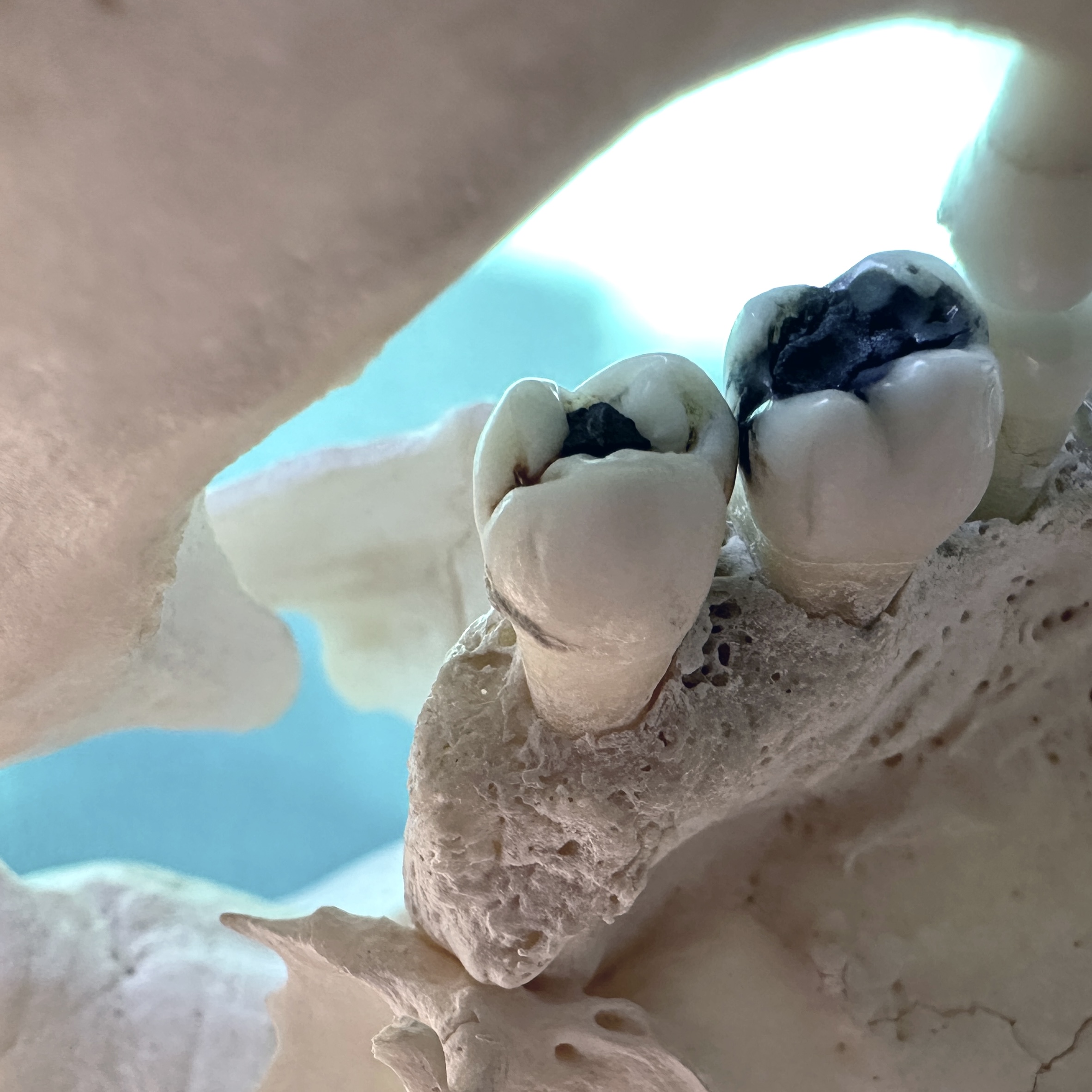
The presence of amalgam fillings places a definitive lower bound on the date of manufacture: amalgam entered Western dental practice in the 1830s, reached widespread use by mid-century, and was described by the first published reports on restorative materials from the 1840s onward. A mandible with an intact amalgam restoration cannot predate this window. A jaw carrying a titanium implant belongs to the late 20th century at the earliest, since osseointegrated implants did not reach clinical practice until the work of Brånemark in the 1970s and mass adoption in the 1980s. Porcelain-fused-to-metal restorations, resin composites, and the full spectrum of modern restorative materials each carry their own temporal signature, legible to anyone who knows what to look for. On the other end of the timeline, heavy occlusal attrition consistent with fibrous plant material, the absence of any restorative work, and enamel surface characteristics consistent with a pre-modern diet place a skull in a different century entirely. These assessments can be made at the scene, without a laboratory, in the first hour of contact with the material. When we confirm the impression with radiocarbon dating, the result is almost always consistent with what the teeth already said.
That is what I mean when I say that teeth speak. They speak about identity, about time, about diet, disease, geography, and behavior. They speak about the choices other people made on behalf of the person who owned them, the dentist’s technique, the material available in a given era and country, the quality of the healthcare system that shaped the treatment history. And they continue speaking long after every other biological record has dissolved. The obligation of the examiner is to listen accurately, report honestly, and resist the temptation, present in every contested case, to hear more than the evidence is actually saying.
References
- Berketa, J. (2010). Survival of batch numbers within dental implants following incineration as an aid to identification. Journal of Forensic Odontostomatology, 28(1), 1-4. https://pubmed.ncbi.nlm.nih.gov/21239857/
- Coble, M.D., Loreille, O.M., Wadhams, M.J., Edson, S.M., Maynard, K., Meyer, C.E., Niederstätter, H., Berger, C., Berger, B., Falsetti, A.B., Gill, P., Parson, W., & Finelli, L.N. (2009). Mystery solved: The identification of the two missing Romanov children using DNA analysis. PLOS ONE, 4(3), e4838. https://doi.org/10.1371/journal.pone.0004838
- de Boer, H.H., Blau, S., Delabarde, T., & Knoblauch, L.M. (2018). DNA identification of human remains in disaster victim identification: An efficient sampling method for muscle, bone, bone marrow and teeth. Forensic Science International, 289, 253-259. https://doi.org/10.1016/j.forsciint.2018.05.044
- Emam, A.N.M. (2024). Role of forensic odontology in identification of persons: A review article. Cureus, 16(3), e56570. https://doi.org/10.7759/cureus.56570
- National Academy of Sciences. (2009). Strengthening forensic science in the United States: A path forward. National Academies Press. https://doi.org/10.17226/12589
- National Institute of Standards and Technology. (2022). Summary of published criticisms of bite mark analysis (NIST IR 8352 Supplement 3). U.S. Department of Commerce.
- Petju, M., Suteerayongprasert, A., Thongpud, R., & Hassiri, K. (2007). Importance of dental records for victim identification following the Indian Ocean tsunami disaster in Thailand. Public Health, 121(4), 251-257. https://doi.org/10.1016/j.puhe.2006.10.018
- Schuller-Götzburg, P., & Suchanek, J. (2007). Forensic odontologists successfully identify tsunami victims in Phuket, Thailand. Forensic Science International, 171(2-3), 204-207. https://doi.org/10.1016/j.forsciint.2006.08.013
- Sognnaes, R.F., & Strøm, F. (1973). The odontological identification of Adolf Hitler: Definitive documentation by X-rays, interrogations and autopsy findings. Acta Odontologica Scandinavica, 31(1-2), 43-69. https://doi.org/10.3109/00016357309002803
- Weyrich, L.S., Duchene, S., Soubrier, J., Arriola, L., Llamas, B., Breen, J., Morris, A.G., Alt, K.W., David, D., Doronicheva, E., Han, Y., Rougier, H., Crevecoeur, I., Posth, C., Krause, J., Lindahl, A., Dobney, K., Mackie, M., Scheu, A., … Cooper, A. (2017). Neanderthal behaviour, diet, and disease inferred from ancient DNA in dental calculus. Nature, 544, 357-361. https://doi.org/10.1038/nature21674
Disclaimer: This article reflects the author’s own research and opinion as of the publication date shown above; later findings or legal changes may have overtaken it, so always check that date. Sources are cited for independent verification, and no liability is accepted for third-party studies. This is general information, not medical, legal, or professional advice: for medical questions see a doctor, for legal questions a lawyer, and in an acute crisis contact emergency services or a crisis helpline.
About the header image: it is AI-generated. Cheaper than a photo shoot, and I have made my peace with the age of AI. Everything inside the article is real, the diagrams, the skulls, the findings, and every word. The machine gets the opening shot and not one inch past it.
What Is Radiocarbon Dating? Everything About the Method That Decides Between a Murder Case and an Archaeological Find
Radiocarbon dating measures remaining carbon-14 to determine when carbon exchange ended. This article explains the method from atmospheric…
Is It Legal to Own a Real Human Skull? Yes, Subject to 3 Conditions
Private possession of a real human skull is not prohibited in Germany. Three conditions decide the question, and…

The Science and Ethics of Age-Gap Attraction: Why Older Men Are Drawn to Younger Women, and Where the Line to Crime Runs
A forensic examiner lays out the evolutionary psychology and the data from 130 countries: the algorithm of age-gap…