Thank You, Adobe, for the Price Increase
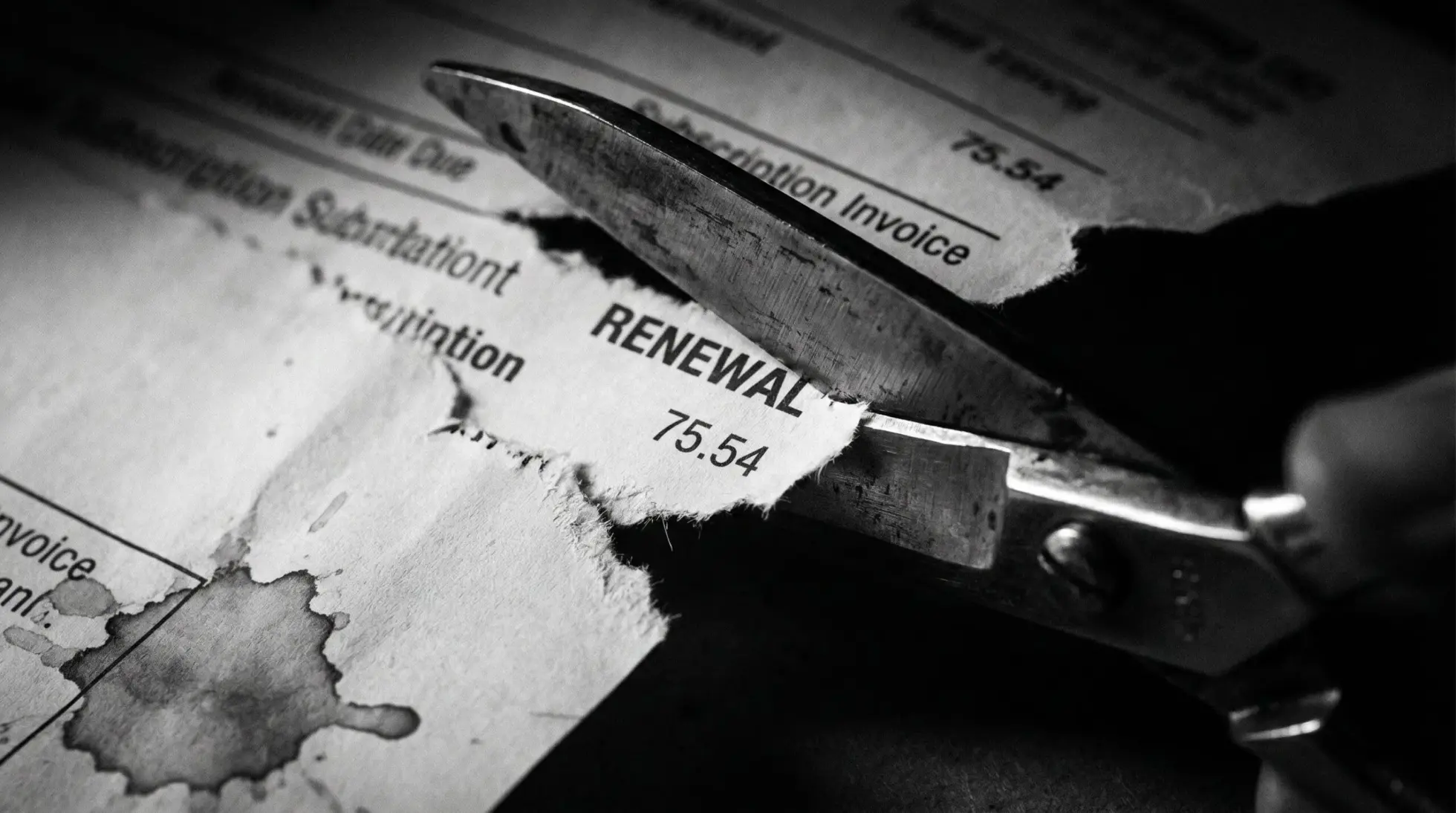
How a corporate notification on a Friday morning, a routine cup of coffee, and the discovery of a quarter-century of accumulated Adobe residue on my MacBook led to the most satisfying account closure of the year
The notification arrived on a Friday morning in May. I had just sat down with the first coffee of the day, the inbox was the usual mixture of newsletter remnants, the polite request from a vendor I had never evaluated, and the automated reports nobody had asked for. Among them was a message from Adobe with the polished tone of a company that has been writing this kind of letter for many years and has learned to dress it convincingly. The renewal of my Creative Cloud Pro with 2TB plan, currently still labelled Creative Cloud All Apps with 2TB, would proceed automatically on June 14, 2026, at the new price of €75.54 per month including VAT (Adobe email notification, May 2026). The exact amount was printed in the kind of bold that reads as inevitability. The next renewal date was printed underneath as a calm fact. I read the sentence twice, set the coffee down, and recognized the moment for what it was.
I had been an Adobe customer for over 25 years, going back to a time when Photoshop 1.0 (released February 19, 1990) and Acrobat 1.0 (released June 15, 1993) defined the categories they continue to dominate today (firstversions.com, 2015; Mapsoft, 2026). The Creative Cloud subscription specifically had been running for roughly 10 years, a quiet and unremarkable arrangement that exited my bank account every month with the unobtrusive confidence that only recurring charges manage. Approximately €63 per month, every month, in exchange for access to Audition, Acrobat Pro, Photoshop, and Lightroom. The arrangement had long since passed the stage of active endorsement and settled into the particular kind of institutional inertia that most professionals develop toward services they once consciously chose and have since stopped consciously evaluating. You pay, the applications open, and you do not think further about the relationship until one party announces that the terms are changing. Adobe announced that the terms were changing. The Creative Cloud All Apps plan would be renamed Creative Cloud Pro effective at the next renewal cycle, and the new monthly cost of €75.54 represented an increase of roughly €12.54 per month against my personal baseline (Adobe email notification, May 2026).
Calculated against Adobe’s officially published German list price of approximately €66.45 per month for the previous tier, the increase amounts to approximately 13 to 14 percent (DOCMA, 2025). Calculated against my personal legacy rate of approximately €63 per month, accumulated through several years of account continuity at a tier Adobe had been quietly dismantling since 2022, the relative increase comes closer to 20 percent. Over a full year, the difference works out to approximately €150 of additional expense for a product I had been using less attentively each year, and over a decade, the cumulative figure Adobe had already collected from my account sat somewhere in the range of €7,500. Across the full 25 years of perpetual licenses and subscriptions combined, the number sits comfortably in five digits, which is the kind of figure that changes character considerably when stated as a lump sum rather than absorbed as an invisible monthly deduction into the background of professional operating costs.
I closed the email, finished the coffee, looked at Bandit who had briefly assessed the situation from his position under the desk and concluded no action was required on his part, and began composing the cancellation.
What Adobe Has Always Actually Been Selling
Understanding why the morning was satisfying rather than distressing requires understanding what Adobe has been selling for the past decade. The answer is not software in the sense that software was once understood by people who bought it, owned it, and used it until either the hardware or their needs moved on. In 2013, Adobe completed its transition from perpetual software licenses to a pure cloud subscription model, ending the era in which a designer could purchase Creative Suite, install it on a workstation, and use it for as long as that machine and that version of the software remained compatible with each other (Wingfield, 2013). A perpetual license created ownership in the ordinary legal sense, while a Creative Cloud subscription creates access, which is a different arrangement in legal terms and in practical ones. The practical difference becomes visible most acutely at the moment when you decide to stop paying. The moment you stop paying for Creative Cloud, the applications stop functioning, and the files you have accumulated across years of work remain on your hard drive in proprietary formats you cannot open without either reactivating the subscription or locating a compatible alternative.
This model is not inherently dishonest, but it creates a structural dynamic that deserves precise naming. A Lightroom catalog containing a decade of developed images, a Photoshop file with non-standard fonts, layer structures, and adjustment settings, an InDesign document with linked assets and embedded objects: these are not neutral containers in the way a plain TIFF or a PDF is a neutral container. They represent accumulated technical investment in a specific software ecosystem, and that investment grows with every year of continued use. Adobe understood this dynamic with clarity in 2013, because the subscription model does not simply generate recurring revenue in the way that perpetual license sales generate revenue. It generates what economists describe as switching costs, and switching costs, once sufficiently large, give the party holding the platform a structural pricing advantage that operates independently of whether the software is good or bad, improving or stagnating, fairly priced or not.
Adobe’s public language for these adjustments has consistently involved the word innovation. Each price increase arrives accompanied by a list of new features that provide the official justification for the higher amount, and the 2026 increase arrived accompanied by Firefly, Adobe’s proprietary generative AI platform for image synthesis, object removal, and what the company markets as generative fill. The notification email also announced a new lower-tier plan called Creative Cloud Standard, which the message describes as offering the popular desktop applications and services but excluding the premium functions in web applications and mobile apps, along with restricted access to generative AI features. The Standard plan exists, in commercial terms, as a release valve for subscribers who can no longer justify the Pro pricing, calibrated to retain customers at a lower per-seat revenue rather than lose them entirely to competitors.
The Department of Justice Took an Interest
Before I describe what I personally found when I uninstalled Adobe’s software from my MacBook, it is worth spending a moment on what the United States Department of Justice found when its investigators looked at how Adobe manages subscription enrollment and cancellation. The DOJ, acting in coordination with the Federal Trade Commission, filed a civil complaint against Adobe, Inc. in June 2024, alleging violations of the Restore Online Shoppers’ Confidence Act (DOJ, 2024). That statute, abbreviated ROSCA, requires companies offering online subscriptions to disclose key terms clearly before charging customers and to provide straightforward cancellation options.
The complaint centered on Adobe’s Annual, Paid Monthly subscription plan. During enrollment, Adobe pre-selected this plan as the default option and displayed the monthly cost prominently. What the company did not display prominently was the early termination fee: 50 percent of all remaining monthly payments if the subscriber canceled within the first 12 months of an annual commitment. That figure was buried in fine print, placed behind small icons or inconspicuous hyperlinks, or disclosed only during the cancellation process itself, after the customer had already committed (DOJ, 2024; CineD, 2026). The cancellation process itself was, according to the complaint, designed with unnecessary steps, delays, unsolicited retention offers, and warnings designed to discourage completion. When customers called to cancel by phone, the FTC alleged, they encountered resistance and delay from Adobe representatives trained in retention techniques (DOJ, 2024).
Adobe finalized a settlement with the Department of Justice in March 2026. The terms required Adobe to pay $75 million in civil penalties and to provide $75 million worth of free services to qualifying customers, for a total settlement value of $150 million (DOJ, 2026; CineD, 2026). Adobe denied wrongdoing in a statement accompanying the settlement announcement. The company’s annual revenue for fiscal year 2025 was approximately $18.5 billion, of which 95 percent derived from subscriptions, according to figures cited at the time of the original complaint (LiveNOW, 2025). The $150 million settlement represents roughly 0.8 percent of a single year’s revenue. As a forensic practitioner who has spent decades evaluating the reliability of corporate statements made under pressure, I find the regulatory record speaks for itself, and the timing of the simplified European cancellation flow relative to the settlement is a coincidence I will note here without pursuing further.
Your Right to Leave: §314 BGB and the Sonderkündigungsrecht
What the DOJ addressed for American consumers, German contract law has long provided for German ones, through a mechanism that every subscriber should understand before the next price increase email arrives. Under §314 of the Bürgerliches Gesetzbuch, a party to a continuing contractual obligation may terminate the agreement extraordinarily, meaning without observing ordinary notice periods, when a material reason exists that makes continuation of the contract unreasonable (BGB §314). A unilateral price increase by the provider constitutes precisely such a material reason when the increase is spürbar, meaning perceptible and significant (Ra-Kotz, 2024; IT-Recht Kanzlei, 2023).
Legal practice and established case law have settled on approximately 5 percent as the orientation threshold. An increase below that level may or may not trigger the extraordinary termination right depending on the specifics; an increase above it generally does, regardless of whether a minimum contract period is still running, and regardless of the reason the provider gives for the increase (IT-Recht Kanzlei, 2023). Adobe’s officially published increase exceeds this threshold by more than double, and the increase against legacy customer rates exceeds it by a wider margin still. The Sonderkündigungsrecht, as this right is called in German legal practice, activates from the moment the price increase is announced. The termination takes effect at the point when the new price would otherwise first apply, with no financial penalty and no ordinary notice period required (DAHAG, 2025; Hopkins Law, 2026). Legal sources commonly cite approximately one month after notification as the reasonable outer limit for declaring the cancellation.
Adobe’s own notification email, in its version compliant with European consumer law, informs recipients that they may cancel through their Adobe account or through customer support at any time, and includes the renewal date and new price as required disclosures. The acknowledgment is not optional corporate communication strategy. It is the mandated recognition of a legal right that Adobe is required to communicate because the European consumer protection framework leaves no room for omission. When a company with Adobe’s legal resources tells you in writing that you may leave, it is not being generous. It is following the law because the law does not permit omitting this information.
The Uninstallation, or: 25 Years of Adobe Residue on a Single MacBook
Uninstalling Adobe software from a Mac is an experience worth describing in detail, because it is genuinely informative about how Adobe conceives of the relationship between its software and the system that hosts it. Adobe’s Creative Cloud suite does not install applications in the ordinary sense of the word. Adobe installs an ecosystem, and that ecosystem extends considerably beyond the applications visible in the Applications folder.
When I ran the Creative Cloud uninstaller and Adobe’s own Creative Cloud Cleaner Tool, and then conducted a manual audit of the filesystem, the residue I found was remarkable. The cache directories alone, where Adobe applications had been storing thumbnail data, font information, color profile metadata, and synchronization markers for years, occupied substantially more space than I had expected. Across the system Library and the user Library, the directories prefixed with com.adobe or containing the word Adobe in their name spanned background daemons configured to launch at system boot, browser extensions that had quietly attached themselves to Safari and Chrome, font caches, Adobe CEP infrastructure files for the Common Extensibility Platform, system library components in locations that the standard uninstall process explicitly does not remove, and preference files distributed across the user Library, the system Library, the Application Support folders, and the Caches folders. The complete cleanup required 60 minutes of focused Terminal work on the MacBook, without any third-party cleanup software, working systematically through path categories that Adobe’s own uninstaller and Cleaner Tool had not touched, and ending with a system restart to confirm that no background processes had survived.
What made the experience genuinely unpleasant, rather than merely tedious, was the sheer ubiquity of the word Adobe across the filesystem. Even after running the official Cleaner Tool, every directory I inspected contained another entry I had not yet seen. Every cache folder, every preferences file, every library directory contained the company name embedded in identifiers, configuration keys, and file paths I had no recollection of ever creating. There is a particular sensation that accompanies the discovery that a vendor whose software you thought you owned has, over the course of 25 years and through dozens of update cycles, distributed its name through every quiet corner of your operating system in ways that the standard removal process does not address. The polite term for that sensation is irritation. The more accurate term, which I will use because this is an honest essay, is that I found it deeply repugnant.
This is not a technical complaint without further relevance. A subscription service that makes entering easy and exiting difficult, that buries termination costs in fine print, that designs cancellation flows with unnecessary friction, that distributes system-level components that outlast the subscription itself, is a service that has applied design intelligence consistently toward the goal of retention rather than satisfaction. The DOJ found this pattern in Adobe’s financial architecture. I found the software equivalent on my own filesystem. The two observations are different expressions of the same corporate operating principle, and the principle is straightforward: once you are inside, you should have to expend considerable effort to be all the way outside again.
What I Use Instead, and What It Costs
The four applications I actually needed Adobe for were Audition, Acrobat Pro, Photoshop, and Lightroom. I will take them in ascending order of interesting.
Adobe Audition handled audio editing for recordings and forensic audio analysis. The replacement I settled on is a combination of Audacity for rapid editing tasks and Logic Pro for anything requiring more precise multitrack work. Audacity is open source and costs nothing; it has been performing the core functions of audio editing since the year 2000, and its interface has not changed dramatically in that time, which is either a limitation or a guarantee of predictability depending on your perspective (TechRadar, 2025). Logic Pro is a one-time purchase at €229.99 from the Mac App Store, runs natively on Apple Silicon, and covers everything Audition covered while adding capabilities Audition never offered, including a professional instrument library and a digital audio workstation architecture engineered specifically for Apple hardware. For anyone whose audio work does not require this level of multitrack complexity, GarageBand ships on every Mac for free and handles the substantial majority of everyday recording and editing tasks without requiring a subscription or interaction with a company currently settling federal consumer protection litigation.
Adobe Acrobat Pro was not difficult to replace. PDF Expert from Readdle, according to the company’s official pricing page consulted in May 2026, costs $79.99 per year for an annual subscription covering Mac, iPhone, and iPad under a single account, or $139.99 for a one-time lifetime license for the Mac version (Readdle, 2026). The annual subscription includes the PDF Copilot AI assistant for document interaction, OCR, translation, professional annotation, and the full editing toolkit. The lifetime license covers the Mac application with major updates and ongoing support, though some future features may carry additional cost. The interface is clean in a way that Acrobat’s interface, accumulated across more than 30 years of feature additions, decidedly is not. The application opens large PDF documents in roughly 1.5 seconds against Acrobat’s roughly 10 seconds in comparative tests on the same hardware (Readdle, 2026). For annotation, signature management, form completion, page manipulation, OCR, and the bulk of professional PDF work, PDF Expert covers the ground completely. It does this without requiring a cloud subscription, without monthly payment to a company currently settling a $150 million federal consumer protection case, and without installing daemons in system directories that require dedicated removal procedures.
Photoshop and Lightroom are where the discussion becomes genuinely interesting, because the primary argument Adobe presents for the 2026 price increase is that its generative AI features, Firefly, Generative Fill, Generative Expand, AI-assisted masking, and the rest, justify the premium over what competitors offer. This argument has a logical problem that becomes visible the moment you examine what is available elsewhere.
Nano Banana Pro, which is Google DeepMind’s Gemini 3 Pro Image model released on November 20, 2025, is accessible through the Together AI API at $0.134 per generated image with no monthly minimum, no annual commitment, and no early termination fee (Together AI, 2026). The model accepts up to 14 reference images simultaneously, maintains identity consistency for up to 5 distinct people across complex scenes, generates at 2K and 4K resolution with professional cinematic controls including lighting configuration, depth of field specification, and camera angle adjustment, and renders legible text in multiple languages within generated images, a capability that has historically been a significant weakness of AI image generators. All images generated with Nano Banana Pro carry Google DeepMind’s SynthID invisible cryptographic watermark, providing AI attribution transparency that Adobe’s own Firefly system does not embed by default for all output types.
The pricing contrast reads sharply when laid out in plain numbers side by side. An annual Adobe Creative Cloud Pro subscription in Germany at the new €75.54 monthly rate costs approximately €906 per year. Nano Banana Pro on the Together AI API costs $0.134 per inference call. A professional generating 100 images per month through the API spends $13.40, against €906 per year, or €75.54 per month, for the Adobe subscription. The cost per generated image through the API is several orders of magnitude below what the Adobe subscription amortizes to on a per-image basis, without any monthly minimum, annual commitment, or early termination fee. For raw photo processing and color work, Pixelmator Pro and Affinity Photo both offer one-time purchase pricing and handle the Lightroom Classic workflows I had relied on, without requiring cloud connectivity to validate a license every time a file is opened.
A Direct Response to Adobe’s AI Argument
There is one argument left for the 2026 price structure that I should take on directly, since a clear answer is more useful than waving it away. Adobe Firefly is, judged by its own standards, not a bad system. It has a genuine commercial advantage: the training data consists of licensed Adobe Stock content, which means that images generated with Firefly carry substantially reduced copyright liability for commercial use compared to models trained on scraped web content (Adobe, 2026). For advertising agencies, marketing departments, and anyone producing assets for commercial licensing at scale, this is a real and meaningful differentiator. I am not in the business of dismissing it.
The relevant question is whether this advantage justifies €906 per year for someone who does not need the commercial licensing clarity Firefly provides, who uses image generation and editing for research documentation, forensic illustration, and editorial production, and who has access to Nano Banana Pro at $0.134 per image through an API connection that takes approximately 15 minutes to configure. The answer is clearly no, and the answer would have been clearly no much earlier if I had examined the alternatives with the attention they deserved. Adobe’s price increase email, arriving on that unremarkable Friday morning, forced exactly that examination. The examination produced the answer I should have found years ago.
Otto Sapiens, as I call that comfortable subspecies of Homo Sapiens whose defining characteristic is the conviction that the audiobook represents complete expertise, will tell you that Photoshop cannot be replaced because Photoshop has always been there. Otto Sapiens is also the person who has been paying Adobe’s price increases since 2013 without once opening the App Store to look at what Pixelmator has been doing in the same period. Otto Sapiens currently pays €75.54 per month for a generative AI add-on that is outperformed at a per-image cost a small fraction of what the subscription amortizes to. I was, until that Friday morning, closer to Otto Sapiens than I would prefer to acknowledge.
At Some Point, It Is Enough for Everyone
There is a point at which it is enough for everyone. Prices rise across every category in a household budget each year. Every fixed cost creeps upward, every subscription renews at a slightly higher rate than the year before, every service finds a new reason why the new amount is necessary. Pushing back on every single increase is one possible response, and it leads to a different kind of exhaustion. The relevant question is where to draw the line on the increases that matter least to actual quality of life, and to draw that line clearly enough that the decision survives the moment of doubt that arrives a few hours after the cancellation is confirmed.
For me, the line was drawn precisely at this email. The money I now do not pay to Adobe, calculated across a full year, is a substantial sum, and the knowledge of that sum lets me sleep an hour more peacefully each night, which is a small return that compounds rapidly when extrapolated across the years of subscription I will not be paying. The cumulative figure across the decade ahead, assuming Adobe continues its current trajectory of biennial price adjustments justified by AI investment cycles, sits in five digits. That is enough to change the structure of the year, not in the sense of dramatic lifestyle expansion but in the sense that one more thing has been removed from the list of fixed costs that operate as background noise and one more decision has been brought back under conscious control.
Polemic Warning Before the Conclusion
What follows is not legal advice, not an instruction, and not a universal recommendation. It is the description of what one person with a specific set of tools and requirements found when he was forced by a price increase email to look carefully at what he had been paying for and what existed as an alternative.
The Sonderkündigungsrecht analysis draws from established German case law and legal commentary; anyone uncertain about their specific contract situation should consult a lawyer practicing German consumer or contract law rather than relying on a blog. The characterization of Adobe’s business practices and the DOJ settlement draws from publicly available court filings, the DOJ press release, and Adobe’s own March 2026 settlement statement; none of those facts are in dispute. The performance comparison between Nano Banana Pro and Adobe Firefly reflects published testing and my own evaluation; it is a snapshot of a rapidly evolving technical landscape and will not remain accurate indefinitely. The PDF Expert pricing reflects Readdle’s official pricing page consulted on the day this essay was written; promotional discounts and educational pricing may apply to specific customer categories.
What I am confident will remain stable is the legal structure of the Sonderkündigungsrecht, because it is grounded in the BGB and in case law that has been consistent for decades. If you have received a price increase notification from any subscription service, software or otherwise, and the increase exceeds approximately 5 percent, the extraordinary termination right under §314 BGB is very likely available to you. The time to use it runs from the notification onwards. The clock is already running while you read this.
After 25 Years and One Friday Morning Email
There is a specific kind of favor that arrives in the form of an unwelcome letter. The letter forces a decision that comfort and habit have been indefinitely postponing, and the decision turns out to be one that should have been made considerably earlier. Adobe’s price increase email was that letter for me. I had been paying Adobe between approximately €50 and €75.54 per month for the past decade of Creative Cloud subscription, plus the perpetual license investments across the 15 years before that, which sums to a figure I have elected not to calculate in this essay because doing so would require me to set down something I am currently holding.
The tools I now use for the same tasks cost a fraction of that figure annually, in most cases perform better on the specific functions I actually use, and do not require a dedicated uninstall procedure to remove their system-level residue from the filesystem. Audacity and Logic Pro handle every audio editing task that Audition previously covered, at higher quality on Apple Silicon. PDF Expert handles every document workflow that Acrobat Pro managed, in less time and with a cleaner interface, at $79.99 per year or $139.99 once. Nano Banana Pro via the Together AI API produces image work at professional quality for $0.134 per image, a price that makes Adobe Firefly look like the product of an organization that invested very heavily in AI marketing before it invested sufficiently in AI economics. Pixelmator Pro handles the photo processing workflows Lightroom Classic managed. The monthly cost of the entire replacement stack, depending on how intensively I use the Together AI API in a given month, sits well below €15.
Adobe built extraordinary software in its first 20 years, particularly in the period from the early 1990s through roughly 2010, when Photoshop was genuinely without peer and Acrobat defined a category. The subscription transition in 2013 was a defensible business decision, even if it generated immediate and sustained criticism from professionals who preferred owning their tools outright. The 2026 price restructuring, financed by AI investment costs the company chose to pass to its subscriber base rather than absorb internally, combined with the legal track record documented by the DOJ complaint and the ubiquitous filesystem residue documented on my own MacBook, is a different matter. It is the behavior of a company that has calculated its existing customers have nowhere else to go.
The calculation turns out to be incorrect in my case, and the error is not a small one. I am one data point demonstrating this. Bandit, who as a Malinois is constitutionally opposed to the concept of procrastination, kept me company through the writing of this essay and through the deinstallation work that preceded it. My next book, “Das Hamsterrad,” will examine in considerably more depth the mechanisms by which subscription platforms, streaming services, and digital infrastructure have replaced the traditional eight-to-eighteen Hamsterrad with a thirty-day billing cycle that achieves the same result with considerably more elegance.
References
- Adobe. (2026). Creative Cloud plans and pricing. https://www.adobe.com/de/creativecloud/plans.html
- Adobe email notification. (2026, May). Renewal notice for Creative Cloud Pro with 2TB plan, effective June 14, 2026. Personal correspondence sent to customer account.
- CineD. (2026, March 16). The $150 million price of “Cancel”: Adobe settles DOJ lawsuit over subscription practices every filmmaker knows too well. https://www.cined.com/the-150-million-price-of-cancel-adobe-settles-doj-lawsuit-over-subscription-practices-every-filmmaker-knows-too-well/
- DAHAG Rechtsservices. (2025). Alles zum Abo-Vertrag: Vom Widerrufsjoker bis zum Sonderkündigungsrecht. https://www.dahag.de/c/ratgeber/zivilrecht/abonnementvertrag
- DOCMA. (2025, May 22). Adobes Preiskeule: Droht deutschen Kreativen der nächste Kostenschock bei der Creative Cloud? https://www.docma.info/blog/adobes-preiskeule-droht-deutschen-kreativen-der-nachste-kostenschock-bei-der-creative-cloud
- firstversions.com. (2015, July). First Versions: Adobe Photoshop. https://www.firstversions.com/2015/07/adobe-photoshop.html
- Hopkins Law. (2026). Sonderkündigungsrecht bei Preiserhöhung: Verbraucherrecht 2026. https://www.hopkins.law/expertise/sonderkuendigungsrecht-bei-preiserhoehung
- IT-Recht Kanzlei. (2023). Darf Vertragspartner im B2B-Dauerschuldverhältnis einfach den Preis erhöhen? https://www.it-recht-kanzlei.de/preiserhoehung-b2b-kuendigung.html
- LiveNOW from FOX. (2025). Adobe settlement includes $75M in free services for some users: What to know. https://www.livenowfox.com/news/adobe-settlement-includes-75m-free-services-some-users-what-know
- Mapsoft. (2026, March 31). Adobe Acrobat version history (1993 to 2026). https://mapsoft.com/posts/history-acrobat.html
- Ra-Kotz. (2024). Sonderkündigungsrecht bei Preiserhöhung: Das müssen Sie wissen. https://www.ra-kotz.de/sonderkuendigungsrecht-bei-preiserhoehung-das-muessen-sie-wissen.htm
- Readdle. (2026). PDF Expert Premium pricing. https://pdfexpert.com/de/pricing
- TechRadar. (2025). Best Adobe Audition alternative of 2025. https://www.techradar.com/best/adobe-audition-alternatives
- Together AI. (2026). Nano Banana Pro (Gemini 3 Pro Image) API. https://www.together.ai/models/nano-banana-pro
- United States Department of Justice and Federal Trade Commission. (2024, June). FTC takes action against Adobe and executives for hiding fees, preventing consumers from easily cancelling. https://www.ftc.gov/news-events/news/press-releases/2024/06/ftc-takes-action-against-adobe-executives-hiding-fees-preventing-consumers-easily-cancelling
- United States Department of Justice. (2026, March). Adobe agrees to $150 million settlement and injunction to resolve alleged violations of the Restore Online Shoppers’ Confidence Act. https://www.justice.gov/opa/pr/adobe-agrees-150-million-settlement-and-injunction-resolve-alleged-violations-restore-online
- Wingfield, N. (2013, May 6). Adobe shifts to subscription model. The New York Times. https://www.nytimes.com/2013/05/07/technology/adobe-shifts-its-software-to-a-subscription-model.html
Disclaimer: This article reflects the author’s own research and opinion as of the publication date shown above; later findings or legal changes may have overtaken it, so always check that date. Sources are cited for independent verification, and no liability is accepted for third-party studies. This is general information, not medical, legal, or professional advice: for medical questions see a doctor, for legal questions a lawyer, and in an acute crisis contact emergency services or a crisis helpline.
About the header image: it is AI-generated. Cheaper than a photo shoot, and I have made my peace with the age of AI. Everything inside the article is real, the diagrams, the skulls, the findings, and every word. The machine gets the opening shot and not one inch past it.

I have never been afraid of the gun
A forensic expert on why the knife, not the gun, is the weapon he watches for in a…

I would not run a bank’s IT right now
Between August 15 and September 2, more than 20 documented intrusions reached a payment platform, a hospital supplier,…

Where the 1.43 trillion goes, and why the state cannot fully account for its distribution by nationality
Germany's social budget reached 1,430.95 billion euros in 2025, which works out to 45,375 euros per second. For…