Cognitive Bias in Forensic Experts: How to Minimize It
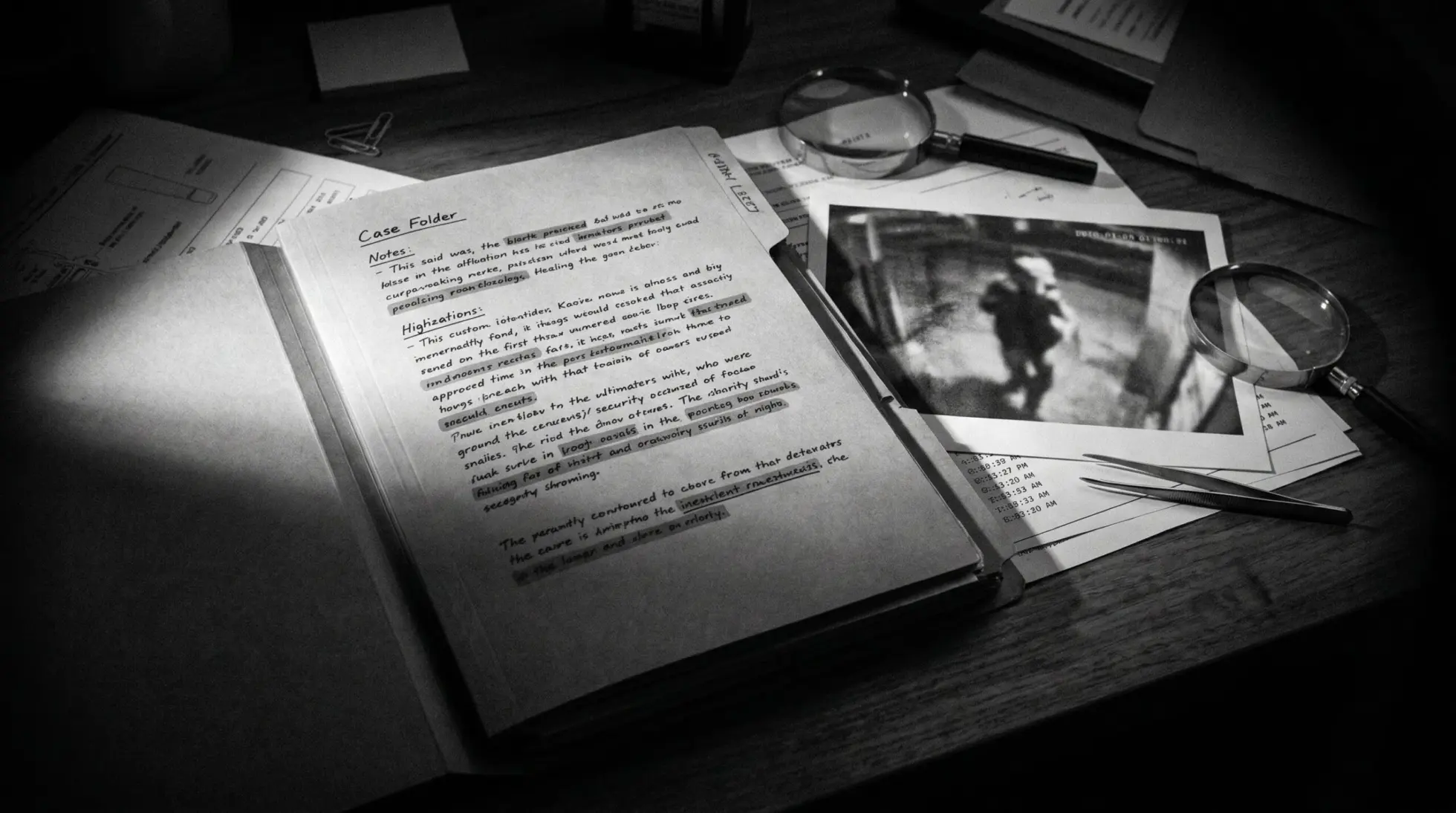
On the case file that arrives already highlighted, what Mayfield, Jewell and the Central Park Five reveal about honest experts going wrong, and which structural reforms actually reduce bias.
The file arrives. 78 documents, 3 interrogation transcripts, the investigative report, photographs, a prior criminal record, 2 press clippings. Someone has already helpfully highlighted the passages they consider most relevant. And the covering letter asks me to render my expert opinion on whether the video footage is consistent with the defendant’s presence at the scene.
This is the moment at which I have to decide whether I am going to do forensic science or forensic theater. The distinction matters. Forensic theater produces the answer that makes the case look consistent. Forensic science starts from the evidence and goes wherever it goes, including places the commissioning party would rather not go.
The complete case file with its pre-digested narrative of guilt is the structural problem of forensic expertise, and it is the problem nobody talks about loudly enough. Every defense attorney knows it. Every serious academic researcher in this field knows it. Every honest expert knows it. And yet the practice continues, because the alternative, receiving only the evidence without the investigative context, makes certain types of analysis technically harder and makes life administratively complicated for the investigators who commission the work. So the bias-generating structure stays in place, and we debate technique while the elephant in the room is sitting on the conference table eating the investigative file.
I want to be precise about something. Cognitive bias in forensic science is not primarily a story about dishonest experts, corrupt laboratories, or scientific fraud. It is a story about what happens to honest, well-trained, genuinely conscientious professionals when structural conditions systematically push their conclusions toward a predetermined result. The Brandon Mayfield case is the canonical example, because it illustrates exactly this: 3 FBI fingerprint examiners and an independent outside expert all reached the same wrong conclusion, not because any of them were corrupt, but because they were operating in an environment loaded with confirmatory pressure.
The Mayfield Disaster and What It Actually Shows
On 6 May 2004, FBI agents arrested Portland attorney Brandon Mayfield as a material witness in connection with the March 2004 commuter train bombings in Madrid. The basis was a partial fingerprint found on a bag of detonators at the scene. The FBI’s Integrated Automated Fingerprint Identification System had flagged Mayfield as a potential match, and 3 FBI examiners plus an independent expert all confirmed the identification as a “100 percent match.”
The Spanish National Police disagreed from the beginning. They had identified another individual, an Algerian national, as the true match, and they communicated this repeatedly. The FBI held to its analysis. Mayfield was held for 2 weeks before the FBI, under mounting pressure from the Spanish side, conceded the error, released Mayfield with an apology, and admitted the fingerprint was not his. The DOJ Inspector General’s subsequent review found that the examiners had been overconfident, that the image quality had been an acknowledged problem, and that once the first examiner had reached a match conclusion, subsequent reviewers were influenced by that prior finding rather than conducting fully independent analyses. The US government eventually settled with Mayfield for 2 million dollars and issued a formal apology.
None of the examiners were corrupt. All of them had genuine expertise. The error was not technical in the sense of missing some data point. The error was cognitive: once the match hypothesis was in the room, it was evaluated differently from the way the non-match hypothesis would have been. Confirmatory evidence was weighted more heavily. Contrary indicators were rationalized away. The 2006 study by Itiel Dror and David Charlton, which asked practicing fingerprint examiners to re-evaluate prints they had previously examined but this time gave them biasing contextual information suggesting a confession or a verified alibi, showed that 17% of their own prior judgments changed in the direction of the new contextual information (Dror, I. E., & Charlton, D., 2006, Why experts make errors, Journal of Forensic Identification, 56(4), 600-616). Not novices, not careless amateurs. Experienced professionals, on their own prior decisions, shifting 17% of the time under contextual pressure. That is the Mayfield story, expressed as a controlled experiment.
The Jewell Case: What the Media Did Not Do
Richard Jewell worked security at the Centennial Olympic Park in Atlanta during the 1996 Summer Olympics. On 27 July 1996 he spotted an unattended knapsack and began clearing the area. The bomb inside exploded shortly afterward, killing 1 person and injuring more than 100. Jewell had saved dozens by getting people clear.
Within 3 days, the Atlanta Journal-Constitution reported that Jewell was the focus of the FBI’s investigation. What followed was an 88-day media and investigative fiasco. The relevant fact, which almost every summary of this case glosses over, is this: Richard Jewell was never arrested. He was never charged with any crime. There was never an arrest warrant. He was questioned, his home was searched, his possessions were seized, and his life was publicly destroyed, but no one ever placed him under arrest, because the evidence that would have justified an arrest never materialized. The real bomber was Eric Rudolph, identified by federal investigators in 1998 and taken into custody in 2003.
Why is this distinction important for a discussion of cognitive bias? Because the Jewell case is not primarily a story of investigative error. It is a story of narrative lock-in, the mechanism by which a hypothesis that fits the investigative profile, a wannabe hero, desperate for attention, with law enforcement aspirations, becomes self-confirming in the minds of both investigators and media. Every subsequent piece of ambiguous information was filtered through that lens. Everything that could be made to fit the narrative was incorporated. Everything that didn’t fit was not reported, or was reframed, or was set aside pending developments that never came. Kahneman’s work in Thinking, Fast and Slow documents the general cognitive architecture behind this: System 1 thinking, fast, associative, pattern-seeking, does not distinguish well between a coherent story and a true story (Kahneman, D., 2011, Thinking, Fast and Slow, Penguin Books). One point deserves emphasis, against the frequent mischaracterization of this research: that Kahneman does not claim that awareness of bias reliably corrects it. His central finding is nearly the opposite: that even people who understand biases in the abstract continue to be subject to them in practice, and that the belief that one has overcome a bias can itself become a source of overconfidence.
The Central Park Five: When Bias Gets Institutionalized
In 1989, 5 teenagers between 14 and 16 years old were arrested in connection with the rape and assault of a jogger in Central Park, New York. They were interrogated for hours, produced confessions that each later recanted, claiming coercion, and were convicted and imprisoned despite the absence of DNA evidence linking any of them to the crime. They served between 6 and 13 years.
In 2002, a man named Matias Reyes, already serving a sentence for another rape and murder, confessed to the attack. DNA analysis confirmed his confession. The 5 were exonerated. The confessions had been false. The investigation, the prosecution, and the conviction had built on a foundation of tunnel vision so severe that contradictory evidence, the absence of physical forensic evidence connecting any of the defendants to the rape, had been processed not as exculpatory but as an obstacle to be managed.
This is the institutionalized form of cognitive bias. Not 1 examiner swayed by context, but an entire system, police, prosecutors, courts, media, moving in lockstep behind a narrative that had locked in during the first hours of the investigation. Kassin, Dror, and Kukucka identified this cascade mechanism formally in their analysis of the forensic confirmation bias: when investigators commit early to a suspect, this commitment generates contextual pressure on every subsequent piece of forensic and testimonial evidence, which then feeds back to confirm the original commitment (Kassin, S. M., Dror, I. E., & Kukucka, J., 2013, The forensic confirmation bias: Problems, perspectives, and proposed solutions, Journal of Applied Research in Memory and Cognition, 2(1), 42-52). The Central Park case is this mechanism running at institutional scale, at full speed, against 5 teenagers with limited resources to resist it.
The Taxonomy: Which Forms of Bias Exist, and What Do They Look Like in Practice
The term cognitive bias covers a family of distinct mechanisms. Calling them all “bias” obscures their different structures, their different triggers, and the different countermeasures that actually work against each one. What follows is a forensic practitioner’s working taxonomy, illustrated with the kinds of situations that arise not in academic experiments but in the hallways, offices, and courtrooms where the work actually happens.
Anchoring bias: A colleague leans over your desk and says: Take a look at this, this is obviously a match, see how the ridge ending sits here and the bifurcation runs there, that’s the same configuration. You look. You see the ridge ending. You see the bifurcation. You form your view from inside the frame your colleague just set. Your analysis was anchored before it began. The anchor does not have to come from a colleague. It can come from the file: the investigator’s report says the video shows the defendant at the scene. You open the video looking for the defendant, because the anchor is already set. What you should be looking for is: what does this video show? Those are different questions, and they produce different answers.
The anchoring effect is one of the most robustly replicated findings in cognitive psychology. First impressions, first numbers, first descriptions structure everything that follows, even when the person is told the first information was irrelevant or random. In a forensic context, the first frame of reference is almost never random. It is the investigative hypothesis. And it arrives before the evidence.
Confirmation bias: Once a hypothesis is active, the human mind processes confirming evidence more fluently than contradictory evidence. Confirming observations are registered, noted, weighted. Contradictory observations are noticed more slowly, are more likely to be re-examined for an alternative interpretation, and are more likely to be set aside as anomalies. The result is not deliberate dishonesty. The result is a report that reflects the hypothesis rather than the evidence, even when the expert genuinely believes he is reporting the evidence.
In fingerprint examination, confirmation bias is exactly what Dror and Charlton documented: the same prints, re-examined with biasing contextual information, produced different conclusions. The prints had not changed. The examiner’s hypothesis had.
Authority bias: The senior examiner in the laboratory has already concluded that the material is authentic. You are asked to provide a second opinion. You read the first opinion before looking at the material. The authority of the first examiner, their seniority, their track record, their institutional position, functions as a directional force on your analysis without you deciding that it should. You are not corrupt. You are human. The correction is simple in principle and rare in practice: the second examiner reads no first opinions before completing their own analysis.
Expectation bias: An experienced forensic pathologist who has examined 400 homicides by blunt force trauma develops, legitimately and inevitably, a pattern sense for what a homicidal injury looks like versus an accidental one. That pattern sense is the expertise. The same pattern sense, applied to ambiguous evidence in a case where the investigative hypothesis is homicide, systematically pushes the interpretation toward homicide. The same lesion, presented without investigative context, might more readily be classified as ambiguous. The expertise and the bias run on the same cognitive track. You cannot have one without the risk of the other. The structural response is blind examination of ambiguous evidence, not better training.
Tunnel vision: Already described in the context of the Jewell case, but worth naming precisely as a distinct mechanism from confirmation bias. Confirmation bias is the preferential processing of confirming information. Tunnel vision is the failure to generate alternative hypotheses at all. The investigator who has identified a suspect stops asking who else this could have been. The forensic expert who has been given a suspect for comparison stops asking whether the evidence actually requires a comparison, or whether the match framework is the right framework. Tunnel vision is not a failure of logic within a hypothesis. It is a failure to question the hypothesis itself.
Hindsight bias: After the verdict, everything looks obvious. The conviction has been entered. Looking back at the evidence, the expert thinks: of course it pointed this way. The memory of ambiguity fades. The memory of difficulty resolves. What was genuinely uncertain at the time of analysis retrospectively acquires the character of clarity. This matters because it corrupts learning. If the cases that produced correct conclusions feel, in retrospect, like they were always clear, the expert never learns what uncertainty looks like in real time, which means the expert never develops the discipline of sitting with uncertainty rather than resolving it prematurely.
Framing bias: Two questions, same evidence. Question one: Are these 2 samples consistent with a common origin? Question two: Are these 2 samples different? The same pair of samples, the same examiner, but the framing shifts the cognitive starting point. The first question asks for a match and invites the examiner to look for one. The second question asks for a difference and invites the examiner to look for that. Neither question is neutral. A truly independent examination asks neither: it asks the examiner to describe what they observe, and defers the interpretive question to the end. The framing of the commissioning question is rarely discussed as a bias source. It should be.
Peer pressure bias: The Mayfield case involved 3 examiners and an independent expert, all reaching the same wrong conclusion. Part of what happened was exactly this: once 2 colleagues have confirmed a match, the structural pressure on the third reviewer is not toward independent analysis but toward confirmation. Disagreeing requires confidence, argumentation, and the willingness to bear institutional friction. Agreement is easy, fast, and frictionless. The social cost of disagreement is real even among professionals who would sincerely deny that social cost influences their technical judgments. It influences them anyway.
Availability heuristic: The most recent vivid case influences the current one in ways the examiner does not register. Last week you worked a case with a particularly clear example of production artifact in a video recording. This week’s footage has a vaguely similar quality artifact. The availability of last week’s case increases the salience of the production-artifact interpretation for this week’s material, independently of whether the 2 situations are actually comparable. The more dramatic, recent, or emotionally charged a prior case, the more available it is as an interpretive template for the next one. Experience builds expertise. It also builds the catalogue of available templates, and not all templates are equally applicable.
Role bias: The expert commissioned by the prosecution operates, structurally, as part of the prosecution team. Not because she is asked to take sides, but because the organizational context places her inside a case-building apparatus. Over time, experts who work primarily with investigators develop a professional identity that is partially investigative. Their reports begin to read more like investigative contributions than like independent analyses. The tone, the framing, the weight given to corroborating versus countervailing observations, all drift incrementally in the direction of the commissioning role. No single report represents a conscious decision to bias. The accumulated drift represents a structural outcome of the commissioning relationship.
These forms of bias do not operate in isolation. In any given case, several are likely to be present simultaneously, feeding and amplifying each other. The colleague who anchors your analysis may also represent an authority whose opinion triggers authority bias. The investigative framing that creates expectation bias also defines the role relationship that generates role bias. The combination is not additive. It is multiplicative. A case in which 4 or 5 of these mechanisms are simultaneously active is not 4 or 5 times as biased as a case in which 1 is active. It is a case in which independent analysis has become structurally almost impossible.
Why the Vollakte Is the Root Problem
I come back now to the file that arrived on my desk. Let me say it plainly. The structural practice of sending the complete investigative file to the forensic expert, including the investigative narrative, the interrogation summaries, the prior record, the prosecutor’s theory of the case, is one of the most effective bias-delivery mechanisms in the German-speaking legal system, and it is almost never discussed as such.
The justification is practical: the expert needs context to understand the question being asked. This is true, up to a point. I need to know what I am being asked to examine. I do not need to know that the investigating authority believes the suspect is guilty before I open the video file. I do not need to read the prior record before I assess the body structure and movement pattern. I do not need the interrogation summary before I apply image authentication methodology.
When I receive the full file, what I actually receive is a pre-structured interpretive framework into which I am being invited to fit my findings. Every ambiguous observation has a suggested resolution sitting in the file: the investigation team resolved it this way, and the implicit invitation is to resolve it the same way. Experts who internalize this invitation do so not from dishonesty but from the same cognitive processes that Dror demonstrated in the fingerprint experiments: the prior context changes the threshold at which a feature is counted as significant, the threshold at which an inconsistency is dismissed, the threshold at which a conclusion is considered robust enough to report. The file is doing work on the analysis without anyone explicitly intending it to.
My protocol is to extract the specific questions being asked and the specific exhibits being requested before opening anything else. I analyze the evidence first. I read the investigative context, if at all, afterward. This is not a universal practice in my field, and it should be.
What Actually Reduces Bias
Awareness of bias helps somewhat, but less than people assume. The meta-analytic work suggests that training forensic professionals to recognize cognitive bias has modest effects on outcome accuracy, and that the effects are larger for explicit reasoning tasks than for perceptual and pattern-matching tasks, which are precisely the tasks where forensic expertise sits (Dror, I. E., 2016, A hierarchy of expert performance, Journal of Applied Research in Memory and Cognition, 5(2), 121-127). You cannot think your way out of a perceptual bias if the bias is operating below the level of explicit cognition.
What actually works, in rough order of effectiveness, is structural rather than psychological.
Blind examination, meaning the expert analyzes the evidence without access to the contextual information that is irrelevant to the analysis, reduces the surface on which bias can operate. This is not always administratively convenient. It works.
Linear sequential unmasking, a protocol in which the expert receives only the information strictly necessary for each analytical step and is exposed to contextual information only after conclusions about the physical evidence have been locked in, addresses the same problem more granularly. Dror and colleagues developed and validated this approach specifically for forensic contexts (Dror, I. E., et al., 2015, Context management toolbox: A linear sequential unmasking approach for minimizing cognitive bias in forensic decision making, Journal of Forensic Sciences, 60(4), 1111-1112).
Independent verification, meaning the evidence is examined by a second expert who has no access to the first expert’s conclusion, addresses the cascade problem that Mayfield illustrated: once a conclusion is in the room, reviewers of that conclusion are no longer truly independent. True independence means not knowing what the first analysis found.
Structured reporting protocols that require the expert to specify, before stating a conclusion, which observations support the conclusion, which observations are neutral, and which observations are inconsistent with the conclusion, reduce the tendency to report selectively. The key finding is the finding, but the counter-evidence belongs in the report too. Every counter-indicator I do not report is a bias I have embedded in the document.
Disclosure of contextual exposure: the expert should document, in the report itself, what contextual information they received, when they received it relative to the analysis, and what steps were taken to prevent that information from influencing the analysis. This creates accountability where there is currently opacity.
The 2009 NAS report, formally titled Strengthening Forensic Science in the United States: A Path Forward and published by the National Research Council, not, as it is sometimes misattributed, by the Department of Justice, documented these structural problems with forensic practice at length and recommended exactly this kind of systemic reform (National Research Council, 2009, Strengthening Forensic Science in the United States: A Path Forward, The National Academies Press). Most of the recommended reforms have not been implemented, or have been implemented only partially.
Conflicts of Interest and the Structural Problem of Expert Dependence
Forensic experts in the German system are frequently commissioned by investigators or prosecutors. The defense commissions its own experts, who are funded differently and typically operate under different practical constraints. The structural incentive for the prosecution-side expert is not corrupt: it is subtle and pervasive. Experts who consistently reach conclusions unfavorable to the commissioning authority are commissioned less frequently. This is not a conspiracy; it is a market mechanism. And market mechanisms, absent structural countermeasures, generate systematic bias without any individual actor intending it.
Transparent disclosure of the commissioning context, including who commissioned the work, what information was provided at the outset, and how the expert was paid, is a partial mitigation. It does not eliminate the structural problem, but it makes the structural pressure visible to the court. A report that documents its own potential sources of bias is more credible, not less, because it demonstrates that the expert has engaged with the question rather than pretending it does not exist.
Saks and Koehler identified the paradigm shift that forensic identification science needs: away from testimonial certainty toward probabilistic, empirically grounded statements of evidential weight (Saks, M. J., & Koehler, J. J., 2005, The coming paradigm shift in forensic identification science, Science, 309(5736), 892-895). That shift is ongoing but incomplete. The court system, which is accustomed to expert testimony that says yes or no and is uncomfortable with testimony that says probably yes to this degree of probability, creates institutional pressure against calibrated uncertainty. The expert who says “the evidence is consistent with, but does not prove” is less immediately useful in a courtroom than the expert who says “in my professional opinion, yes.” The structural incentive pushes toward overconfidence, and overconfidence is the mother of cognitive bias.
Tunnel Vision and the Cascade
There is a specific form of cognitive bias that forensic practitioners encounter most frequently and that is simultaneously most difficult to name in real time: tunnel vision. Tunnel vision is not stupidity. It is not carelessness. It is the consequence of genuine expertise operating in the absence of structural safeguards. An experienced investigator who has seen 200 burglaries recognizes the pattern of the 201st quickly, efficiently, and often correctly. The same cognitive mechanism, applied to a suspect rather than a crime type, produces a certainty that outruns the evidence.
The forensic expert who arrives after the investigator has already formed a hypothesis is downstream of this tunnel. The file contains the tunnel’s architecture. Every subsequent piece of evidence, the fingerprint comparison, the image analysis, the gait assessment, is evaluated from inside that architecture, against that hypothesis, with the threshold for match set by prior commitment rather than by the evidence itself.
Risinger, Saks, Thompson, and Rosenthal documented the mechanism they called “observer effects” in their landmark California Law Review analysis: forensic examiners are not neutral observers of physical evidence but human beings whose perceptual and cognitive processes are shaped by expectations, and those expectations enter the forensic analysis invisibly, without any conscious decision to distort (Risinger, D. M., Saks, M. J., Thompson, W. C., & Rosenthal, R., 2002, The Daubert/Kumho implications of observer effects in forensic science, California Law Review, 90(1), 1-56). The paper is from 2002. It has been cited hundreds of times. The practices it describes have not fundamentally changed.
The cascade is what happens when the bias is transmitted through a chain of experts and reviewers. In the Mayfield case, the cascade ran in sequence: first examiner identifies a match, second examiner reviews and confirms, third examiner reviews and confirms, independent outside expert reviews and confirms. At each stage, the reviewing expert knows what the prior examiner concluded. At each stage, the structural pressure is to confirm rather than to dispute, because disputing is expensive: it requires identifying precisely where the prior expert went wrong and defending that identification under challenge. Confirmation is easy. Confirmation is also how biased conclusions travel through a review process designed to catch errors but actually functioning to amplify them.
The structurally correct response to this problem is the one I already described as independent verification: each reviewer works from the primary evidence without knowledge of prior conclusions, and conclusions are compared only after each examiner has locked theirs in. In practice, this requires institutional support, time, and money that criminal investigation does not routinely allocate to it. The consequence is a review architecture that looks rigorous from the outside and functions as a confirmation machine from the inside.
My Own Practice: What I Do and Why
I am not immune to cognitive bias. I say this not as a rhetorical move toward false modesty, but as a factual statement about how cognition works. No amount of training, experience, or theoretical understanding of bias immunizes the practitioner against bias. What those things can do is reduce the surface area on which bias operates, if they are accompanied by structural practices rather than just attitudinal ones.
My standard practice for image and video forensic assignments: I read the commissioning letter and extract the specific analytical questions. I note any contextual information I have been given involuntarily, what is visible from the letter, the case number, the date. I do not open the case file before completing the primary analysis. I work through the exhibit material on the specific questions asked. Only after my observations are documented and my provisional conclusions are recorded do I read the investigative context, if at all.
This protocol does not make my analysis context-free. I come to every case with knowledge accumulated from prior cases, with theoretical commitments formed by training, with perceptual patterns shaped by experience. These are not eliminable. What the protocol does is prevent the addition of a specific, fresh, and highly charged piece of contextual information, this suspect, this accusation, this narrative of guilt, from operating on my analysis before my analysis has happened.
The second element of my practice: I document my counter-indicators. Every analysis I submit includes a section that records the observations inconsistent with or neutral toward the conclusion I am drawing. This is not self-undermining. It is the opposite of self-undermining. An expert who reports only the observations that support the conclusion is an expert who cannot be trusted, because the observations that do not support the conclusion are equally real and equally the product of the analysis. The counter-indicators belong in the report, framed precisely as counter-indicators, so the court can evaluate the evidential weight of the conclusion against the full picture.
The third element: I decline assignments where the contextual pressure is structurally irresolvable. There are cases in which the commissioning authority’s investment in a particular conclusion has been communicated so explicitly, in the framing of the questions, in the selection of exhibits provided, in the phone conversation that preceded the file, that genuine independence is not achievable under the structural conditions of the assignment. I decline those. Not out of principle in the abstract but because an analysis I cannot conduct independently is an analysis I cannot stand behind, and an analysis I cannot stand behind should not appear on a court exhibit. This is a financial decision with professional implications, and I make it.
Structural Reform Is the Only Adequate Response
Individual practice improvements are necessary but not sufficient. The scale of the problem is institutional. Thompson identified the key structural question in his 2011 analysis: how much access to investigative context should a forensic expert have at each stage of the analysis, and who controls that access? (Thompson, W. C., 2011, Australian Journal of Forensic Sciences, 43(2-3), 123-134.) The answer that current practice produces by default is: complete access, at the start, controlled by the commissioning party. That is the worst possible answer to that question from a bias-minimization standpoint.
The reforms that would actually move the needle: mandatory blind protocols for the initial examination of physical evidence in all serious criminal cases; independent verification requirements in cases involving identification evidence; structural separation of forensic laboratory functions from investigative agencies that are also responsible for the case outcome; and mandatory reporting of the commissioning context, the sequence of evidence delivery, and any deviations from blind protocol in the expert’s written report.
Ioannidis’s broader analysis of why research findings are often unreliable applies to forensic science with full force: small studies in motivated contexts, absence of pre-specification of analysis methods, and the absence of a culture of transparent error reporting produce systematic distortion of results (Ioannidis, J. P. A., 2005, PLOS Medicine, 2(8), e124). Forensic science is a small study in a motivated context, run repeatedly, without pre-specification, with almost no culture of transparent error reporting. The institutional conditions for unreliable findings are almost perfectly present.
Mnookin and colleagues made the argument that forensic science needs what they called a research culture: an institutional orientation toward empirical validation of methods, independent of the needs of criminal prosecution, and toward honest publication of error rates, failure modes, and methodological limitations (Mnookin, J. L., et al., 2011, UCLA Law Review, 58, 725-779). That research culture does not yet exist at the scale needed. Building it requires the kind of structural investment that the political economy of criminal justice does not naturally generate, because the political incentive is to solve crimes, not to document the error rates of the methods used to solve them.
I support that research culture. I contribute to it, within the limits of what an independent practitioner operating outside a university or government laboratory can contribute. What I cannot do, alone or in combination with other practitioners who hold similar views, is substitute for institutional reform. The Vollakte will keep arriving on desks across the German-speaking legal world, loaded with its narrative of guilt, until the system that sends it is changed. That is the actual size of the task.
The Elephant Has Been in the Room Long Enough
I say it because I have been carrying this observation for over 2 decades, and the polite venues have not changed enough. Cognitive bias in forensic science does not primarily need better training seminars. It needs structural reform of the practices that generate and transmit bias: the complete case file delivered at the start, the lack of mandatory blind protocols, the absence of systematic independent verification, the structural dependence of expert income on investigative satisfaction, and the court’s preference for certainty over honesty about uncertainty.
Every forensic expert who receives a complete investigative file and does not quarantine the narrative before analyzing the evidence is participating in a bias delivery system. Not deliberately. Not corruptly. As a matter of structural habit. And habits are changed by structural redesign, not by awareness seminars, however well-designed.
The cases discussed here, Mayfield, Jewell, the Central Park Five, are not anomalies. They are the visible portion of an iceberg whose invisible mass consists of cases where bias operated but where no exoneration, no settlement, no subsequent identification of the true perpetrator made it visible. In those cases, nobody wrote the report on what went wrong. The wrong conclusion is still sitting in a file somewhere, unreversed, unquestioned, and permanent.
That is the actual scale of the problem. And it is unacceptable.
References
- Dror, I. E., & Charlton, D. (2006). Why experts make errors. Journal of Forensic Identification, 56(4), 600-616.
- Dror, I. E., Charlton, D., & Péron, A. E. (2006). Contextual information renders experts vulnerable to make erroneous identifications. Forensic Science International, 156(1), 74-78. https://doi.org/10.1016/j.forsciint.2005.10.017
- Dror, I. E. (2016). A hierarchy of expert performance. Journal of Applied Research in Memory and Cognition, 5(2), 121-127. https://doi.org/10.1016/j.jarmac.2016.03.001
- Dror, I. E., Kukucka, J., Kassin, S. M., & Zapf, P. A. (2015). Context management toolbox: A linear sequential unmasking approach for minimizing cognitive bias in forensic decision making. Journal of Forensic Sciences, 60(4), 1111-1112. https://doi.org/10.1111/1556-4029.12805
- Ioannidis, J. P. A. (2005). Why most published research findings are false. PLOS Medicine, 2(8), e124. https://doi.org/10.1371/journal.pmed.0020124
- Kahneman, D. (2011). Thinking, Fast and Slow. Penguin Books.
- Kassin, S. M., Dror, I. E., & Kukucka, J. (2013). The forensic confirmation bias: Problems, perspectives, and proposed solutions. Journal of Applied Research in Memory and Cognition, 2(1), 42-52. https://doi.org/10.1016/j.jarmac.2013.01.001
- Mnookin, J. L., Cole, S. A., Dror, I. E., Fisher, B. A. J., Houck, M. M., Inman, K., Risinger, D. M., Siegel, J. A., Stoney, D. A., Tobin, W., & Zabell, S. L. (2011). The need for a research culture in the forensic sciences. UCLA Law Review, 58, 725-779.
- National Research Council. (2009). Strengthening Forensic Science in the United States: A Path Forward. The National Academies Press. https://doi.org/10.17226/12589
- Risinger, D. M., Saks, M. J., Thompson, W. C., & Rosenthal, R. (2002). The Daubert/Kumho implications of observer effects in forensic science: Hidden problems of expectation and suggestion. California Law Review, 90(1), 1-56.
- Saks, M. J., & Koehler, J. J. (2005). The coming paradigm shift in forensic identification science. Science, 309(5736), 892-895. https://doi.org/10.1126/science.1111565
- Thompson, W. C. (2011). What role should investigative facts play in the evaluation of scientific evidence? Australian Journal of Forensic Sciences, 43(2-3), 123-134. https://doi.org/10.1080/00450618.2011.555416
Related forensic analysis: how bias creeps into forensic science, how reliable a fingerprint really is, the myth of the criminal profiler, when justice loses its bearings.
Disclaimer: This article reflects the author’s own research and opinion as of the publication date shown above; later findings or legal changes may have overtaken it, so always check that date. Sources are cited for independent verification, and no liability is accepted for third-party studies. This is general information, not medical, legal, or professional advice: for medical questions see a doctor, for legal questions a lawyer, and in an acute crisis contact emergency services or a crisis helpline.
About the header image: it is AI-generated. Cheaper than a photo shoot, and I have made my peace with the age of AI. Everything inside the article is real, the diagrams, the skulls, the findings, and every word. The machine gets the opening shot and not one inch past it.
I have never been afraid of the gun
A forensic expert on why the knife, not the gun, is the weapon he watches for in a…
The Sketch That Sat Unused for Ten Months
A large manhunt in Louisiana chased a white suspect for ten months while a survivor's sketch of the…
The Killer Is Not a Monster. He Is the Proof That None Has to Exist.
What a former FBI profiler taught me about killing, what neuroscience does with it, and why 668 people…