Where Is the Guardian When Justice Loses Its Bearings? Home Searches, Smartphone Seizures and the IT Fundamental Right
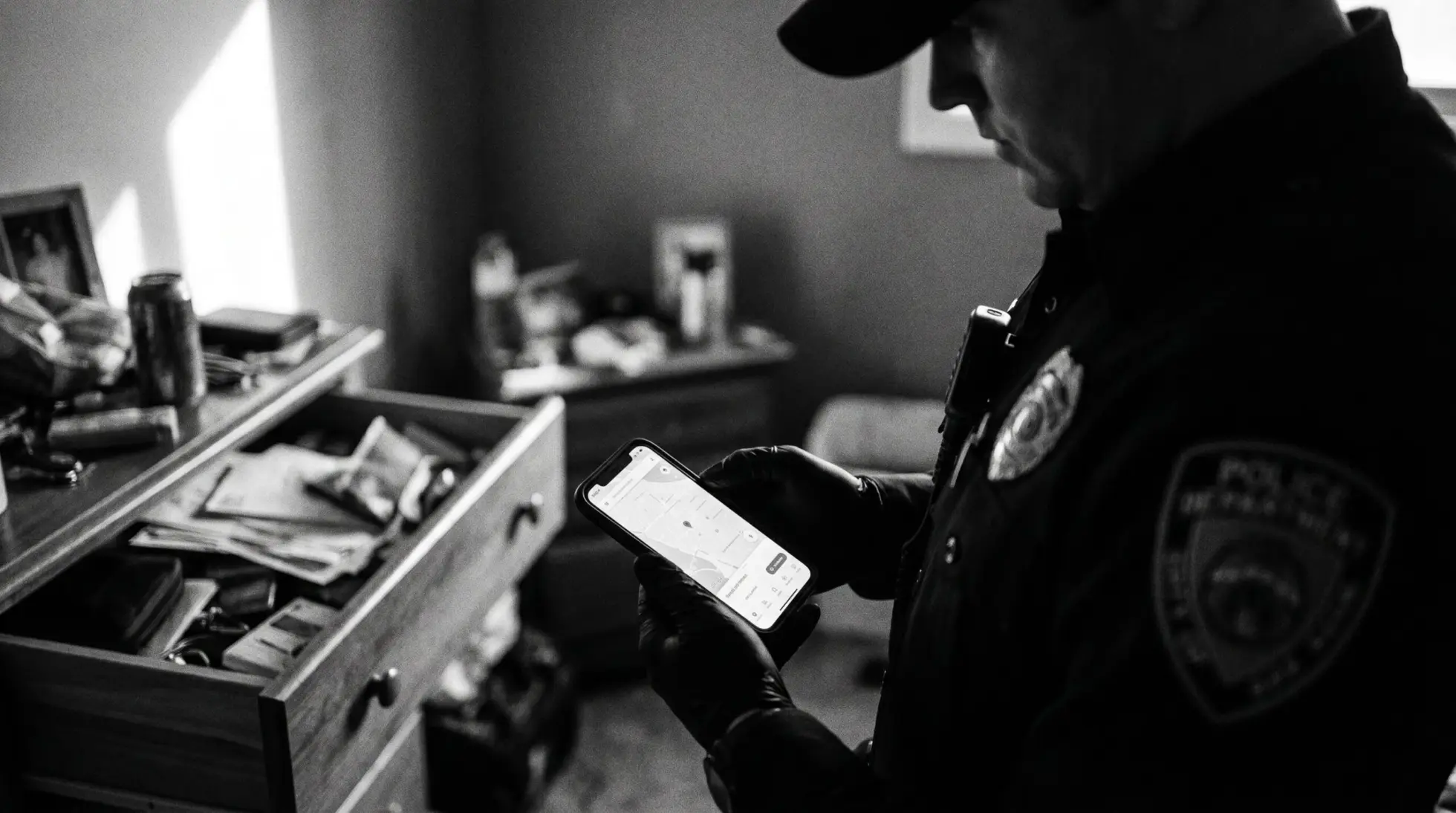
Your home is inviolable. Your smartphone even more so. And yet it’s always the first thing they take.
I was nursing my morning coffee and scrolling through the news the way you do when the world feels far enough away to fit on a screen. A headline stopped me cold. A journalist, well-known, sharp-tongued, had his home raided. Armed officers, a search warrant, personal devices seized. All of it because of a social media post. The offending phrase was something like: Germany, wake up. A few words tapped into the void, apparently powerful enough to mobilize an entire law enforcement apparatus.
I stared at that headline for a long time. Not out of surprise. I know this script. What I felt was recognition, that slow, unsettling sense that I’d seen this scene before, in different forms, under different names.
After decades inside the justice system, I’ve watched the extraordinary become routine. A home search used to be something reserved for serious crime: organized violence, drug trafficking, terrorism. Now I’m reading about one triggered by a tweet. I keep hearing the echo of a line from Germany’s Basic Law, a sentence that once sounded like a promise: The home is inviolable. These days it sounds more like a question.
The Home Is Inviolable. But What Is the Home?
When officers search your house, they enter rooms. They open drawers, look behind books, take computers. The intrusion is real, it’s serious, and the law treats it that way for good reason: a home search is one of the most severe interventions the state can authorize against an individual.
But there’s an object that never gets enough attention in these conversations, something that has become more intimate than any room in any house. The smartphone. Anyone who hasn’t spent years analyzing them doesn’t fully grasp what they contain. I have, and I’m not raising this as a footnote: I’m raising it because nobody else in this debate is bringing the forensic perspective it actually requires.
A smartphone isn’t technology. It’s a diary, a confession, a psychological portrait, a complete record of a life compressed into something that fits in your palm. On a typical phone you’ll find intimate photos meant for no one else, messages to a partner, to a lover, to a friend in crisis, to a doctor, to a therapist, to a lawyer. Years of messaging history, email threads, search records, location data, health apps tracking sleep patterns, menstrual cycles, heart rate, financial information, browsing data, notes never meant for another pair of eyes. Calendar entries. Draft messages that were typed and never sent. Forms for doctors, attorneys, government agencies. The complete private correspondence of a life, in a device smaller than a paperback.
I’ve analyzed smartphones, and I can build a psychological profile from a full phone extraction that is more accurate than any psychiatric evaluation conducted over a few hours. Sleep patterns, social ties, sexual preferences, financial anxieties, political leanings, health struggles, relationship conflicts, professional frustrations, all of it, timestamped, spanning years.
Here’s a concrete example. The Health app on an iPhone logs every step, every flight of stairs climbed, every hour of sleep, every location visited, every physical activity, with timestamps and geodata, continuously, over years, without the user actively noticing or controlling it. A few years ago I was able to prove a suspect’s innocence before a German court using nothing but that man’s iPhone Health data. The dataset showed, to the minute, where he had been, how many stairs he had climbed, when he had slept, all of which made it physically impossible for him to have committed the offense. The court accepted the analysis. The data had been sitting in the device the entire time. Nobody had thought to look for it.
A forensic AI system can extract a complete psychological and forensic profile from existing smartphone data: movement patterns, social networks, emotional states, habits, physical presence at disputed locations down to the minute. Run through a system like that, every smartphone is a complete and total loss of privacy. Not partial. Total.
And here’s the question that closes this section: Who doesn’t get access to that system? Law enforcement. Why that is and why it’s going to stay that way, you can read about in another post on this blog.
Anyone who understands this also understands that seizing a smartphone is not equivalent to searching a home. It’s worse. The German Federal Constitutional Court recognized this dimension for the first time in a landmark ruling on February 27, 2008, establishing what German law now calls the IT fundamental right, the constitutional right to the confidentiality and integrity of information technology systems, a right that explicitly ties government access to private digital systems to higher constitutional standards than access to physical spaces (BVerfG, February 27, 2008, Az. 1 BvR 370/07, 1 BvR 595/07). And in July 2025, the same court expressed serious constitutional doubts about the proportionality of a smartphone seizure in a concrete case, explicitly weighing the affected person’s private interest in her device against the state’s interest and finding the state’s interest not particularly high (BVerfG, July 9, 2025, Az. 1 BvR 975/25).
American law arrived at essentially the same place through a different route. In Riley v. California (2014), the Supreme Court ruled unanimously that police generally cannot search the digital information on a cell phone seized from an arrested person without a warrant, and Chief Justice Roberts wrote something that any forensic practitioner who has spent years extracting phone data will recognize immediately: a cell phone is not just another item. “Modern cell phones,” he wrote, “are not just another technological convenience. With all they contain and all they may reveal, they hold for many Americans ‘the privacies of life.’” Four years later, in Carpenter v. United States (2018), the Court extended Fourth Amendment protection to cell-site location data, recognizing that the digital trail a phone leaves behind reveals the “privacies of life” in ways that earlier search doctrine had not anticipated. These are not minor procedural rulings. They reflect a judicial system trying, imperfectly, to catch up to what forensic practitioners already know from standing in front of a phone extraction screen.
The Law That Didn’t Grow With the Technology
There is a specific problem here that barely surfaces in public debate, and it applies on both sides of the Atlantic. In Germany, the physical search of a home requires a judicial warrant, meaning no officer crosses a threshold without a judge’s authorization, and every warrant must be specifically justified, proportionate, and bounded. That’s the mechanism designed to prevent the state from searching private spaces on a fishing expedition before it knows what it’s looking for.
Section 110 of the German Code of Criminal Procedure governs the examination of electronic storage media, and it contains a feature that is almost entirely absent from public discussion: the substantive review of a smartphone’s contents by investigators does not carry its own standalone judicial review requirement the way physical searches have for decades. Once seized, a device’s contents can be reviewed by the investigating authority within the scope of the suspicion, without a judge specifying in advance the boundaries of that review. In an analog search warrant, the scope is constrained by the named object of the investigation. You’re looking for documents related to Offense X. The digital content of a smartphone operates differently, practically speaking, and the gap between what the warrant authorizes and what the extraction covers can be wide.
Austria looked at this honestly and acted. In December 2023, the Austrian Constitutional Court declared the existing statutory provisions governing the seizure and analysis of mobile phones to be unconstitutional, because accessing and evaluating a phone without judicial authorization violates the constitutional right to data protection and the right to respect for private and family life under Article 8 of the European Convention on Human Rights (Austrian Constitutional Court, December 14, 2023, G 352/2021). The court’s reasoning was direct: a mobile phone doesn’t provide a snapshot of a person’s behavior. It provides comprehensive access to the entirety of that person’s life. That level of access requires stronger legal protection than a seizure order alone can supply. The provisions expired at the end of 2024. Germany has no direct equivalent ruling.
The Fourth Amendment case law in the United States has moved in the same direction through constitutional interpretation rather than statutory reform, and yet the gap between what the law requires on paper and what happens in practice remains substantial. Proportionality review of digital device searches, the question of whether the scope of a phone extraction is matched to the scope of the investigation, is still inconsistently applied, and the forensic capacity of modern extraction tools has outpaced the legal frameworks designed to constrain them in every jurisdiction I’m aware of.
What a Search Warrant Actually Means
I have no interest in defending extremists of any variety, and I’m not here to argue for a world without law enforcement. I’m interested in the precise point at which the state forgets that freedom and control are not symmetrical forces.
Germany’s Basic Law didn’t encode that asymmetry by accident. Article 13, paragraph 1: The home is inviolable. Four words, written in the shadow of a regime that believed no room, no door, no private thought belonged to the individual. The exceptions exist, paragraphs 2 through 7 of the same article, but they were designed as narrow corridors, not highways. A home search requires judicial authorization, a concrete suspicion grounded in verifiable facts, and proportionality. That last word is the quiet, beating heart of any democratic legal system. It separates justice from retaliation and law from convenience.
Proportionality requires that every state action pass three tests. It must be suitable for achieving the intended goal. It must be necessary, meaning no milder and equally effective measure was available. And it must be appropriate, meaning the severity of the intrusion bears a reasonable relationship to the purpose being pursued. When a home is searched because of a social media post, because of words whose immediately dangerous or clearly criminal character has not been established, those three tests need to be applied seriously. What was the concrete danger that justified so severe an intrusion into the core of someone’s private life? What milder measure was unavailable? And what reasonable relationship exists between the state’s interest in that post and the impact of the intrusion on the person searched, and on every other person who sees it and draws the obvious conclusion?
If those answers aren’t convincing, then proportionality wasn’t just missed. It was abandoned.
The American parallel is the probable cause requirement of the Fourth Amendment, which the Supreme Court has held cannot be satisfied by vague suspicion or generalized concern, but requires specific and articulable facts supporting a reasonable belief that evidence of a crime will be found. Both frameworks rest on the same underlying principle: the government’s power to intrude into private life is legitimate only when it is specifically justified, not when it is convenient.
The Statute That Gets Called On Too Often
Germany’s Section 86a of the Criminal Code, which prohibits the use of symbols and slogans of organizations deemed unconstitutional, was written for a specific and necessary purpose: to prevent the resurrection of ideologies that burned Europe to the ground, that turned nations into graveyards, that made cruelty into state policy. That purpose is legitimate, it is historically necessary, and it should not be casually dismissed.
But the statute includes explicit exceptions for art, education, research, and journalism, because the people who wrote it understood that context and intent are everything. The same phrase that is criminal when shouted as propaganda, when used to mobilize hatred and violence, can be entirely lawful when quoted in analysis or deployed ironically to expose absurdity. Intent and interpretation are the two pillars on which that distinction rests.
When irony can no longer be distinguished from endorsement, when satire is no longer recognizable as satire, the first casualty is creative expression. Journalism follows close behind. Public discourse, that fragile ecosystem of ideas and challenges and counterarguments, suffocates gradually. And a law applied without context, stripped of nuance and human judgment, becomes ideology in uniform. Ideology, even when it speaks in the righteous name of justice and protection, has a long history of kicking in the wrong doors.
What Happens When Fear Becomes the Unwritten Law
I’ve worked in courtrooms long enough to know how fear changes the atmosphere of a society. It doesn’t announce itself with speeches. It doesn’t arrive with fanfare. It settles into daily life like dust. People check their words twice before posting. Writers pull their punches. Journalists question their headlines not for accuracy but for risk. Open discussion becomes whispered calculation.
When citizens start policing their own thoughts, the state doesn’t need to. That’s the most efficient, most insidious form of control, the kind that requires no surveillance cameras, no midnight arrests, nothing but the slow erosion of nerve. The moderate voices, the nuanced perspectives, the people who want to argue rather than proclaim, they step back. Their retreat creates a vacuum that the people who thrive on conflict rush to fill, because extremists have less to lose, or simply don’t care about consequences.
The chilling effect is real and measurable, not in statistics but in conversations that don’t happen, articles that never get written, posts that get typed and deleted before anyone sees them, jokes that die in the throat because the risk of misinterpretation feels too high. That isn’t paranoia. It’s rational adaptation to a changing environment. When the cost of speaking rises high enough, rational people choose silence.
A Direction I Never Thought Possible
In my work I’ve watched a seized smartphone expose a person more completely than any interrogation, any psychiatric evaluation, any witness examination ever could. Knowing someone’s device means knowing the person, not their public face, not their professional persona, not what they choose to show others, but the person they are when they’re alone. The messages sent at three in the morning. The drafts that were never sent. The search terms nobody else was supposed to see. The photos that were made for one other person only.
That private space is the dwelling the Constitution doesn’t address, not because it didn’t intend to protect it, but because it didn’t exist yet when the document was written. The IT fundamental right established by Germany’s Federal Constitutional Court in 2008 was the first serious attempt to close that gap, important and bold and still incomplete, because the smartphone in its current form came afterward and because the forensic consequences of its extractability have not yet been fully translated into legal requirements anywhere in the world.
We are developing in a direction where the technical capacity to build a complete psychological portrait from a single device has outrun the legal architecture designed to protect against exactly that. I’ve watched this from the inside for decades, and I say with the certainty of someone who has run these extractions himself: what is forensically possible with a seized smartphone today was not imaginable twenty years ago even in science fiction. And what the law does to protect against it has not grown at anything close to the same pace.
That’s the direction I never thought possible. Not the authoritarian gesture, not the home search over a tweet, which is shocking and remains so. It’s the normalcy with which the most intimate thing a person owns gets treated as just another piece of evidence, an afterthought to the warrant, a hard drive you grab on the way out the door.
What the Courts Know and What Practice Hasn’t Learned Yet
The courts understand what’s at stake. Germany’s Federal Constitutional Court made clear in its February 2023 ruling on automated data analysis that combining personal data with algorithmic processing creates its own independent weight, demanding its own proportionality analysis beyond what the underlying occasion can justify (BVerfG, February 16, 2023, Az. 1 BvR 1547/19 et al.). Algorithmically driven smartphone analysis is exactly that situation: a machine extracting patterns from thousands of data points that no human investigator would find in weeks of manual review, patterns extracted not just for the specific offense that justified the seizure but for everything the device contains.
Austria’s ruling went further. The Constitutional Court grounded its finding of unconstitutionality in a single precise argument: seizing a mobile phone without judicial authorization for review is disproportionate because the device doesn’t document a slice of someone’s life. It documents the entirety of it. That statement is not only a legal argument. It’s a forensic fact, and I can confirm it from direct experience.
Practice in Germany has not fully absorbed that fact. Seizures happen routinely, the scope of extraction is rarely constrained by a judge in advance, and the question of whether the state’s interest in a specific data point in a specific case is proportionate to the total intrusion into a person’s digital life is rarely asked before it should be. American practice is inconsistent in exactly the same ways, despite the doctrinal advances of Riley and Carpenter. The gap between what the law requires on paper and what happens when investigators have an extraction tool and a seized device is wide, and it has consequences for real people that the courts are still working to define.
The Line I Draw
I know prosecutors, judges, and investigators who believe in what they do. I’ve seen people in those roles take their responsibility seriously, lose sleep over their decisions, do difficult work under real pressure. They’re not villains. But I’ve also watched the system reward behaviors that are structurally at odds with proportionality: act, and you’re seen as decisive; hesitate, and you’re seen as negligent. The question of whether you should act at all rarely surfaces in that calculus at the right moment.
That culture needs to change, not through external criticism alone, but through the people inside these institutions who remember that their legitimacy doesn’t come from the power they hold. It comes from the trust they preserve. Every disproportionate seizure, every search conducted over words that caused no demonstrable harm, every phone extraction that goes deeper than the case requires, erodes that trust, and it erodes it not just for the person directly affected but for everyone who sees it happen and draws the appropriate conclusion about what speaking freely might cost them.
The home is inviolable. That was the promise. The smartphone is the private space of the twenty-first century, more intimate than any room built from brick and drywall. Entering it means entering the person. That requires justification, not routine, not schematic, not appended to a home search warrant as an afterthought, but serious, specific, and grounded in full awareness of what forensic analysis of that device will actually produce.
We’re heading somewhere I never thought we’d go. And it’s time for the people setting that direction to grapple seriously with where it leads, before the forensic capacity of extraction systems outstrips the legal architecture protecting against them so completely that the damage can no longer be repaired by rulings, only by the slow, irreversible erosion of the trust on which every legal order ultimately depends.
References
- Federal Constitutional Court of Germany, Judgment of February 27, 2008, Case Nos. 1 BvR 370/07, 1 BvR 595/07 (establishing the constitutional right to the confidentiality and integrity of information technology systems).
- Federal Constitutional Court of Germany, Judgment of February 16, 2023, Case Nos. 1 BvR 1547/19 et al. (automated data analysis, proportionality, purpose limitation).
- Federal Constitutional Court of Germany, Order of July 9, 2025, Case No. 1 BvR 975/25 (proportionality of smartphone seizure).
- Austrian Constitutional Court, Ruling of December 14, 2023, G 352/2021 (unconstitutionality of mobile phone seizure without judicial authorization; statutory provisions invalidated effective December 31, 2024).
- Riley v. California, 573 U.S. 373 (2014) (Fourth Amendment protection for digital contents of cell phones seized incident to arrest).
- Carpenter v. United States, 585 U.S. 296 (2018) (Fourth Amendment protection for cell-site location data).
- German Code of Criminal Procedure, Section 110 (examination of documents and electronic storage media).
- German Basic Law, Article 13 (inviolability of the home); Article 2(1) in conjunction with Article 1(1) (general right of personality, informational self-determination).
- German Criminal Code, Section 86a (use of symbols of unconstitutional and terrorist organizations).
- This post is written solely for informational purposes and to encourage public discussion. Nothing here constitutes legal advice, and it should not be treated as a substitute for professional legal counsel. I am not a lawyer. If you are personally affected by a search, a seizure, or a criminal investigation, contact an attorney of your choice without delay.
Disclaimer: This article reflects the author’s own research and opinion as of the publication date shown above; later findings or legal changes may have overtaken it, so always check that date. Sources are cited for independent verification, and no liability is accepted for third-party studies. This is general information, not medical, legal, or professional advice: for medical questions see a doctor, for legal questions a lawyer, and in an acute crisis contact emergency services or a crisis helpline.
About the header image: it is AI-generated. Cheaper than a photo shoot, and I have made my peace with the age of AI. Everything inside the article is real, the diagrams, the skulls, the findings, and every word. The machine gets the opening shot and not one inch past it.

I have never been afraid of the gun
A forensic expert on why the knife, not the gun, is the weapon he watches for in a…
The Sketch That Sat Unused for Ten Months
A large manhunt in Louisiana chased a white suspect for ten months while a survivor's sketch of the…
Cognitive Bias in Forensic Experts: How to Minimize It
The file arrives. 78 documents, 3 interrogation transcripts, the investigative report, photographs, a prior criminal record, 2 press…