Is Life Worth Living? Albert Camus, Viktor Frankl, Leo Tolstoy, Friedrich Nietzsche, David Foster Wallace, and a Question That No Human Being Can Permanently Escape. And What Homo sapiens Has to Do With It.
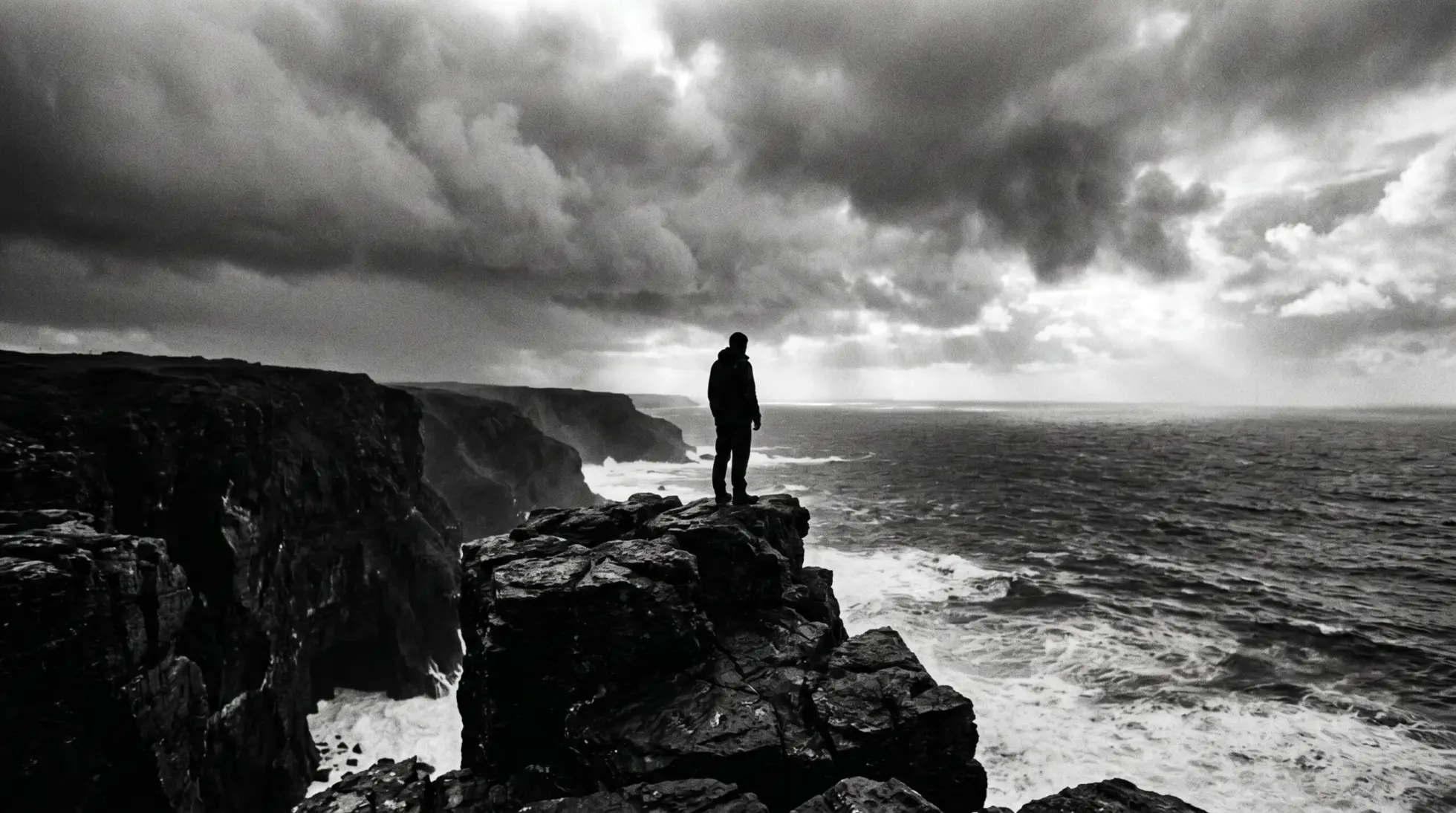
Albert Camus, Viktor Frankl, Leo Tolstoy, Friedrich Nietzsche, David Foster Wallace, and a Question That No Human Being Can Permanently Escape. And What Homo sapiens Has to Do With It.
Every forty seconds, somewhere in the world, a person dies by suicide. Not in a film, not in a statistic that gets clicked away, but in a concrete moment, at a concrete place, with a concrete name that someone else knows and will miss. More than 800,000 people take their own lives every year, and the World Health Organization estimates that the true number is considerably higher, because suicide is stigmatized, concealed, and misclassified in many cultures and legal systems. A number so large it stops being graspable, the way all large numbers eventually stop being graspable, and exists only as an abstract weight that one briefly feels and then sets aside again.
I don’t set it aside.
Not because I have any affection for pain, but because I believe that an honest look at this number raises a question that goes far beyond psychiatry, beyond crisis hotlines and prevention programs, a question that is anthropological in nature, that reaches deep into what Homo sapiens actually is, what he was designed for, and what we have done with that design over the past few decades.
Albert Camus wrote in 1942 the sentence that has since appeared in every serious discussion of philosophy and suicide: there is only one truly serious philosophical problem, and that is suicide. He did not write it to provoke. He wrote it because he believed that this question, whether life is worth living, is the only question that every person eventually answers, either through action or through the decision to stay. And he was right. Not because of the philosophy, but because of the anthropology.
Homo sapiens and the Question He Was Not Supposed to Ask
Ten thousand years ago, in the small mobile communities that Homo sapiens had inhabited for tens of thousands of years before becoming sedentary, the question of the meaning of life arose in a fundamentally different way. It existed as a question, but it had a different resonance chamber. The human being was embedded in a network, in the group, in the daily cooperation with other people, in direct contact with nature, in rituals and collective meaning systems that were not optional but structurally part of life. He slept when it got dark. He ate what the earth and the animal provided. He suffered when someone close to him died, and he celebrated when a child was born or the hunt was successful. He was sensorially present in a world that was immediate.
He was not reachable around the clock. He had no debts in an abstract financial system he didn’t understand. He was not flooded daily with news telling him that the world is burning, simultaneously, in twenty different places, in real time. He owed no one a reply to an email that arrived at eleven at night. His stress system, the cortisol, the adrenaline, the amygdala that responds to threat, was designed to function in concrete, short, survivable crises and then return to rest. Not to run at high tension for thirty years because the mortgage is running, the boss is waiting, the pension is uncertain, and the smartphone never stops.
I am currently writing a book that examines exactly this subject from an anthropological perspective: the hamster wheel that Homo sapiens has gotten trapped in, how he got into this wheel, what it does to him biologically and psychologically, and how one can, if one wants to and understands it, get back out or at least slow the spinning. One of the central arguments of this book is that the accumulation of modern illness, from chronic burnout to sleep disorders to depression and suicide, is not a coincidence and not an individual failure, but the biologically predictable result of an organism operating in an environment it was not built for. I have written about a related dimension of this mismatch in The Anthropology of Light and Darkness, examining what sunlight and circadian disruption do to the same organism.
The question of the meaning of life is, in this context, not a pure philosophical question. It is a symptom. When millions of people worldwide arrive at the conclusion that continuing to live is not an answer, that says something about those millions of people, yes, but it also says something about the world in which they are forced to live.
Albert Camus: The Absurd as a Finding, Not a Defeat
Camus grew up in a basement apartment in Algiers, his father killed in the First World War before he had experienced his first birthday, his mother nearly deaf and unable to read or write, poverty a constant reality and not a metaphor. He became nonetheless the most significant French-language writer of the twentieth century, not because life favored him, but because he had learned early to look life in the face without illusions.
What he called the Absurd is not the same as the nihilistic, and this distinction is decisive. The Absurd in Camus arises from a very concrete conflict: the human being searches desperately for meaning, for order, for an answer that tells him why he is here and what any of it is good for, and the universe gives him none. This silence is not meant with hostility, the universe is simply indifferent, but the tension between the searching human being and the silent world, that is the Absurd. And Camus said: one must live with it. Not manage it, not heal it, not suppress it, but look at it, name it, and then get up anyway.
His symbol for this was Sisyphus, condemned by the gods to roll a boulder up a mountain for all eternity, and every time he arrives at the top, the boulder rolls back down, and he begins again. Camus wrote: one must imagine Sisyphus happy. Not because his situation is beautiful. But because it is his. He knows it. He has stopped hoping it will be different, and in precisely this relinquishment of hope lies a strange freedom, the freedom to roll his own boulder consciously, rather than waiting for someone else to carry it or clear it away.
This is not a call to resignation. It is a call to revolt, to rebellion against the temptation to either surrender to the pain or escape from it into illusions, into ideologies, into the belief that someone or something outside holds an answer that is missing within. Camus had seen two exits that he rejected: physical death and philosophical suicide, meaning the flight into a belief system that promises ready-made meaning without the effort of creating it yourself. The third way was revolt, enduring the Absurd and continuing to live in spite of it, not blindly, not with rage, but awake and without illusions.
Viktor Frankl: Finding Meaning When You Have Lost Everything
Where Camus described the Absurd, Viktor Frankl delivered the counter-program from the experiential perspective of a man who had lived it not theoretically but in reality. Frankl, an Austrian psychiatrist and neurologist, was deported with his family to the concentration camps in 1942. He survived Auschwitz. His wife, his parents, his brother did not. The manuscript of his planned book on logotherapy, which he had still secretly tried to save at the time of the Nazi invasion, was taken from him in the camp and destroyed.
What he observed in the camp, and what he recorded after his liberation in the book known in English as Man’s Search for Meaning, which has been translated into more than forty languages, was a single central paradox: the people who most often survived in the camps were not necessarily the physically strongest. They were the people who had a why. Frankl quoted Nietzsche, he who has a why to live can bear almost any how, and he meant by this not some abstract life purpose but something very concrete: an unfinished book waiting to be completed, a wife one thought of and wanted to return to, a task that only this particular person could fulfill.
Frankl wrote: a man who becomes conscious of the responsibility he bears toward a human being who affectionately waits for him, or to an unfinished work, will never be able to throw away his life. That sounds simpler than it is. In Auschwitz, in the complete dehumanization, without possessions, without dignity, without certainty about the next day, some people still found that thread. Others lost it, and Frankl described how this loss became visible, in the eyes, in the posture, in the readiness to give up.
His logotherapy, which he worked out systematically after liberation, rested on the conviction that the will to meaning is the primary drive of the human being, not the will to pleasure as Freud believed, and not the will to power as Adler argued, but the will to meaning. And that meaning cannot be found like an object lying on the floor, but only created, through what one does, through the people one loves, and through the attitude with which one carries unavoidable suffering.
The existential vacuum that Frankl described, the inner emptiness that arises when no why is present, is no longer a rare phenomenon in the industrialized societies of the twenty-first century. It is a structural one. A survey of American college students showed that 78 percent named finding purpose and meaning in life as their most important goal, while only 16 percent said earning a lot of money. The hamster wheel that this book examines produces more material prosperity than at any previous point in human history, and at the same time a growing sense that this prosperity runs past the actual question.
Leo Tolstoy: The Crisis of the Successful Man
Tolstoy was fifty years old, world-famous, one of the most widely read writers of his time, healthy, wealthy, with a large family, when he entered a crisis that he described in the 1882 text known as A Confession in terms that made his contemporaries think he had lost his mind, and that the censors initially banned. He wrote that he could no longer imagine why he should get up tomorrow. Not because of external hardship, not because of illness, not because of loss. But because the question of what any of it is good for had suddenly become loud enough to drown out all other questions.
He described how he went hunting and could not carry a gun because he was afraid of shooting himself, not because he wanted to, but because he was no longer certain he would decide against it. He hid ropes so that he would not be tempted. He, the author of War and Peace, of Anna Karenina, the man who had everything that society recognizes as proof of a life well lived.
What saved him was not therapy and not philosophy, but the simple people around him, the peasants on his estate, people without education and without wealth, who worked, loved, bore children, were buried, and lived anyway, not because they had solved the question of meaning, but because they were so deeply embedded in concrete life that the question had no room to interrogate them. Tolstoy called this a kind of faith, although he rejected the church as an institution, and meant by it less a metaphysical conviction than an attitude toward the present, toward work, toward the other person as a sufficient answer to the question of why one lives.
The parallel to the present is unmistakable. Tolstoy’s crisis was not the crisis of the poor person who sees no future, but the crisis of the person who has everything society promises and discovers that it is not enough. This crisis has, in the twenty-first century, acquired an infrastructure that produces it on a mass scale: an economic order that equates success with consumption, dignity with productivity, and treats the question of the actual why as a private problem of the individual, for which the individual is personally liable.
Friedrich Nietzsche: Nihilism as Diagnosis, Not as Solution
Nietzsche saw coming the end of the nineteenth century that he called the nihilistic age, and by this he meant not a personal attitude toward the world but a cultural diagnosis: the old meaning systems, above all the Christian faith as a collective framework of purpose, would collapse, and when they collapsed without anything viable taking their place, an emptiness would arise that is destructive. God is dead, he wrote in 1882 in The Gay Science, and we have killed him. He added: is the greatness of this deed not too great for us?
What he meant was not a call for godlessness but a description of a cultural condition and its consequences. When the framework within which a person’s life automatically held meaning disappears, because he was born into a community of believers, because the liturgical calendar of the church structured his daily life, because suffering had a purpose and death had a place, then he must construct that framework himself. That is a considerably harder task, and it is not equally easy for all people, and it is not equally well supported by all social structures.
Nietzsche formulated as the counterweight the concept of the will to power, which has been frequently misunderstood and continues to be, and which does not mean dominion over others but dominion over oneself, the capacity to generate meaning from within, to set one’s own values, to conceive of one’s own life as a creative act rather than the passive execution of assigned roles. His famous sentence, he who has a why to live can bear almost any how, was written not as encouragement but as diagnosis: whoever does not have the why cannot bear even the most comfortable how.
The modern hamster wheel is in this respect the perfect Nietzschean experiment. It gives the human being every possible how: apartments, securities, subscription systems, entertainment available around the clock, an endless production of new things to buy. It gives him almost no help with the why. The why is considered a private matter, a luxury problem, something one may work out in leisure time when one gets around to it, even though leisure time is consumed by the same structures that drive the hamster wheel.
David Foster Wallace: The Fish and the Water
Wallace was one of the most influential American writers of the second half of the twentieth century, a man of extraordinary intellectual sharpness and equally extraordinary inner torment. In his novel Infinite Jest he wrote about a society that has fled into total entertainment consumption, about addiction as a structural response to emptiness, about the loneliness that arises when everything one consumes briefly distracts and then leaves the silence deeper than before.
In his famous commencement address at Kenyon University in 2005, published under the title This Is Water, he told the story of two young fish swimming in the sea, and an older fish swimming toward them who asks: how’s the water today? The two young fish swim a bit further and one turns to the other and asks: what the hell is water? Wallace used this image to describe the deepest form of education, not knowledge about the world, but awareness of one’s own embeddedness in it, the ability to see what one takes for granted because it is everywhere.
The water in which the modern Homo sapiens swims is the hamster wheel. He does not see it because he has never been outside it. He considers the exhaustion normal because everyone around him is exhausted. He considers the sleeplessness normal, the anxiety normal, the pressure normal, the meaninglessness of the work normal, because he has never experienced a different model from the inside. Wallace spoke of how real freedom requires the ability to consciously choose what one thinks and how one perceives what is happening around one. That this freedom is daily work, not a one-time decision. That it is not to be found through consumption or entertainment or the next notification on the smartphone, but through precisely the opposite.
David Foster Wallace took his own life in 2008. He was 46 years old. His wife found him at home. He had suffered from severe depression for decades and did not survive an interruption of his medication. I mention this not as a rhetorical device but because it is relevant: even the person who had described the phenomenon as clearly as almost anyone else was not protected from being undone by it. The diagnosis does not automatically protect against the illness.
Why the Numbers Are So High, and Why They Will Probably Stay That Way
Suicide is the third leading cause of death among 15- to 29-year-olds worldwide, and more than half of all suicides occur before the age of fifty. That is not the statistic of a biologically inevitable tragedy, but of a social condition that produces circumstances that make life a burden for certain people. This is said not to politicize, but to be precise: Homo sapiens is, biologically speaking, a robust, social, adaptable creature. He was not designed to fail permanently in a system he built himself.
What he built is a system without precedent in human history. A system in which the individual must secure his livelihood through highly complex, abstract work in structures he cannot survey and does not control. In which he is reachable around the clock and accompanied by a flood of information for which his nervous system has no evolutionary equivalent. In which social connections are increasingly digital rather than physical, meaning without the bodily presence that actually nourishes the human attachment system. In which sleep counts as inefficiency and breaks as wasted time. In which the value of a person is defined by his economic productivity rather than his mere existence within a community.
Homo sapiens ten thousand years ago had no pension, no healthcare system, no legal protection, and life was in every measurable respect harder and shorter. But he had a why that did not have to be renegotiated daily. He belonged somewhere. He was embedded. His contribution to the group was visible and immediate. When he suffered, he suffered in the presence of others. When he lost, he lost in the presence of others. That changes something essential.
What Homo sapiens is not designed for is chronic social isolation in spatial proximity to others, meaning the feeling of being surrounded by people who do not know him and whom he does not know, being occupied around the clock without the feeling of doing something essential. It is the hamster wheel spinning and spinning and not moving forward.
What Camus, Frankl, Tolstoy, Nietzsche, and Wallace All Knew
For all their differences in temperament, era, and intellectual method, these five men share a conviction that can be extracted when their works are laid beside each other: the meaning of life is not given. It must be created. And it can be created, even under the most extreme conditions, when a person turns toward this task rather than running from it.
Camus said one must imagine Sisyphus happy, because he knows his boulder and accepts it and rolls it anyway. Frankl said he who has a why can bear almost any how, and he proved it in Auschwitz. Tolstoy found meaning in the simple people around him, in work, in presence. Nietzsche demanded that one become the creator of one’s own values instead of consuming given ones. Wallace described how real freedom is the awareness of the water one swims in.
None of them said it was easy. None of them said it was equally possible for everyone. And none of them said the society in which one swims is irrelevant to whether one sees the water or drowns in it.
A Question I Ask, and a Book I Am Writing
I have been asking myself for years a question that will not leave me alone, and that I keep examining as a scientist from different angles: what did Homo sapiens have ten thousand years ago that he no longer has today? What in nutrition, what in behavior, what in social structure, what in sleep, what in physical activity, what in meaning? This question is, in most cases, the most direct route to the answer to why a particular biological system is under pressure.
The hamster wheel that this book examines is the anthropological answer to this question from the other direction: what does Homo sapiens have today that he did not have ten thousand years ago, and what does it do to him? What does permanent reachability do to the nervous system of a creature never designed for it? What does the decoupling of cause and effect in the modern working world, in which one often cannot see what one’s own work produces, do to the meaning that a person can draw from his activity? What does the dissolution of collective meaning systems do to the individuals who had lived within those systems without consciously choosing them?
These questions do not have simple answers. But they have answers, and I believe that the philosophers, the Camuses and Frankls and Tolstoys and Nietzsches and Wallaces, arrived at those answers not because they were anthropologists, but because they looked, more carefully than most, and because the looking itself, the naming of the water, is the first step toward leaving it.
What Camus Knew at the End
Camus died in 1960 in a car accident. He was 46 years old. In his pocket was an unused train ticket. He had changed his mind at the last moment and decided to go by car instead. In his briefcase lay the unfinished manuscript of a novel that was published posthumously under the title The First Man and that was perhaps the most personal thing he had ever written.
He left behind something no accident could take. The proof that one can look the Absurd in the face and still write. That one can live without illusions without therefore giving up. That the revolt against the meaningless is itself a form of meaning that no other person and no system can remove.
The question he leaves us is not: does life have a meaning? But: do you live as though you would give it one?
Because meaning is not found. It is created. Every day, through the decisions one makes, through the people one loves, through the work one does with intention. Sisyphus rolls his boulder. But he decides how he does it.
That is not a little. That is, under the circumstances, perhaps everything.
This post is part of an ongoing engagement with questions that will not leave me alone. The book referenced here is in progress. It will examine the hamster wheel from an anthropological perspective, meaning it will investigate what Homo sapiens was, how he is now forced to live, what that does to him, and how one can, if one chooses, get back out.
If this text has touched something in you and you are going through a difficult time yourself, please don’t stay alone with it. In the United States, the 988 Suicide and Crisis Lifeline is available by calling or texting 988, free of charge, around the clock, confidentially. In the United Kingdom, the Samaritans can be reached at 116 123, at any hour of the day or night. In Germany, the Telefonseelsorge is available at 0800 111 0 111 and 0800 111 0 222, free and anonymous.
References
- Camus, A. (1942). The Myth of Sisyphus. Gallimard. English translation: Vintage, 1991.
- Camus, A. (1994). The First Man. Gallimard. English translation: Vintage, 1996.
- Frankl, V. E. (1946). Man’s Search for Meaning. Beacon Press. English translation: Beacon Press, 2006.
- Frankl, V. E. (1985). The Will to Meaning. Meridian.
- Institute for Health Metrics and Evaluation (2025). About 740,000 global deaths from suicide occur annually. IHME, University of Washington, February 2025.
- Nietzsche, F. (1882). The Gay Science. E. W. Fritzsch. English translation: Cambridge University Press, 2001.
- Nietzsche, F. (1883). Thus Spoke Zarathustra. Ernst Schmeitzner. English translation: Penguin Classics, 1961.
- Tolstoy, L. (1882). A Confession. English translation: Penguin Classics, 2008.
- Wallace, D. F. (2005). This Is Water. Commencement address at Kenyon University, May 21, 2005. Published as a book: Little, Brown and Company, 2009.
- Wallace, D. F. (1996). Infinite Jest. Little, Brown and Company.
- World Health Organization (2024). Suicide: Key Facts. https://www.who.int/news-room/fact-sheets/detail/suicide
Disclaimer: This article reflects the author’s own research and opinion as of the publication date shown above; later findings or legal changes may have overtaken it, so always check that date. Sources are cited for independent verification, and no liability is accepted for third-party studies. This is general information, not medical, legal, or professional advice: for medical questions see a doctor, for legal questions a lawyer, and in an acute crisis contact emergency services or a crisis helpline.
About the header image: it is AI-generated. Cheaper than a photo shoot, and I have made my peace with the age of AI. Everything inside the article is real, the diagrams, the skulls, the findings, and every word. The machine gets the opening shot and not one inch past it.

Six years later: you can take the tinfoil hats off
COVID-19 was not a statistical illusion: 22.1 million excess deaths worldwide and 1,245,272 American death certificates naming it…
What Is Radiocarbon Dating? Everything About the Method That Decides Between a Murder Case and an Archaeological Find
Radiocarbon dating measures remaining carbon-14 to determine when carbon exchange ended. This article explains the method from atmospheric…

Is It Legal to Own a Real Human Skull? Yes, Subject to 3 Conditions
Private possession of a real human skull is not prohibited in Germany. Three conditions decide the question, and…