The Most Expensive Nothing in the World
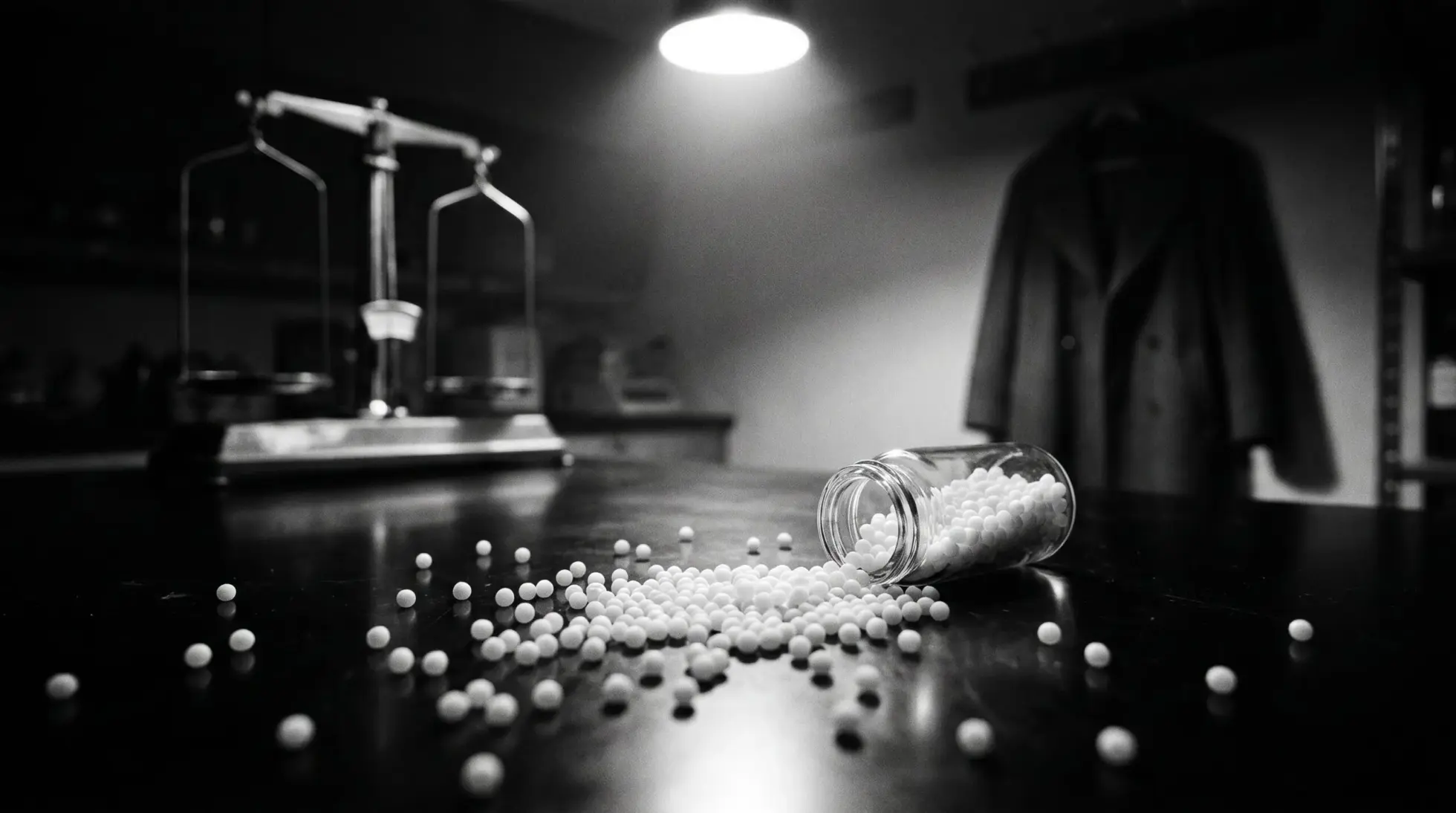
Why not a single molecule of active substance survives inside a homeopathic pill, why the flu with sugar lasts exactly as long as without it, and why a state registers a nothing as medicine
I have smiled and stayed silent a great many times in my life. Someone sits across from me, eyes shining, and tells me the little white pills chased off their flu, stopped their child’s infection, magicked away their hay fever, and I nod and I smile and I swallow the correction sitting on the tip of my tongue. I know that there is nothing in those pills. Not a little, not a trace, not a residue, but simply nothing at all. And still I smiled for years, because you do not gladly take from anyone the small belief that carried them through a feverish winter. It costs nothing, I told myself, it comforts, and who am I to argue someone out of comfort.
That is over now, this text no longer smiles, it does the math. It takes a single product and lays it on the dissection table, and by the end of this text you will know why a homeopathic pill is the purest form of sold nothing that the legal market has to offer. I stay with the little pill and I do not widen the subject artificially, because the pill on its own gives us plenty. Anyone who has hung their worldview on these sugar beads is about to be furious, and I have a certain understanding for that, though no argument that I therefore withdraw. This is science, and this blog concerns itself with science, even when the science in this case is inconvenient.
What is actually inside the pill
Let us begin with the number that decides everything, and let us do it at once, so that nobody has to wait 3,000 words for the punchline. Homeopathic remedies are diluted, in stages, and the stages have names. A D potency means dilution at a ratio of 1 to 10 per step, a C potency at a ratio of 1 to 100 per step. D7, a common value from the pharmacy shelf, is therefore a dilution of 1 to 10 million. That already sounds like very little, and in chemistry it is. But homeopathy does not stop there, that is where it truly begins.
Take C30, the classic of the remedy shelf. C30 means the starting substance was diluted 30 times at a ratio of 1 to 100. That yields a dilution of 10 to the power of minus 60, a 1 with 60 zeros after it in the denominator. Against that stands a fixed constant of nature, the Avogadro number, which tells us how many particles sit in one mole of a substance, roughly 6 times 10 to the power of 23. Once the dilution exceeds that number, and that already happens at around C12, the probability that a single molecule of the starting substance still sits in your pill is statistically zero. At C30 we are far beyond that line. At C200, which you can also buy, we are talking about 10 to the power of minus 400, a number that no longer has any counterpart in the entire known universe.
Let us make it vivid, because bare exponents slide through the brain like water through the fingers. To have any arithmetical hope of even one remaining molecule of the starting substance at a C30 dilution, you would need a quantity of water in front of you that goes far beyond everything this planet holds. You are holding a little vial in which, statistically, nothing remains of what the label promises, and you are paying a price that pretends an active ingredient is sitting inside. That is not an opinion, that is arithmetic, and arithmetic cannot be talked around.
What remains in a C30 pill is the carrier, and the carrier is sugar. Milk sugar and cane sugar, pressed into a small bead, sweet and round and entirely free of any active substance. You are buying a sugar bead on which a drop of a solution once sat, in which a molecule of something may once have been present. The price of this bead bears no relation to its content, because it simply has no content.
Why I am allowed to do this arithmetic, even though I am no pharmacist. For a large part of my life I have read substances, traces and data sets forensically, and the first question any real forensic examiner asks is always the same, namely whether there is something in a sample or not. A dilution series is no secret, it is a multiplication that anyone can follow with a pocket calculator. You do not need to have received any special consecration to understand 10 to the power of minus 60. You only need to be willing to look at the number, instead of believing the feeling that has formed around the number.
How you manufacture a nothing
To understand how these pills came about at all, one has to go briefly to a German physician from the years around 1800. Samuel Hahnemann, born 1755, died 1843, set out his guiding principle in 1796 in an essay with the cumbersome title „Versuch über ein neues Prinzip zur Auffindung der Heilkräfte der Arzneisubstanzen“, an attempt at a new principle for discovering the healing powers of medicinal substances. „Similia similibus curentur“, let like be cured by like. His main work, the „Organon der Heilkunst“, appeared from 1810 onward, and he kept refining it until 1842, through 6 editions. At the beginning stood a single observation, the famous cinchona bark experiment. Hahnemann took cinchona bark, which helped against malaria, and from it he himself developed malaria-like complaints, and from that he drew the sweeping conclusion that whatever produces symptoms could also heal those same symptoms.
Out of that one observation he built an entire system. He had healthy people take substances and noted down every twinge, every shift of mood, every dream, and these collections of symptoms became the basis of prescription. The dilution into infinity, which today counts as the actual hallmark of homeopathy, came only later, it was a later invention of Hahnemann and not the starting point. The more diluted, so the new teaching went, the stronger the effect, a sentence that contradicts every experience of daily life, because nobody grows more awake from ever weaker coffee.
You have to see Hahnemann in the context of his own time, and here comes a thought that matters to me. Medicine around 1800 was a catastrophe. They bled patients until the circulation collapsed, they administered mercury against nearly everything, they applied enemas and emetics, and whoever fell into a physician’s hands back then was often better off escaping in time. Against that backdrop, Hahnemann’s idea of leaving the patient largely in peace with heavily diluted remedies was genuinely a step forward, because it did less harm than the brutal competition. Doing nothing was, around 1800, sometimes the best available medicine. That does not justify homeopathy, it only explains why it survived, while bloodletting rightly ended up in the museum. Let us return to the manufacturing, because that is the real joke of the thing.
Dilution alone was eventually too little for Hahnemann, so potentization was added. At every dilution step the vial is shaken vigorously, or more precisely, it is struck several times against a surface, in the classic variant against a leather cushion or against one’s own hand. This procedure is called succussion, and without it, so the teaching goes, the remedy does not unfold its power. So you dilute a substance until it has long since vanished by the numbers, and you strike the vial against your hand each time, so that the nothing remembers what once was in it. If you are reading this in such clarity for the first time and your sandwich drops out of your hand, then you have grasped the core of the matter.
The memory that water does not have
The obvious question occurs to every halfway alert person at once. If there is nothing in it, how is it supposed to work? The answer of homeopathy is the most elegant sleight of hand in the history of medicine. It is not the substance that acts, they say, but an information that transfers onto the solvent and the sugar during succussion. Water is said to have a memory, to remember the substance even when no molecule remains. The Australian health authority describes exactly this second core assumption of homeopathy quite soberly, that highly diluted preparations retain a „memory“ of the original substance. That is not an invention of its opponents, that is the self-description of the doctrine.
Only water has no memory. Water is a gathering of molecules that reorder themselves on a picosecond timescale and forget every structure within fractions of a second. If water remembered everything that had ever flowed through it, then every mouthful of tap water would carry within it the information of every sewage plant, river and bladder on this planet, and that would be a considerably more unsettling notion than any flu. Why does the water remember the expensive duck extract of all things, and not the chlorine from the pipe it flowed through? There is no answer to that question, because the memory does not exist.
For homeopathy to work, one would have to suspend physics and chemistry at several points at once, so fundamentally that in the end not even a cup of coffee would remain explicable. There is no measuring instrument on earth that could detect the difference between a C30 pill and a pure sugar bead, because that difference does not exist. People have tried it with highly sensitive methods, they have measured water, compared it, analyzed it, and the result was always the same. The memory of water is no mechanism, it is an excuse in a white coat.
The test it has failed for decades
At this point the objection likes to arrive that science is simply too coarse to capture the fine effect. So let us measure not the molecule but the result. You take 2 groups of sick people, you give one the homeopathic remedy and the other an indistinguishable sugar bead, and nobody knows until the end who got what. That is exactly what the placebo-controlled trial is for, and it is exactly this test that homeopathy has faced again and again for decades. The result is as clear as a result in medicine can possibly be.
The Australian National Health and Medical Research Council examined the entire available body of evidence in 2015, an overview of 57 systematic reviews with 176 individual studies, spread across more than 60 conditions. The verdict fits into a single sentence, and it reads that there are no health conditions for which there is reliable evidence that homeopathy is effective. Among them, and this is decisive for our flu topic, were expressly the influenza-like illnesses and the classic upper respiratory infections we call colds, where no reliable advantage over the sugar bead showed itself. The British science committee of the House of Commons reached the conclusion that systematic reviews and meta-analyses showed homeopathic products performing no better than sham medicines, and that any perceived benefit rested on the placebo effect alone. The large comparative study by Shang and colleagues, published in the medical journal The Lancet in 2005, pointed in the very same direction. The finding repeats itself, ever since it has been seriously measured.
And the placebo effect itself is, to be fair, no nothing, that has to be said. The belief in a treatment, the attention of a person who listens, the ritual of taking something at fixed times, all of that can dampen pain and lift wellbeing, measurably and really. A homeopath who takes plenty of time and looks at the whole human being produces exactly this effect, and that is why their patients often feel better. Only this effect comes from the encounter, from the attention, from the ritual, and not from the sugar. You could achieve the same effect with a pure sugar bead, and that is precisely the point of the placebo group.
I want to be honest here as well, because the honest phrasing is stronger than the dramatic one. There are individual small studies that reported an advantage for homeopathy. They were uniformly small, methodologically weak or poorly documented, and no well-conducted, sufficiently large study has confirmed the effect. There are also associations that fight the Australian report bitterly to this day and accuse it of methodological errors. These counter-voices exist, and I do not conceal them. Only they change nothing about the overall picture, because the overall picture is assembled from many independent sources and keeps hitting the same point. I long believed the adherents secretly all knew better. That is not true, and the correction matters, because most of them really do believe in it, and that makes the thing not more harmless but more stubborn.
The duck with no duck in it
If you want to see a single product in which the whole absurdity can be grasped with your hands, then take the best-selling homeopathic flu remedy in the world. Its starting material is an extract from the heart and liver of a wild duck, obtained from a 1 percent solution. This solution is diluted 200 times at a ratio of 1 to 100, by the so-called Korsakovian method from a single flask, with succussion at every step. We are back at 10 to the power of minus 400, far beyond any molecular limit. What you swallow in the end are little sugar pills of milk sugar and cane sugar, in which nothing whatsoever of the duck remains, no heart, no liver, not a single molecule.
It is, with respect, the most expensive duck extract in the world that contains no duck. The idea behind it is even lovelier than the product. Wild ducks count as a natural reservoir for flu viruses, so, the reasoning goes, an extract of the duck must somehow help against the flu. You take the animal that harbors the viruses, dilute it into nothing, and hope that the memory of the duck brings the immune system into shape. The Cochrane Collaboration, the most internationally respected body for evaluating medical studies, examined this remedy thoroughly in 2015. The 2 studies on prevention showed no protection against the flu, and for treatment the evidence, in its weak quality, was not enough to make any dependable statement. A remedy made from a duck in which there is no duck, against an illness it neither prevents nor shortens, sold in millions of packs. One could laugh about it, if only so many people did not spend their money and, worse, their time on it.
Why it feels as though it works
Now we come to the point at which the pills win their adherents, and this point is psychological and not pharmacological. Take the flu, the standard example on which everything shows itself. A real case of the flu is a self-limiting illness. According to the American health authority CDC, the acute complaints usually last a few days to about a week, after which the infection subsides on its own, because the immune system defeats the virus. Cough and exhaustion can linger longer, but the course is at its core always the same, and the body does the actual work entirely by itself.
And here the trick happens that no pill manufacturer says out loud, because he needs it himself. You fall ill on Monday, you feel wretched, on the third day you reach for the pills, and around the seventh day you feel better. The pills pocket the applause for a recovery that would have come anyway. The body heals, and the sugar takes a bow for the applause. Exactly the same, by the way, holds for most of the over-the-counter flu remedies from the pharmacy, in which an active ingredient very much does sit, because that too only lowers the fever and dampens the pain, without shortening the viral course. And the same holds for the trip to the doctor on Monday, who for a normal flu has little to offer beyond advice and rest. An uncomplicated flu takes its time, no matter what you take, no matter what they prescribe you, no matter how expensive or how cheap the stuff is. The only difference is that the pharmacy preparation at least honestly eases a symptom, while the pill pretends to heal the cause.
This error in thinking is called the fallacy of temporal succession, a touch more elegant in Latin, but just as wrong. Something happens after something else, therefore the one must have caused the other. The rooster crows, then the sun comes up, so the rooster wakes the sun. The entire edifice of homeopathic success stories rests on this one rotten beam, and it stands astonishingly stable, because our brain loves causes and hates coincidences. We are built to see an intention in every coincidence, and this ancient wiring was once vital for survival, but on the remedy shelf it leads us straight around by the nose.
When the nothing turns into pneumonia
Up to here the whole thing is above all expensive and a little silly. Now it turns dangerous, and here the mockery stops for me. The flu is mostly harmless, but only mostly. In some people it tips over, and the viral infection becomes a secondary bacterial pneumonia, one of the most common and most dangerous complications of influenza. The CDC lists exactly this complication expressly, and it can become life-threatening. Especially affected are older people, small children, pregnant women and people with chronic underlying conditions, that is to say precisely those who have the fewest reserves to begin with.
And in this moment the person stands there with their vial of pills, the pills that apparently helped so nicely with the harmless flu, and now trusts the same sugar with something that can kill them. The belief that only cost money with the harmless infection now perhaps costs days, and with a pneumonia days are the currency in which life and death are settled. The Australian health council named this danger as clearly as an authority can. Homeopathy should not be used for conditions that are chronic, serious or could become serious, and whoever rejects or delays effective treatment thereby endangers their health. That is not a quote from some polemical pamphlet of the pill-haters, that is the official warning of a national health authority.
I deliberately do not say that homeopathic pills kill people, because there is no clean number for that, and I do not set a number I cannot support. What I do say is more precise and therefore harder to refute. The danger of the pill lies not in the pill, that is only sugar and as such harmless. The danger lies solely in the time it costs. Every day on which someone treats a serious illness with a nothing is a lost day, and with a pneumonia every single one of them counts. No sugar in the world beats a pneumonia. Whoever believes in the pills for the harmless flu and therefore goes to the doctor too late for the dangerous variant, I wish them from the heart that they belong to the lucky ones for whom it stays harmless. On that luck I would only reluctantly bet my own health.
The pharmacist who knows better
Now it gets personal, and I mark this expressly as my opinion, so that nobody confuses evidence and judgment. I consider every pharmacist who slides these pills across the counter to be operating on the edge. And I mean that exactly as hard as it sounds. A pharmacist has a degree in pharmacy behind him, he knows the Avogadro number, he knows the dilution arithmetic better than I do, he knows with absolute certainty that there is nothing in the vial. And still he sells it, for not a little money, because people ask for it and because the sales feel good. That is my reproach, and it is an opinion and not a criminal charge, because legally the pharmacist is in the clear. That is precisely the real irritation of the whole affair.
For the state even sanctions this nothing, instead of reining it in. In Germany, finished homeopathic medicines are not approved but merely registered, under paragraphs 38 and 39 of the Medicines Act. The difference is enormous and is gladly overlooked. An approval demands proof that a remedy works. A registration does not demand any such thing. Homeopathic remedies enter the market expressly without any statement of an area of application, that is to say without saying what they even help against. The responsible Federal Institute for Drugs and Medical Devices puts it with remarkable openness, that the legislator did „not provide for proof of efficacy“ for this group of medicines. Only the safety and the pharmaceutical quality are checked, whether the remedy is cleanly manufactured and harmless. Whether it works, nobody checks, because nobody has to. A nothing that is clean and harmless may call itself a medicine and stand on the shelf next to real drugs, and several hundred such remedies are even exempted from individual examination altogether.
The Americans at least went one small step further. The trade authority there, the FTC, demanded in 2016 that a homeopathic remedy must either prove its effect scientifically or make clear on the label that there is no such proof. On a pill product it would then have to say, in substance, „there is no scientific evidence that the product works“, and that the claims rest solely on theories of homeopathy from a long-outdated era that are not accepted by most modern physicians. Savor that for a moment. A state authority considers it necessary to point out to the buyer expressly that his medicine is at bottom an idea from the age of the stagecoach, for whose effect there is no proof whatsoever. A label can hardly be more honest, and still the stuff keeps selling.
The bubble that will be furious
Germany has a great many alternative practitioners, and here I have to draw a distinction that truly matters to me, because otherwise I would be unjust. I am an explicit supporter of people being treated systemically, that is to say of not merely pressing down a symptom but searching for the cause behind it. A good practitioner who listens, who looks at the whole person and asks after the reason behind the complaints, is something valuable, and conventional medicine has far too little time on exactly this field. So far I go along completely. But a practitioner who swings a pendulum over the belly, lays on hands or tests with dubious devices what the organism allegedly needs right now, has in my firm conviction nothing to do with medicine. That is esotericism in a costume, and the costume deceives the patient about what is really inside.
It is, by the way, no law of nature that a state must tolerate this. Austria, for example, does not tolerate it. There the practice of the healing arts is reserved exclusively to physicians, and the profession of the alternative practitioner, as well as the training for it, are prohibited and even punishable under the Medical Practitioners Act, which the European Court of Justice has confirmed as compatible with EU law. Germany does not follow here, and that is honestly to be expected, because the alternative practitioner is a firm and tradition-rich institution in this country. But you ought to know what this institution actually rests on. Many people believe that behind the title there stands a long, demanding training. In truth it does not. For the German alternative practitioner no particular training is prescribed, all that is required is passing an official medical examination at the health office, and this examination is meant at its core only to ensure that the candidate poses no danger to public health. It is a safety check, not a medical state examination.
And then there is the escalation at which it becomes finally grotesque. With the animal alternative practitioner even this thin hurdle falls away. The occupational title of animal alternative practitioner is not legally protected in Germany, as even the state veterinary chamber confirms in all clarity. Anyone may call themselves that, anyone may work that way, there is no prescribed training and no state examination, and practicing the profession is possible even entirely without any training. Under the prevailing case law the mere self-designation does not even count as misleading. Picture that for a moment. A car mechanic who after 12 years no longer feels like getting his hands dirty simply writes animal alternative practitioner under his name, hangs a sign in the window, and that is perfectly legal. No examination, no proof, no real oversight. And because here an animal can neither choose its practitioner nor object, the owner alone decides whether the sick animal comes to someone who swings a pendulum, or to someone who can truly heal. When a seriously ill animal is treated for days with sugar pills, instead of being professionally cared for in time, then that is the same lost time as with the neglected pneumonia, only on a creature that can neither defend itself nor object. The whole alternative-practitioner bubble will be furious over these sentences. I am fully aware of that, and it changes nothing, because not one of these sentences is false.
What I explicitly defend
So that nobody carries away the wrong thing in the end, I draw the line as sharply as I can draw it. I am not shooting at natural medicine, I am shooting at the fraud in the coat of natural medicine. Nature is one of the most powerful pharmacies we know, and that is no romantic sentence but a hard pharmacological fact. From the leaves of the foxglove, the digitalis, medicine obtains the cardiac glycosides digitoxin and digoxin, which are used for heart failure and for cardiac arrhythmias. From willow bark comes salicin, which in the body becomes salicylic acid, and out of that came acetylsalicylic acid, the aspirin that has stood on the World Health Organization’s list of essential medicines since 1977. From annual mugwort the Chinese pharmacologist Youyou Tu isolated artemisinin against malaria, and for it she received the Nobel Prize in Medicine in 2015.
Do you see the decisive difference? In all these cases a real molecule sits in the plant, an active substance that can be measured, isolated and dosed. And because it works, it can also harm. The foxglove is a poisonous plant, its cardiac glycosides have only a narrow therapeutic window, the dose must be precisely right, or the remedy turns into a deadly poison. That is exactly the mark of real medicine. It has an active substance, it has a dose, it has an effect, and it has a risk that must be taken seriously. The homeopathic pill has none of all that. It has no active substance, no effective dose, no demonstrable effect, and, this is its only honest advantage, no direct risk either, because in sugar there is simply nothing that could do harm. The difference between real plant medicine and homeopathy is the difference between an active substance and the mere memory of an active substance. The one is a warm meal, the other is the notion of becoming full because you remember a meal that someone else ate a long time ago.
Send me your money
Let us come to the practical part, because I am a friend of practical solutions. Anyone who after this text is still of the firm conviction that the information of a substance can transfer onto sugar and heal, to them I make an exceptionally fair offer. Write me an email or a short message on Telegram, and I will send you my account number without delay. Then I take a standard pack of sugar cubes, lay my hand on it, concentrate for a moment and transfer my very own information into the sugar, in principle exactly what happens during succussion and during the laying on of hands, only without the cumbersome detour through the vial. Afterwards you receive a potentized pack of Georgie C1, charged with my own energy, and in return I pocket the 500. That is, to be honest, the most transparent business model I can present to you in this entire text, because you know from the outset exactly what you are getting, namely pure sugar.
The only difference between my offer and the pill on the shelf is honesty. I tell you to your face that you are buying sugar. The pack on the shelf does not tell you, the pharmacist does not tell you, and the Medicines Act to this day forces nobody to tell you. And that is why, the next time someone with shining eyes tells me about their beloved pills, I no longer smile politely to myself. Instead I write this text and lay it on the table, and whoever after that still reaches for the white bead does it at least no longer in the belief that it is medicine. It is the most expensive nothing in the world, sweet, round and entirely empty, and the only active ingredient in it sits between your ears.
References
- Bundesinstitut für Arzneimittel und Medizinprodukte. (2025). Themendossier Homöopathische Arzneimittel. Bonn: BfArM.
- Centers for Disease Control and Prevention. (2026). Influenza (Flu): About, Signs and Symptoms, Surveillance Manual Chapter 6. Atlanta: CDC.
- Deutscher Bundestag, Wissenschaftliche Dienste. (2018). Zum Beruf des Heilpraktikers in Österreich und der Schweiz (WD 9-110-18). Berlin: Deutscher Bundestag.
- Federal Trade Commission. (2016). Enforcement Policy Statement on Marketing Claims for OTC Homeopathic Drugs. Washington, D.C.: FTC.
- Fisher, P., & colleagues. (2021). Similia Similibus Curentur: Theory, History, and Status of the Constitutive Principle of Homeopathy. Homeopathy.
- House of Commons Science and Technology Committee. (2010). Evidence Check 2: Homeopathy. London: The Stationery Office.
- Mathie, R. T., Frye, J., & Fisher, P. (2015). Homeopathic Oscillococcinum for preventing and treating influenza and influenza-like illness. Cochrane Database of Systematic Reviews, 2015(1), CD001957.
- National Health and Medical Research Council. (2015). NHMRC Information Paper: Evidence on the effectiveness of homeopathy for treating health conditions. Canberra: NHMRC.
- Sächsische Landestierärztekammer. (2025). Tierheilpraktiker. Dresden: Sächsische Landestierärztekammer.
- Shang, A., Huwiler-Müntener, K., Nartey, L., Jüni, P., Dörig, S., Sterne, J. A. C., Pewsner, D., & Egger, M. (2005). Are the clinical effects of homoeopathy placebo effects? Comparative study of placebo-controlled trials of homoeopathy and allopathy. The Lancet, 366(9487), 726 to 732.
Disclaimer: This article reflects the author’s own research and opinion as of the publication date shown above; later findings or legal changes may have overtaken it, so always check that date. Sources are cited for independent verification, and no liability is accepted for third-party studies. This is general information, not medical, legal, or professional advice: for medical questions see a doctor, for legal questions a lawyer, and in an acute crisis contact emergency services or a crisis helpline.
About the header image: it is AI-generated. Cheaper than a photo shoot, and I have made my peace with the age of AI. Everything inside the article is real, the diagrams, the skulls, the findings, and every word. The machine gets the opening shot and not one inch past it.
Six years later: you can take the tinfoil hats off
COVID-19 was not a statistical illusion: 22.1 million excess deaths worldwide and 1,245,272 American death certificates naming it…
Houston, I Have a Problem, and It Is in My Glass
A perfectly healthy man quits in the middle of high summer because pure water turns into an accomplice…

Where Does Cancer Come From? 20 Years of Thinking About a Disease That Keeps Growing More Common
A good friend sends me a Spiegel article, and twenty years of notes fall into place. What did…