If you wake up at 3 a.m., you are not sick, you are running on very old software
Why our ancestors took a break between two sleeps at night and spent it praying, chatting, and eating, why Homo sapiens never slept straight through from 10 p.m. to 8 a.m. on schedule, and why it is not the hour that ruins the night but the damned smartphone, the worry, and the quick grab for a diagnosis.
It is Sunday, and I had sworn something to myself … and broken it …
Yesterday was the most stressful day I have ever lived through, and I do not mean that as an exaggeration but as a sober ranking after decades in which there was truly no shortage of stressful days. So at some point late in the evening I promised myself that I would do absolutely nothing for a week. Zero assignments, zero code, zero text. After all, as you all know, I stepped off the hamster wheel long ago, and anyone who steps off is allowed to sit down for once and watch the wheel keep turning without him… and it will keep turning.
Then I woke up this morning and read a long email. It came from Vanessa, a really good friend of mine, and it described a phenomenon I know by heart, because I had it myself and because it feels like every other person I meet has told me about it since. She wakes up at night, always at roughly the same time, around 3 a.m., then lies awake and wonders what is wrong with her. And because the human mind in that situation never stops at the harmless explanation but reliably slides all the way down to the worst one, she is by now worried sick that something serious is behind it.
So my vow held about as long as a New Year’s resolution at the gym, except that I did not even make it to breakfast. Stepping off the hamster wheel apparently does not mean that I stop writing or stop wanting to help people. So here I am after all, and this text is basically the long version of what I tell everyone who asks me about it. I will say it right at the start, so nobody has to wait until the end: Waking up at 3 a.m. is not an illness, it is completely harmless. The only thing wrong is how we react to it today, namely by pathologizing it. I am sick, I have depression, I am heading for burnout, something is wrong with me. That is the reflex, and that very reflex is the real problem. Our brain has a funny quirk: if we have no problems, it hands us one. :xD
I went through this phase myself, this punctual waking around 3 a.m., night after night, as if someone had set an alarm clock in my head without asking me. And I dealt with it the way I deal with everything, which is to say obsessively, until I had understood the mechanics. My opinion up front, clearly marked as opinion: if we start turning natural processes that we have simply forgotten in our modern age into an illness, we are on the wrong path entirely. What comes after this is the evidence that this process really is natural.
Homo sapiens had no alarm clock and no 10 p.m. rule
With everything, I look for the cause first, and with human beings the cause almost always lies further back than you think. What were people like back then? What were they like 10,000 years ago, before light bulbs, shift schedules, and sleep apps? Do you really think Homo sapiens went to bed on the dot at 10 p.m. and then slept like a log until 8 in the morning? Do you really believe that?
The idea is so absurd that it is almost touching. A human being in an open landscape, with predators, cold, a fire that has to be tended, and a group whose survival depends on not everyone being out cold at the same time at night. And this person supposedly lay unconscious for 10 hours straight because he had to show up well rested for a meeting the next morning.
Today we can even check this, and not with imagination but with measuring devices on the wrist. A research group around the anthropologist Gandhi Yetish measured sleep in three preindustrial societies only in 2015 (not that long ago, for once), in Tanzania, in Namibia, and in Bolivia, among people without electric light. None of these groups went to sleep at sunset. On average they fell asleep only 3.3 hours after sunset, usually woke before sunrise, and came to a sleep duration of 5.7 to 7.1 hours. That is not a lot, it sits at the low end of what people in industrial societies sleep. Nobody there kept the night we hold so sacred, with 8 or 9 hours in one stretch. And why would they?
Now I have to rein myself in once again, because I want to report the finding honestly here and not the way it fits my text best. The same study found no long waking phases in the middle of the night in these three groups. Anyone who now expects traditional peoples everywhere to get up at 1 a.m. and go sit by the fire will be disappointed by these data. So the picture is not uniform, and that alone is the first lesson for everyone who believes there is one right, healthy kind of sleep. There is no such thing, there is a range, and the modern ideal does not even sit in its middle.
The second study is even more interesting for our topic. The anthropologist David Samson and his team measured the nights of the „Hadza” in Tanzania in 2017, a community of hunter-gatherers. Over 20 days of observation, they found only 18 minutes in which every member of the group was actually asleep at the same time. 18 minutes in 20 nights. The median was eight people awake at some point every night. The researchers interpret this as sentinel behavior: because people get tired at different times and wake up at different times, there is always someone around who keeps an eye on the surroundings. And then they write a sentence I would put on the nightstand of everyone who lies awake at night and thinks he is broken. The nighttime waking of modern humans may be a legacy of natural selection, which once made sure that sleep was less dangerous.
Go ahead and read that sentence a second time. What you experience as a defect at 3 a.m. was a survival function over a very long stretch of time. Your brain is simply keeping watch, as it always has. It just does not know that there is no bear outside your apartment door, at most the neighbor taking out the recycling.
First sleep, second sleep, and an hour in between
Anthropology supplies the range, history supplies the pattern, and this pattern is so well documented that you wonder how it could ever have been forgotten.
The American historian Roger Ekirch of Virginia Tech spent some twenty years working through diaries, court records, medical writings, and literature, mostly from Great Britain, but not only from there. He found more than 500 references to a practice that was so self-evident back then that nobody had to explain it: the first and the second sleep. The trail goes back as far as Homer’s Odyssey. His book on it appeared in 2005 under the title „At Day’s Close“.
The pattern was almost always the same. About 2 hours after nightfall, people lay down and slept for 3 to 4 hours. Then they woke up, without an alarm clock and without panic, and stayed awake for a while. After that came the second sleep, also called morning sleep, which lasted until it got light. The first one even had its own, somewhat grim name: people called it dead sleep. The waking phase in between had no fixed term, sometimes people simply spoke of the watch.
And what did people do during that time? All sorts of things, and this is the part that makes me grin every single time. They prayed, talked over their dreams with whoever shared the bed, chatted about the day before, did housework, smoked, ate something, took their medicine, or had great sex. A 16th-century French physician even expressly advised couples not to conceive their offspring right at bedtime but only after the first sleep, because it went better when they were rested, which makes sense, right? I have nothing to add to this medical recommendation, except that it is probably the only one from the 16th century that everyone would still sign today without objection.
The night was busy, and nobody lay there staring at the ceiling because they believed they had a problem.
Nor was this a European peculiarity. Some Tiv in central Nigeria use terms that roughly translate as „first sleep” and „second sleep” to describe their nights.
The experiment in which the body did it all by itself
Historical sources can be doubted, diaries can exaggerate, court records only tell what mattered in court, or, as I often had to read in the past, not even that. That is why the following experiment is so valuable, because it lets the body speak for itself.
In the early 1990s, the psychiatrist Thomas Wehr at the National Institute of Mental Health in the United States wanted to know how people sleep when you take artificial light away from them, to me a pioneering „experiment.” He moved healthy test subjects from a normal day with 16 hours of light into a rhythm in which it was light for only 10 hours and dark for 14, and he kept that up for a month. He published it in 1992 in the Journal of Sleep Research, under a title that says it all: in short days, human sleep is biphasic.
In the first days, people simply slept a very long time, apparently catching up on what had piled up over years. After that, something settled in that nobody had taught them. Their sleep split into two blocks of roughly equal length, with a waking phase of 1 to 3 hours in between. In the BBC’s account it sounds like this in plain terms: about 4 hours of sleep, then 1 to 2 hours awake, then about 4 hours of sleep again. The nightly release of melatonin stretched out as well. The very pattern from Ekirch’s archives, produced in a lab by modern Americans who had never read a diary from the 17th century. So a federal agency of the United States needed a month of lab time to find out what every farmer in the 17th century knew without filing an application.
Frankly, I find this finding more comforting than any sedative. The body has a program, and as soon as you give it the conditions it was written for, it runs, without any installation manual.
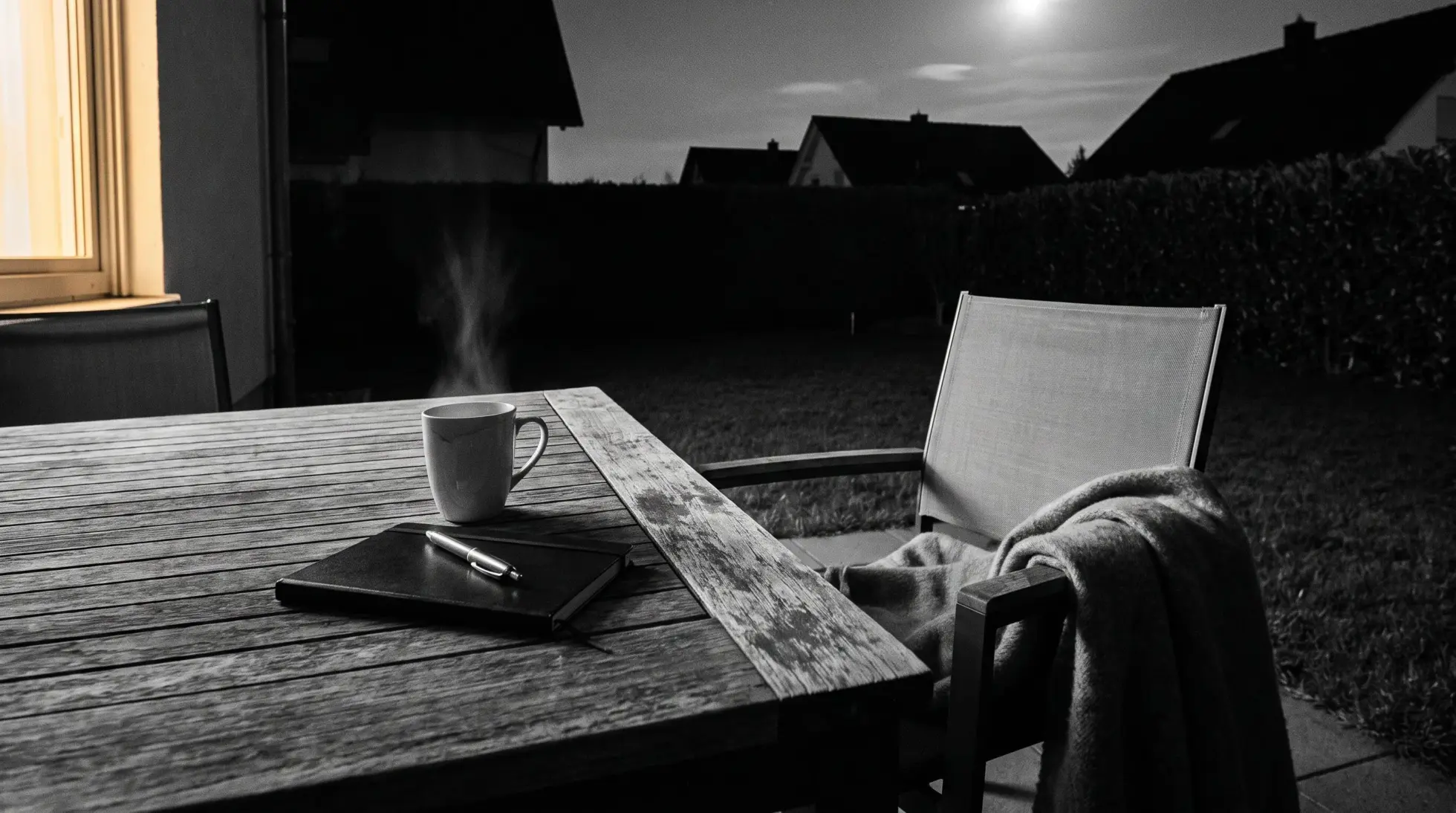
A word of caution, and it comes from science itself, not from me. The chronobiologist Russell Foster told CNN that nobody should force segmented sleep on himself as a regimen, especially not if total sleep time shrinks in the process. That is right, and it fits my point perfectly. This is not about inventing a new sleep ideal and then feeling bad again when you fail to reach it. It is about dropping the old ideal. Because here we are only creating a problem where I truly see none. When I wake up at three in the morning, and yes, it is usually that damned hour, 3 a.m., I do not turn on a light, my damned smartphone is somewhere else anyway, in the car, and the MacBook stays off. I do not fill my brain with garbage during this very waking phase, instead I go sit outside in the dark backyard, for example, or make myself a cup of tea. I learned to live at a slower pace, and I am no longer a hostage to bad news. In these phases I get my most brilliant ideas and inspirations, and I write them down.
How the break disappeared and why of all numbers the 8 became sacred
If the pattern is so natural, why does hardly anyone know about it today? The answer has to do with light and with factories.
From the late 17th century on, the references to the first and second sleep begin to fade. Street lighting and later industrialization shifted social life into the night, and going to bed early suddenly counted as a waste. In the early 19th century, the first sleep then expanded at the expense of the second one and of the waking phase in between, until the break finally vanished from collective memory altogether.
And now comes the punchline that actually made me laugh out loud while I was researching. At roughly the same time that accounts of the first and second sleep disappear from the sources, a new affliction turns up in the literature. Toward the end of the 19th century, the form of insomnia in which you wake up at night and cannot fall back asleep is described for the first time. So we did not abolish the hour between the sleeps. As usual, we simply gave it a medical name and declared it a disorder.
The sacred number 8, by the way, has a remarkably unromantic origin. In 1817, the British factory owner and social reformer Robert Owen coined the slogan: eight hours of labor, eight hours of recreation, eight hours of rest. It was a declaration of war on workdays of 12 to 16 hours in the spinning mills of the Industrial Revolution, a political program for humane working hours. It was never a finding of sleep medicine. So we took a labor demand from the age of the steam engine, declared it a law of nature, and now feel sick when we fail to meet it at 3 in the morning. Owen would probably be quite astonished at what has become of his banner. Owen fought for eight hours of rest, and we turned it into a nightly exam you have to pass, with a sleeping pill if need be. Surreal, isn’t it?
Why it is 3 a.m. of all times
Do the math with me for a moment, because this calculation is my own and not a study result. Take as an example a person from back then who went to sleep around 9 p.m. Add 3 to 4 hours of first sleep, and he is awake around midnight or 1 a.m. Today people tend to go to bed around 11 p.m. Add the same 3 to 4 hours, and you land at 2 to 3 a.m. So the notorious 3 a.m. waking could (my opinion: is) simply be the old midnight break, just pushed back by however long our evenings run these days.
Although that is only half the explanation, and the other half is at least as interesting. Anyone who is going through a period of upheaval, has just moved, changed jobs, or is otherwise sleeping in a new environment has a brain that does something very clever. A research group at Brown University around Masako Tamaki showed in 2016 that during the first night in an unfamiliar place, one hemisphere of the brain sleeps more shallowly than the other and literally keeps night watch. This more vigilant half reacts more strongly to unfamiliar sounds and wakes the sleeper faster. In the following nights, the asymmetry was gone. Sleep researchers call this the first-night effect, and the researchers interpret it as a survival function in an unknown and potentially dangerous environment.
There he is again, the „sentinel of the Hadza,” except this time he sits inside your own skull. Anyone who has just rearranged his life should not be surprised when the brain goes on patrol at night for a while. That is no defect but a pretty clever night watchman who does not know the new neighborhood yet and would therefore rather make his rounds once too often.
The only real mistake lies on the nightstand
There is just one thing our ancestors did not have at 3 a.m., and that is a smartphone on the nightstand. This is where the real mistake happens, and it happens in nearly every story people tell me, almost without exception.
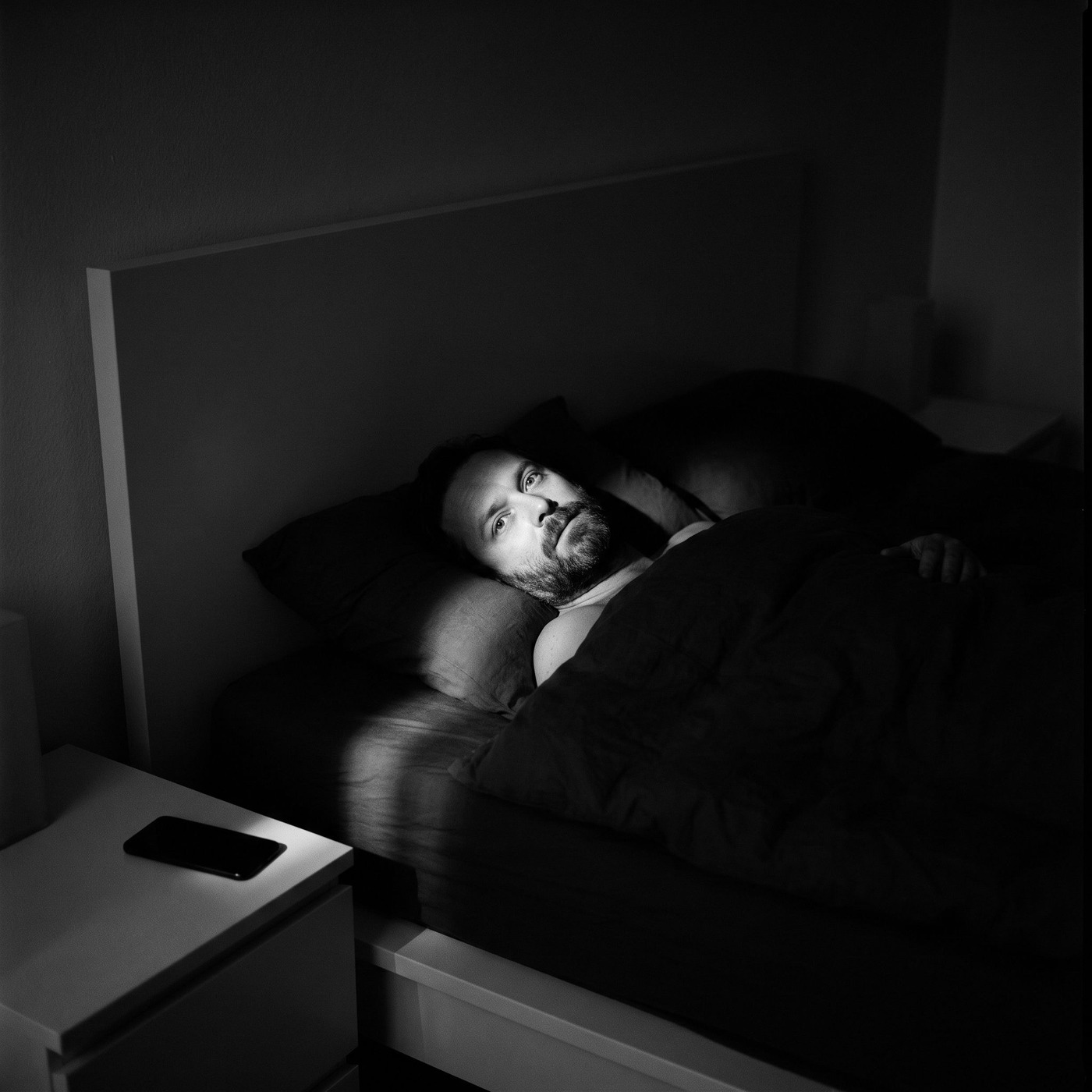
You wake up and reach for your phone, just for a second, just to see what time it is. Then you see a message, read three bad headlines, scroll through Instagram, and at some point end up at an article about rare diseases whose symptoms all somehow fit. Anyone who googles his symptoms at 3 a.m. no longer just wakes up, he wakes up as a patient. After that the night is shot, and the next morning the verdict is that you slept badly.
Our brain, our entire organism, is not built to have a damned iPhone in hand all the time and scroll around on it. This is not cultural criticism from someone who thinks everything used to be better, this can be measured like everything else. A group at Harvard Medical School around Anne-Marie Chang had people read in the evening in 2015, either on a light-emitting reading device or in a printed book. With the light-emitting device, people needed longer to fall asleep, released less melatonin, their internal clock shifted later, and the next morning they were less alert. The light of the screen tells the brain that it is daytime, and the brain believes it. It simply cannot do otherwise, and this missing knowledge is increasingly becoming a problem for many people.
But I do not want to make the light the sole culprit, because that would, once again, be too convenient for good old George. The content is at least as bad, probably worse. No light spectrum in the world keeps a person awake as reliably as a piece of news that gets him worked up. The same goes for the laptop, the tablet, and every other device that glows at night while serving up news. And anyone who wakes up at night and then starts reading a newspaper on top of it, printed or digital, really has no business being surprised when he cannot fall back asleep. The hour between the sleeps was never meant for that. Our ancestors prayed, chatted, and ate bread during that time, but they did not work through the state of the world on three continents, where there are more and more conflicts and problems right now that, logically, trigger us immediately and cause worry.
The worry is worse than being awake
Even more insidious than the phone is a thing that needs no device at all. The biggest mistake of all is worrying about being awake.
Whoever thinks at 3 a.m., „Awake again, what is wrong with me?” switches on the very alarm system that drives sleep away. And this is where a mechanism comes in that I consider one of the most important findings in all of stress research, because it explains so much. When we worry and turn over in our minds what might happen, the body reacts as if it were happening right now. The psychologist Jos Brosschot of Leiden University and his colleagues pulled together the research on this in 2006 and described how worry, rumination, and anticipatory stress prolong the body’s stress activation, and they do so before a stressful event just as much as after it. The heart and circulation, the hormonal system, and the immune system stay in alarm mode, even though nothing is happening outside. A British study from 2013 fittingly found that people who ruminated a lot about stress showed a stronger cortisol response in the morning after waking. I have already written about what cortisol does more than once.
In plain words, this means: with nothing but our thoughts and the fear that it might happen, we torture ourselves into the ground, even though it will most likely never happen. The body simply cannot tell a real danger from an imagined one. It pays the same price for both, a price that is too high in my view. Worrying about being awake makes you more awake than being awake itself, and a harmless hour turns into a real burden that you have built entirely by yourself.
The sleep expert Gregg Jacobs summed this up very dryly to the BBC. Waking up at night, he said in essence, is part of normal human physiology. And the fear of it, in his observation, can really make sleep problems worse. Russell Foster went one step further and said that people should simply not worry about the way they sleep. Two scientists, one piece of advice, and it costs nothing. It would put sleep labs out of business.
Homo sapiens had real problems
In moments like these I always have to think of our ancestors, and every time I think to myself: holy shit, Homo sapiens had real worries. He had no running water, nor a toilet, nor gas heat in winter, nor light, and on bad days not even a fire. When he lay awake at 3 a.m. thinking, it was about whether the cracking behind the cave was a bear, and not about whether the cracking in his knee was a case for the orthopedist.
His toilet was a bush that he had to share with everything that lived in that bush. His bathroom had the temperature of the river in February, and his emergency heating service was himself, with two stones and a great deal of hope. When the fire went out, no technician came with an appointment three weeks out, instead there came a night in which you found out very thoroughly how many toes you actually need. He walked for hours to find water, and we lie awake because an app tells us we are still one glass of water short today. He never heard of cortisol, but he had every reason to release some.
And now imagine explaining our life to this man. We live in a cave where warm water comes out of the wall at the push of a button. We have a box that keeps food cold on its own, and a second one that heats it up on command. The light comes on when we clap, and our fire is called underfloor heating and never goes out as long as we pay the bill. On bad days he had no fire, on bad days we have a red bar on the battery and treat it like an emergency. And then you explain to him that we still lie awake at night because a wristband informed us that our deep sleep was too short. I am pretty sure that at that moment he would put us out of our misery with his club, and not out of malice but out of pure pity.
His biggest worry at 3 a.m. was whether he would still be alive at 4. Our biggest worry at 3 a.m. is whether we will be rested enough at 7 for the team meeting, where all we do anyway is listen. He was hunted by predators, we are hunted by push notifications, and the crazy part is that our brain releases the same hormones for both. We got rid of the leopard outside the cave long ago, but we replaced it with a group chat that never sleeps and has considerably worse manners.
And then there is the contemporary I call Otto Sapiens, the variant of Homo sapiens who believes he knows everything because he once listened to an audiobook about it. Otto Sapiens has of course educated himself extensively on the subject of sleep, namely at 3 a.m. on his smartphone. At 3:10 a.m. he knows the sleep stages, at 3:25 a.m. he has three diseases that match him, and at 3:40 a.m. he is wondering who should inherit his stamp collection. At 4 a.m. he has consulted three experts, one of whom was a naturopath and the other two were ads. At 6 a.m. he finally falls asleep, at 6:30 a.m. the alarm goes off, and Otto Sapiens now knows for certain that he sleeps badly. He is right, he just overlooked the cause, because it is in his hand.
Murphy is foresight, not overthinking
Now I have to clear something up, because otherwise someone who knows me will rightly raise an eyebrow. I call myself Murphy because I live by Murphy’s Law, that is, by the old engineering maxim that anything that can go wrong will go wrong at some point. I make my decisions by it, I play through every eventuality, and I cover myself several times over. Anyone reading this might think I am selling serenity here while living in permanent crisis mode myself, like the firefighter who secretly plays with matches at home.
The difference is decisive, and I described it at length in my text about Murphy’s Law. Murphy is not overthinking but forward-looking living and thinking, and I truly recommend that to everyone. The ball test, as I call it, asks before a decision what can happen if the worst occurs at this very point, and then it does something about it. It has a beginning, a result, and an end. After that the matter is settled, because the precaution has been taken.
Overthinking, by contrast, has no end, it circles around a worry you have no influence over, and it produces no precaution, only more worry. Anyone who lies awake at 3 a.m. wondering whether he is sick makes no decision and secures nothing. He just keeps the engine revving at full throttle in neutral and is surprised in the morning that the tank is empty. Murphy asks what I can do. Overthinking asks about everything that could be, and never stops asking.
The list with two columns
This is an experiment I recommend to everyone, and all it takes is a sheet of paper and a pen. On the left side, write down everything you have ever worried about in your life. All of it, the illnesses, the disasters, the layoffs, the accidents, the conversations that were going to go wrong. And then on the right side, write down which of those things actually happened.
The right column will be frighteningly short, for the left one you need a writing pad, for the right one the back of a receipt will do. That should make it clear to every one of us that our brain is simply wired that way, and is that stupid, yes, that stupid, to work like this. It is a machine that would rather report a danger ten times too often than once too rarely, because for our ancestors that was the cheaper kind of error. A rustle in the grass that was not a lion cost a scare. A lion mistaken for a rustle cost a life.
This list, which to be honest I have written myself several times, is by the way not my invention, it now has a scientific sister. The psychologists Lucas LaFreniere and Michelle Newman of Pennsylvania State University asked people with generalized anxiety disorder to write down their worries for ten days and to track over 30 days which of them came true. Of all the worry predictions, 91.4 percent did not come true. The most common single value per person was 100 percent, so there were participants for whom not one of their fears came true, and that was no outlier but the most common case. And the more clearly people saw in black and white how often their worries had been wrong, the more their anxiety went down.
So that nobody can accuse me of inflating the number, I will say what the study is and what it is not. There were 29 participants, all with a diagnosed anxiety disorder, that is, people whose worries are especially frequent and especially stubborn. Whether the same rate applies to everyone, this study does not prove. But it shows the mechanism I care about: the brain systematically overestimates the probability of the bad, and the simplest way to correct it is to show it the actual track record. That is what the list with two columns does.
When worry becomes a habit
Now comes the part I consider the most important in this entire text, and I will add that it is my interpretation and not a study. Anyone who thinks this way for years, who makes the left column longer every night and never looks at the right one, is training his brain. And brains learn what you teach them, unfortunately the nonsense too. The nightly habit of worrying can turn into an anxiety disorder, and then it is no longer a habit but a condition.
At the center of this condition sits an almond-shaped nucleus deep in the temporal lobe, the amygdala, our built-in smoke detector. In people with anxiety disorders, this smoke detector reacts measurably more strongly. A meta-analysis by Amit Etkin, then at Stanford University, and Tor Wager evaluated brain scans of patients with post-traumatic stress disorder, social anxiety, and specific phobias in 2007, and all three groups showed stronger activity in the amygdala and in the insular cortex than the comparison subjects. A review by Lisa Shin and Israel Liberzon arrived at a similar picture in 2010. My own image for this was always that the amygdala fires around the clock. To be honest, I have to take that back somewhat, because what was measured was an excessive reaction to threatening stimuli, not continuous fire while idling. For the person affected, however, it feels just as if someone had hung the smoke detector next to the toaster and then abolished breakfast.
And these disorders are on the rise. A large analysis in the journal The Lancet estimated in 2021 that in the first pandemic year, 2020, alone, some 76 million additional cases of anxiety disorders were added worldwide, an increase of about 25.6 percent. The World Health Organization put it in the same range in 2022, an increase of 25 percent in anxiety and depression in the first year of the pandemic. A quarter more anxiety in a single year. In fairness, I have to say that this number does not prove my thesis, because the pandemic was a real threat, and fear of a real virus is not an imagined one. But it does show how fast and on what scale a brain switches over when the world hands it new reasons every evening, and the phone now delivers those very reasons even without a pandemic, every night, right to your door.
One distinction matters to me here, and at this point every joke stops for me. Anyone who has post-traumatic stress disorder, or fears that stem from a real trauma, from violence, war, an accident, or a loss, did not train himself into this fear, it was done to him. That is a different chapter, and it belongs in the hands of people who know how to deal with it. My text is aimed at the others, at us, who simply make life hard for ourselves these days and, in a practically ridiculous way, rebuild it into a life full of worries.
The trip to the doctor and the prescription I warn against
And now comes the part that frightens me the most, and here I am speaking expressly as someone with an opinion and not as someone with a statistic. Anyone who goes to the family doctor or the neurologist with this 3 a.m. waking hears, in my observation, the word „depression” astonishingly fast, and at the end of the appointment there is not infrequently a prescription on the table for the very class of drugs I warn against most, namely an SSRI. I have no number for how often this happens, and I will not make one up. I only know how often I have heard this story by now.
What I can back up are three things, and all three speak against this reflex. First, in its 2016 guideline for chronic insomnia, the American College of Physicians recommends not a drug as the first treatment but cognitive behavioral therapy for insomnia, and it does so with a strong recommendation. Second, not a single SSRI appears on the list of drugs the American Academy of Sleep Medicine suggested in 2017 for the treatment of chronic insomnia. Third, and this is the real irony, sleep disturbances are among the known side effects of these drugs. A 2005 review describes the SSRIs, fluoxetine in particular, as sleep-disrupting at the start of treatment, and antidepressants that enhance the effect of serotonin suppress dream sleep the most. Britain’s National Health Service lists difficulty sleeping as a common side effect of antidepressants. In my circle, however, and it is truly gigantic, because I am internationally connected like nobody else, it is usually an SSRI, and by now that is the low-cost route, so that the patient only comes back to the practice to pick up the prescription. The price is paid by the human being when, after 10 years, he wants to get off that „crap” again.
So under certain circumstances you get a drug for a thing that is not an illness at all, and that drug can, as a side effect, make worse the very thing you came in for. Anyone who had made that up would be rejected as a screenwriter for lack of credibility.
So that nobody misunderstands this, because at this point someone is guaranteed to read the wrong thing into it: I am talking about waking up at 3 a.m. in people who function during the day. Anyone who has truly been at the end of his rope for weeks, who can no longer manage during the day, who feels no joy at all anymore, belongs with someone who takes a close look at it. And anyone who is already taking a medication does not stop it on his own because he read a blog post. That is no contradiction to everything I write here. That is Murphy in its purest form, because suicide rates that remain stubbornly high, sadly, prove me right here.
Doing nothing at all at 3 a.m. is the real art
So, what do you do the next time you open your eyes at 3 a.m.? The answer is so simple that it is almost disappointing, and it is just what I tell everyone who asks me. While writing this, I noticed a detail that caught me red-handed. My advice for 3 a.m. is the very same as my vow from Saturday evening, namely to do nothing, no phone and no diagnosis and no brooding, and apparently I am equally bad at both, otherwise I would not be sitting here right now.
Forget about it, accept the time and take it in consciously. Do not look at the clock and do not calculate how many hours you have left, because that calculation has never made anyone sleepy. If sleep does not come back by itself, just get up. Make yourself a cup of chamomile tea, in dim light, not under the ceiling light that could compete with an operating room. Sit down, read a few pages in a printed book, write down what is going through your head, or just look out the window for a while. And if a worry will not leave your head, start the list with two columns right now, because at 3 a.m. the left column is, in my experience, the easiest to fill. When you get tired again, go back to bed and keep on sleeping.
Turn off your damned phone, and your computer while you are at it, and not on silent but really off. And while you are at it, turn it off more often during the day too, because a mind that spends all day in a thunderstorm of notifications does not suddenly calm down at night just because the alarm is set for 7 a.m.
That is how people did it for centuries. They got up at night, ate something, talked with someone or prayed, and they still built cathedrals, survived wars, and raised children. And none of them woke up in the morning and first checked whether he had slept enough, because he knew that without a device grading him on it, the way our smartwatches have lately taken to doing.
The hamster wheel sells you the worries along with it
I want to go one step further, because waking up at 3 a.m. rarely happens in a vacuum. The worries that keep you awake at that hour almost always have an address, and that address is the hamster wheel.
Our society forced us into it, with a promise you really have to savor. You work hard your entire life, you worry your entire life while doing it, and in return you get a pension at the finish line. That is roughly like promising someone on a treadmill that if he only runs long enough, he will get a treadmill at the finish that stands still. And then you are finally retired and have time, and at that very moment you are old. Many then have so many health problems that they can no longer do the things they looked forward to all their lives, traveling, for example. Then they do travel, namely between the family doctor, the orthopedist, and the pharmacy, and the pharmacy loyalty card is the only passport that still gets stamped. That is my observation and not a statistic, but I know hardly anyone who disagrees with me.
What I can back up, on the other hand, is the poverty. In Germany, where I still live part of the time, 16.1 percent of the population were at risk of poverty in 2025 according to the Federal Statistical Office, up from 15.5 percent the year before. Among people aged 65 and over, the rate stood at 19.7 percent according to preliminary figures, up from 19.6 percent the previous year. The German Parity Welfare Association sums this up by saying that almost one in five people of this age is poor or at risk of poverty, and warns that old age is becoming a poverty trap. So that is the reward for a working life full of worries. In the end you cannot even be sure the money will cover the worries.
That is why my advice to everyone who is young is fairly radical and at the same time very simple: do not get on this hamster wheel in the first place, at least not the way it is sold to you. And if you are already on it, then find your way off, piece by piece, even if it takes years. I did it myself, and I can tell you that the wheel keeps turning without you, and that this is one of the most reassuring realizations I have ever had. The bulk of the worries that wake us at 3 a.m. are not even ours, they belong to the wheel that put us there.
Our book of life was written long ago
And now one more fundamental thing, because behind almost every one of these nighttime worries there is a much bigger one. Anyone who lies awake at 3 a.m. wondering whether he is sick is really wondering whether he will die soon, he just does not dare put it that bluntly.
The only thing I can say for sure is that we are alive. We are all alive, at this moment, while you read this sentence. And it is just as certain that we will die at some point, every one of us, without exception and without room to negotiate. But while we are alive, we should not occupy ourselves with when we will die or whether we will get sick, because that is not in our hands anyway. This is my personal conviction, and I am deliberately marking it as such: our book, our „book of life,” was written long ago. We can turn the pages, we can be happy or annoyed about individual pages, but we do not rewrite the ending by trying to read the chapters ahead of time at 3 a.m.
That is not fatalism, and there is no contradiction to Murphy in it. Murphy says: secure what you can secure. The book of life says: let go of the rest. Anyone who can do both sleeps better, and not because he sleeps through the night, but because he has stopped caring whether he sleeps through the night.
So chill out and live your life, and I mean that seriously, even if it sounds flippant.
The cappuccino and the two weeks
It is now late Sunday afternoon. I just made myself a cappuccino, I am sitting here, and this text is finished, which I really had not planned when I read Vanessa’s email this morning. She will probably be the first to read it, and I hope that after the last paragraph she does what I recommend to everyone: put the phone away, write the list with two columns, and take the next 3 a.m. waking for what it is, namely very old software that still runs flawlessly after millennia, even if the device it runs on now has a screen lying on the nightstand.
And with the first sip I corrected one thing, namely my own vow from last night. Doing nothing for a week was thinking too small. I have just made up my mind, and I mean it, that I will simply do nothing at all for the next two weeks. I still have a few small things to take care of, I admit that, but I flat out do not feel like it anymore, and this time I am keeping the vow. When I wake up at 3 a.m. on one of these nights, I will make myself a chamomile tea and think of a French physician from the 16th century who recommended something considerably better for that hour than chamomile tea and who, more than four hundred years ago, knew all of this better than any sleep app. And if Vanessa writes to me during this time, my phone will be lying switched off in the kitchen, and I will read her email, as is only proper, after the second sleep.
And one more thing that matters to me: many people complain because they no longer get an answer to a message, in whatever form, and take it as an attack on them personally. No, I simply live at a slower pace and keep stepping further out of this „I have to answer everything fast.” There are days when I read no emails or messages, and those days will become more frequent. I no longer live in that hamster wheel, and this is my way of dealing with a world that keeps getting faster. In my childhood, or later in the ’80s, this did not exist either, and I am taking back that time in which we lived healthier and happier lives. Because it is my life and I make the rules here. And I „don’t have to do a damn thing,” except die someday. :xD
References
- Berman, R. (2018, November 16). For thousands of years humans slept in two shifts. Should we do it again? World Economic Forum, originally published by Big Think. https://www.weforum.org/stories/2018/11/for-thousands-of-years-humans-slept-in-two-shifts-should-we-do-it-again/
- Brosschot, J. F., Gerin, W., & Thayer, J. F. (2006). The perseverative cognition hypothesis: A review of worry, prolonged stress-related physiological activation, and health. Journal of Psychosomatic Research, 60(2), 113–124. https://doi.org/10.1016/j.jpsychores.2005.06.074
- Chang, A.-M., Aeschbach, D., Duffy, J. F., & Czeisler, C. A. (2015). Evening use of light-emitting eReaders negatively affects sleep, circadian timing, and next-morning alertness. Proceedings of the National Academy of Sciences, 112(4), 1232–1237. https://doi.org/10.1073/pnas.1418490112
- COVID-19 Mental Disorders Collaborators. (2021). Global prevalence and burden of depressive and anxiety disorders in 204 countries and territories in 2020 due to the COVID-19 pandemic. The Lancet, 398(10312), 1700–1712. https://doi.org/10.1016/S0140-6736(21)02143-7
- Deutsches Ärzteblatt. (2026, June 2). Bericht sieht neuen Höchststand bei Armut in Deutschland [Report sees new record high in poverty in Germany]. https://www.aerzteblatt.de/news/bericht-sieht-neuen-hochststand-bei-armut-in-deutschland-93e464c3-c865-477e-a903-e3be91b3c57c
- echo24. (2026, February 5). Senioren armutsgefährdet: Jeder Fünfte in Deutschland von Altersarmut betroffen [Seniors at risk of poverty: One in five in Germany affected by old-age poverty; data from the Federal Statistical Office, preliminary]. https://www.echo24.de/verbraucher/senioren-armutsgefaehrdet-alarmierende-zahlen-jeder-fuenfte-in-deutschland-von-altersarmut-betroffen-rentner-94156649.html
- Ekirch, A. R. (2016). Segmented sleep in preindustrial societies. Sleep, 39(3), 715–716. https://doi.org/10.5665/sleep.5558
- Etkin, A., & Wager, T. D. (2007). Functional neuroimaging of anxiety: A meta-analysis of emotional processing in PTSD, social anxiety disorder, and specific phobia. American Journal of Psychiatry, 164(10), 1476–1488. https://doi.org/10.1176/appi.ajp.2007.07030504
- Garnett, M. F., & Zehner, A. M. (2026, September 23). Changes in suicide rates in the United States from 2023 to 2024 (NCHS Data Brief No. 572). National Center for Health Statistics. https://www.cdc.gov/nchs/data/databriefs/db572.pdf
- Hegarty, S. (2012, February 22). The myth of the eight-hour sleep. BBC World Service. https://people.uncw.edu/imperialm/uncw/PLS_506/BBC_Myth_of_8_hour_sleep_2_22_12.pdf
- HistoryCrunch. (n.d.). Robert Owen. https://www.historycrunch.com/robert-owen.html
- Hunt, K. (2022, January 9). How our ancestors used to sleep can help the sleep-deprived today. CNN, via KEYT. https://keyt.com/?p=690934
- LaFreniere, L. S., & Newman, M. G. (2020). Exposing worry’s deceit: Percentage of untrue worries in generalized anxiety disorder treatment. Behavior Therapy, 51(3), 413–423. https://doi.org/10.1016/j.beth.2019.07.003
- Lovejoy, B. (2014, December 8). The wee hours. Lapham’s Quarterly. https://www.laphamsquarterly.org/node/2492
- National Health Service. (n.d.). Side effects: Antidepressants. https://www.nhs.uk/mental-health/talking-therapies-medicine-treatments/medicines-and-psychiatry/ssri-antidepressants/side-effects/
- O’Connor, D. B., Walker, S., Hendrickx, H., Talbot, D., & Schaefer, A. (2013). Stress-related thinking predicts the cortisol awakening response and somatic symptoms in healthy adults. Psychoneuroendocrinology, 38(3), 438–446. https://doi.org/10.1016/j.psyneuen.2012.07.004
- Qaseem, A., Kansagara, D., Forciea, M. A., Cooke, M., & Denberg, T. D. (2016). Management of chronic insomnia disorder in adults: A clinical practice guideline from the American College of Physicians. Annals of Internal Medicine, 165(2), 125–133. https://doi.org/10.7326/M15-2175
- Samson, D. R., Crittenden, A. N., Mabulla, I. A., Mabulla, A. Z. P., & Nunn, C. L. (2017). Chronotype variation drives night-time sentinel-like behaviour in hunter-gatherers. Proceedings of the Royal Society B, 284(1858), 20170967. https://doi.org/10.1098/rspb.2017.0967
- Sateia, M. J., Buysse, D. J., Krystal, A. D., Neubauer, D. N., & Heald, J. L. (2017). Clinical practice guideline for the pharmacologic treatment of chronic insomnia in adults: An American Academy of Sleep Medicine clinical practice guideline. Journal of Clinical Sleep Medicine, 13(2), 307–349. https://doi.org/10.5664/jcsm.6470
- Shin, L. M., & Liberzon, I. (2010). The neurocircuitry of fear, stress, and anxiety disorders. Neuropsychopharmacology, 35(1), 169–191. https://doi.org/10.1038/npp.2009.83
- Statistisches Bundesamt. (2026, February 3). 16,1 % der Bevölkerung in Deutschland sind armutsgefährdet [16.1% of the population in Germany is at risk of poverty] (Press release No. 039). https://www.destatis.de/DE/Presse/Pressemitteilungen/2026/02/PD26_039_63.html
- Tamaki, M., Bang, J. W., Watanabe, T., & Sasaki, Y. (2016). Night watch in one brain hemisphere during sleep associated with the first-night effect in humans. Current Biology, 26(9), 1190–1194. https://doi.org/10.1016/j.cub.2016.02.063
- Wehr, T. A. (1992). In short photoperiods, human sleep is biphasic. Journal of Sleep Research, 1(2), 103–107. https://doi.org/10.1111/j.1365-2869.1992.tb00019.x
- Wikipedia/EPFL Graph Search. (n.d.). Eight-hour day. https://graphsearch.epfl.ch/concept/2100109
- Wilson, S., & Argyropoulos, S. (2005). Antidepressants and sleep: A qualitative review of the literature. Drugs, 65(7), 927–947. https://doi.org/10.2165/00003495-200565070-00003
- World Health Organization. (2022, March 2). COVID-19 pandemic triggers 25% increase in prevalence of anxiety and depression worldwide. https://www.who.int/news/item/02-03-2022-covid-19-pandemic-triggers-25-increase-in-prevalence-of-anxiety-and-depression-worldwide
- Yetish, G., Kaplan, H., Gurven, M., Wood, B., Pontzer, H., Manger, P. R., Wilson, C., McGregor, R., & Siegel, J. M. (2015). Natural sleep and its seasonal variations in three pre-industrial societies. Current Biology, 25(21), 2862–2868. https://doi.org/10.1016/j.cub.2015.09.046
Disclaimer: This article reflects the author’s own research and opinion as of the publication date shown above; later findings or legal changes may have overtaken it, so always check that date. Sources are cited for independent verification, and no liability is accepted for third-party studies. This is general information, not medical, legal, or professional advice: for medical questions see a doctor, for legal questions a lawyer, and in an acute crisis contact emergency services or a crisis helpline.
About the header image: it is AI-generated. Cheaper than a photo shoot, and I have made my peace with the age of AI. Everything inside the article is real, the diagrams, the skulls, the findings, and every word. The machine gets the opening shot and not one inch past it.

Ghost DNA and what we cannot know about where we come from
Every person alive carries genetic material from a group of humans of whom not a single bone exists.…

What Is Radiocarbon Dating? Everything About the Method That Decides Between a Murder Case and an Archaeological Find
Radiocarbon dating measures remaining carbon-14 to determine when carbon exchange ended. This article explains the method from atmospheric…

Is It Legal to Own a Real Human Skull? Yes, Subject to 3 Conditions
Private possession of a real human skull is not prohibited in Germany. Three conditions decide the question, and…