I Left the Noise
On loyalty that has become rare, and a circle of friends that grinds you down like a job with no meaning, on 5 days of silence in which my blood pressure fell by more than 10 percent, and on a system that has depressed people counting beads in order to stop, while a machine now takes my calls and a finished book sits on my drive that I still do not know whether I will ever release into the world
I have spent months on this text, on research, on reflection, and on a question that at first has nothing to do with medicine. Loyalty matters to me, it always has, and I find that it has become rare. Is there any of it left today? In my experience less and less, and that is not self-pity, it is a finding I have taken from my own surroundings.
Because the hamster wheel is not only the job that no longer brings any joy. It is also the false circle of friends, the one where people agitate, where disinformation gets passed along, where envy and resentment set the tone. A circle like that is exactly as toxic as work that can no longer get you out of bed in the morning, you just notice it later, because it disguises itself as closeness. I went through my surroundings, name by name, the way I otherwise go through a data trail, and the result was uncomfortable. The majority get in touch when they need something from me. Only a very few are truly there, without occasion, without an invoice, without anything in return.
In a life like that you wish for the one person you can trust blindly, without reservation and without a contract. I had 2 such people in my life, and I lost both of them over the past 2 years, and I set that down here as plainly as I feel it, because any embellishment would make the sentence smaller than it is.
So I left the noise. Not as a gesture, not as an announcement, but as an accomplished fact. How it came to that, and what 5 days without this noise do to a 56 year old body, I will now tell in order, and it begins on the night I sat over a sentence that was meant to protect me from myself.
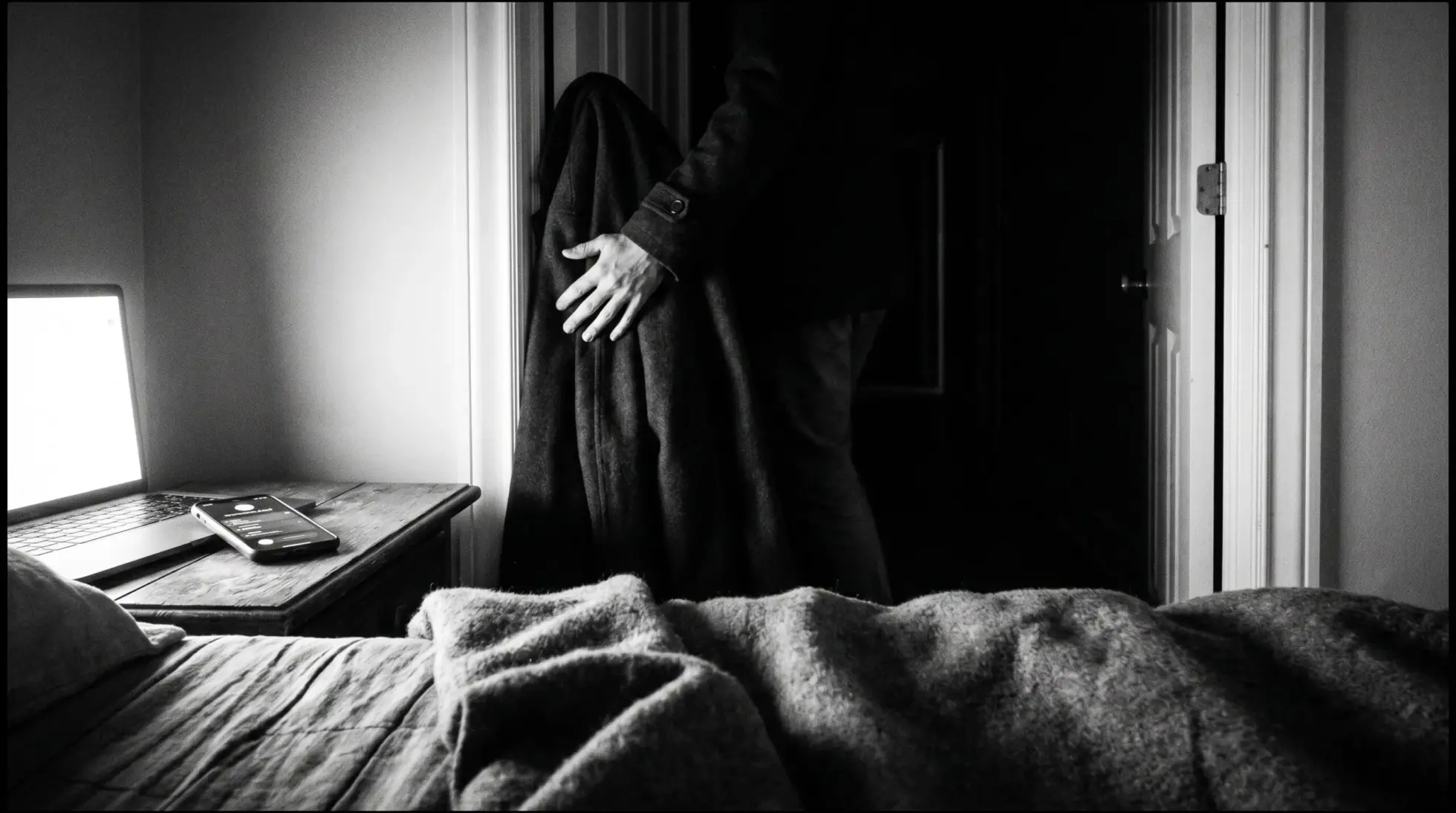
I am sitting in bed with the laptop and with Bandit beside me, and on the screen there is a liability disclaimer that I wrote myself, tonight, over several hours, sentence by sentence, with the feeling that something inside me is dying while I do it. Next to it lies the draft email to the liability insurer of my company, in which I ask whether they actually cover what might happen to me if a human being reads my book and then gets the foolish idea of changing their life as a result. I read that sentence, and then I read it a second time, and at some point I shook my head and laughed out loud, because it is so completely absurd that any reply to it would be too small.
A book that is supposed to help people escape the hamster wheel. And before it may be printed, I have to run through the hamster wheel one more time in its purest form, with the complete legal imprint, the ISBN, the edition number, the name of the printing house, the disclaimer and the query to the insurance company. Line by line, because every single thought in that book might rub up against the disclaimer. My sad conclusion: the system devours you even when you write a book about escaping the system. At that point I seriously considered simply dropping the whole thing.
Last night, a little after 2, I was working on it and formulating the sentence that protects me from being sued because somebody read my text and then looked at their own life, or because it held up a mirror to them. I turned every word over three times. I wondered whether I am allowed to write that a person who is suffering may not be ill at all, but rather stuck in a life that no longer fits. I wondered whether that sentence exposes me to liability. And at some point I noticed that I had spent hours thinking about how to protect myself from writing the damned truth.
You know the sentence I said years ago in a Munich courtroom, the one that got me removed from the room. „Then let’s drop the crap“. It came back to me last night, and this time it was not aimed at the proceedings, but at my own book.
Whether I will drop it, I honestly do not know yet. I am thinking it over, and I am thinking it over very carefully, and anyone expecting a decision at the end of this text will be disappointed. What I am delivering instead is a finding, and it is hard and sad at the same time.
The finding goes like this. When a human being collapses inside this wheel, he gets a pill within a few minutes. Not because anyone knows that something is missing inside his head, but because you can write a prescription for a biochemical problem and you cannot write one for a broken life. We have redefined a social problem as a chemical one, because the chemical one can be billed. And when that same human being tries, years later, to get rid of the substance again, the British professional body of psychiatrists seriously advises him to open every single one of those capsules and count the beads inside them. In the official example there are 200 beads in a 75 milligram capsule of venlafaxine, and 160 of those beads correspond to 60 milligrams, and since the beads differ in size, weighing them is said to be more accurate than counting them, for which one needs a precision scale and a room free of draughts.
This is not a rumour from some forum. It is written in an official document, endorsed by the British general practitioners and the pharmacists, and I will put the source in front of you further down. A depressed person whose hands are shaking is supposed to spend months weighing medication beads, because the industry spent 30 years building tablets for starting and not a single one for stopping.
Why I am telling you this, given that I am not a physician. For decades I have opened seized devices in a forensic capacity. I have read, inside those devices, what people type at 3 in the morning shortly before they collapse, and I have read the messages of those who never typed anything again afterwards. I am not a doctor, I am the man who reads what is left of a human being. And that is why I know what the road to that point looks like.
The rest of this text explains how it comes to that. What 5 days without the loud world do to a 56 year old body, why the brain you carry in your head was not built for this world, and why from today I live by my rules and by nobody else’s, and I am writing this down as plainly as I feel it in my deepest core.
5 days of silence, and the body answered immediately
In my last post I announced that I would disappear for 5 days. No phone, no email, no social media, no messages, no letterbox. I went through with it exactly as brutally as I had announced, and what happened afterwards surprised me.
My blood pressure dropped by more than 10 percent, I am sleeping through the night again, and I am breathing again, the way one breathes when one is not permanently waiting for something to happen. That is my measurement, on my body, with no control group, no blinding, no statistics, and I am explicitly not selling it to you as a study. It is a finding on a single person, and that person is me. But it is a finding, and I am not prepared to argue it away just because it could never be published.
What interests me about it is not the number, but the speed at which it appeared. It was 5 days and not 5 months, it was not a therapy, not a medication and not a spa retreat in a building with a water wall in the reception area. 5 days without stimulus, and a system that had been running off course for years corrects itself in a direction it apparently wants to go on its own.
A body that reacts this quickly to the removal of a disturbance is telling you something about that disturbance. It is telling you that it was not a small one.
The human being 10,000 years ago felt fear, and then it stopped
Now let us look at what this brain was actually built for, because this is where the real core of the matter lies.
Picture a human being, somewhere around 10,000 years ago, at the edge of a forest, and out of the undergrowth steps a stranger with a spear. In that moment, the exact same thing happens in that person’s body as happens in yours when your phone vibrates. First the sympathetic system releases the catecholamines, adrenaline and noradrenaline, within seconds, and that is the blow to the chest you know so well. Then the axis kicks in, the one science calls the hypothalamic-pituitary-adrenal axis, HPA for short. The hypothalamus releases a hormone, the pituitary gland answers, the adrenal cortex releases cortisol, and the cortisol mobilises energy, throttles everything that is not essential for survival right now, and sharpens attention.
This is not a disease, this is a biological masterpiece, and the decisive part of it is not the rise but the end.
Before we get there, I am going to clear up a legend that I encounter in every second text I read, and I am doing it because it points your gaze at exactly the wrong substance, namely the legend of the so-called „adrenaline rush“. It goes like this: in mortal fear, adrenaline shoots into the blood, and suddenly a woman weighing 60 kilograms lifts the car under which her child is trapped. The substance makes you superhuman, so the story runs, and whoever has it bursts through the limits of his own body.
Except adrenaline does no such thing. Adrenaline does something entirely different, and anyone who looks at what it actually does will find none of that in there. It binds to the alpha and beta receptors, drives the heart rate up, increases the contractile force of the heart, dilates the bronchi, constricts the vessels in the periphery and raises blood glucose. It is a distribution order issued to the circulation. It does not rebuild a muscle fibre, it does not add sarcomeres, it does not make a tendon more resistant to tearing, and the structural maximum force of a muscle is determined by the quantity and the architecture of its fibres, not by a hormone in the blood.
And now comes the part the legend leaves out entirely. The plasma half-life of adrenaline is under 5 minutes. The famous rush is biochemically over before you have even climbed out of the car.
So where does the strength in those moments come from? In 1961, 2 physiologists, Michio Ikai and Arthur Steinhaus, ran an experiment that would never be approved today. They had subjects pull on a handle with maximum force while, without warning, firing a starting pistol behind their backs. They had them shout at the moment of maximum exertion. They gave them alcohol, amphetamine and an injection of adrenaline, and they hypnotised them. The swings they measured ranged from plus 26.5 to minus 31 percent, and their conclusion is the actual finding: every performance below the structural limit of the muscle is the expression of an acquired inhibition. The body brakes itself, constantly, so that it does not tear itself apart. What happens in mortal fear is not that somebody becomes stronger. It is that the brake is released for a few seconds and the person reaches into a reservoir that stays closed to him in everyday life, and he pays for it afterwards with torn fibres and tendons.
Why I am hammering on this, even though it looks like a side issue. Because the legend makes you stare at the wrong substance. Adrenaline is the one everybody talks about, because it is spectacular, because it trembles and races and dilates the pupils. It is gone within minutes. The substance that actually takes you apart, in the most literal sense of the word, is the slow one, the quiet one, the one that stays for years, and nobody talks about it because it does nothing exciting, and that substance is called „cortisol“.
And with that we are back at the axis and at its decisive part, the end. Because this system switches itself off again. The cortisol binds to receptors in the hippocampus and in the hypothalamus, and that binding tells the axis to stop, enough now. A negative feedback loop, cleanly engineered, like a control circuit designed by somebody with a brain. The human being at the forest edge runs or fights, and once the stranger is gone, the reaction subsides. He sits by the fire in the evening and he is tired, but he is calm. His cortisol is back down. The system worked, because the stressor had an end.
And now comes the point where the modern world collides at full force with a construction that is 300,000 years old.
Your stressor has no end, it does not stop, it is being reloaded without pause. The email at 6 in the morning, the message at 6:10, the comment under the post, the payment reminder, the phone call, the push notification about some corporation in America that lost data which has nothing to do with you, then the next email, then another message. The stranger does not step out of the forest once, he steps out of it hundreds of times a day, and every time it is only a small fright, and every time the axis answers, and every time the next fright arrives before the feedback loop could finish its work. You drown, quite literally, in your own cortisol.
The research is unambiguous on this point. An acute stressor triggers a response that subsides once the stressor ends. A chronic stressor does not do that, it drags on with no quick resolution in sight, and the feedback loop itself takes damage in the process. Permanently elevated cortisol attacks precisely the structure responsible for the shutdown, the hippocampus, to the point of measurable shrinkage. That is a brake which breaks from being used too often.
Read that last sentence again.
That is the reason you are exhausted in the evening without having carried a single bag of cement. That is the reason chronic stress appears in the very same review articles in the same breath as high blood pressure, diabetes, cardiovascular disease and a weakened immune system. And that is the reason my blood pressure fell by more than 10 percent after 5 days without stimulus. I simply gave the axis no reason for 5 days, and it understood immediately.
The human being at the forest edge felt fear for a few minutes. We feel it around the clock.
Everybody now has their own personal messenger
Let us count it through properly, because only in the full list does the scale become visible. Instagram, Facebook, X and LinkedIn, then Threema, Signal, Telegram and WhatsApp, then SMS and iMessage, then the private email account and the business email account, and finally the second business email account, which I maintain for those clients who would otherwise reach me on the first one.
And the list does not end there, because what I have named so far are only the messengers. Beneath them lies a second layer that nobody bothers to count, because it comes disguised as work. Teams, Zoom, Meet, Webex, the video service of the manufacturer named after a fruit, and with them every platform through which clients, colleagues and conferences come pouring in. Every single one of them can ring. And every single one of them runs not on the telephone you are able to switch off in the evening, but on the machine you earn your living with, the one you cannot switch off precisely when it is working.
And every single one of these applications carries the same small, friendly, lethal expectation, the one that is never spoken and that everybody nonetheless knows: you have seen it, so answer already.
By now everybody has their own favourite messenger, the way people used to have a favourite brand of cigarettes, and every one of them expects to be followed there. So I am supposed to monitor 10 channels simultaneously, so that each individual can feel that I was always reachable. And what actually arrives at my end? Mostly breakfast photographs, a bread roll with an egg on it, shot from above, with that slight blur that occurs when somebody photographs with one hand while already eating with the other. A video explaining why the contrails in the sky are in truth something entirely different. Then a chain letter, and after that another breakfast photograph.
Otto Sapiens, that subspecies which believes it knows everything because it once listened to an audiobook on the subject, has meanwhile grasped that he no longer needs to formulate his insights himself. He simply forwards them along to everybody else. And the algorithm, which presents him with the same theory for the hundredth time, has taught him that repetition is the same thing as proof. This is not malice, this is pure convenience, and convenience is the raw material from which this wheel is built.
I am not mocking the people who send me things here. I am merely saying that the sum of these friendly little items takes apart a brain that was built for forest edges. Hundreds of small strangers with small spears are more dangerous than a single large one.
Do I now have to switch off the machine that works for me as well
On the last day of that silence, on a Sunday evening, something happened that I have to tell you about here, because it sums up everything this text is about, and because it proves that the retreat I am describing to you is technically no longer provided for.
The night before, I had been programming until 6 in the morning on an application that reconstructs a face from photographs of a skull, frontal and lateral, and that eats computing power like a hole in the floor. 2 hours of sleep, then the day, and at 8 in the evening of that Sunday I was in bed. Not because I fancied an early night, but because it was the moment at which a body simply has to sleep and stops holding any further debate about it.
The phone was off, deliberately and with considerable pleasure switched off. The landline was dead as well, and that is something I otherwise never do.
And then the MacBook rang. Yes, the damned MacBook rang me awake.
The machine had to stay on, because in the background an AI was searching for a bug inside a codebase of a million lines, and you do not abort that run just because you want to sleep. So the machine lay open beside me in the bed and worked for me, obediently, silently, all night long. And because some human being on this earth had the brilliant idea of calling me through the video service that the manufacturer built permanently into the operating system, my working tool suddenly started ringing.
Switching it off was not possible without killing the run. Deleting the application was not possible either, because it belongs to the system and cannot be removed. And so there I lay, the mobile dead, the landline dead, the laptop wide awake, and me in the middle of it, jumping up like a fairy tale creature who has just heard somebody say his name.
And do you know what that feels like? I admit it openly, I was furious. Not grumpy, not mildly irritated, but properly furious, and in that same moment I could feel my blood pressure climbing back up, the very blood pressure I had laboriously brought down over 5 days of silence. 5 days of work, undone in 4 seconds.
And here comes the part that surprised me about myself. I was not angry at the person who called me. He did not know any better, he pressed a button, and I do not even know him well enough to hold a grudge. I was angry at the fact that now the damned laptop rings as well. At the system, not at the human being. The human being was interchangeable, the ringing was not.
I shoved the MacBook out of the bed, with a smile on my face. I am writing that down here without any embellishment, because it is the truth, and because decades of expert witness work have taught me that you do not improve a finding by leaving it out. I knew exactly what I was doing in that moment, because I know the drop height, I know the floor, and I know what an aluminium casing will take. The device duly survived without a scratch, and that is probably the only property for which I felt any gratitude towards the manufacturer that evening.
And now ask yourselves where we have ended up. In the old days you pulled the plug and there was quiet. Then came the telephone, and you laid the receiver down beside the cradle. Then came the mobile, and you switched it off. Today you switch off your mobile, you switch off your landline, you disconnect the doorbell, and you are still reachable, because the machine that works for you at night lets any idiot who knows your address ring straight through. So must I in future switch off every device in the house that carries current, whenever I want to sleep? Must I halt my own work so that nobody disturbs me while I am resting? This is surreal, this is sick, and at that point I was finished with the whole arrangement.
And because in moments like that you pause briefly and survey your own situation, the way an expert witness surveys a scene, the thought came to me on which my anger finally settled for good. It happened to be an entirely ordinary Sunday evening. Not a Monday morning, not the end of a quarter, not the day before a hearing, but a Sunday, on which half the country has long since settled onto the sofa and is watching the evening crime drama. And somebody in this land was so profoundly bored that it occurred to him to haul a man out of his sleep by FaceTime, a man he had failed to reach precisely because that man had switched off every telephone he owns. This is no longer rudeness, this is impertinence with a technical substructure.
I thought, this cannot possibly be true, this simply cannot be true. And then I swore, loudly, at length, and in a choice of words that I shall render here, out of consideration for the more delicate among you, as a polite summary: I gave voice to the position that I am no longer in agreement with the present condition of digital civilisation.
Then I went upstairs to the office and cleaned house, thoroughly. The manufacturer’s video service cannot be deleted, because it belongs to the operating system, but you can drive the ringing out of it, and that is what I did. Everything else came off the disk entirely. Every application capable of ringing, flashing, buzzing, popping up or displaying a small red number on an icon has vanished from that machine, and the only thing left standing is the conferencing software for client sessions, because I work with it. Nothing runs on my MacBook any more that is capable of waking me, and I mean not the slightest thing. The machine works, and it does so in silence, the way a good system ought to.
The final step is no longer an announcement, it has been running for a few days, and it is the actual reason I built Tyra in the first place. Our own language model now sits in front of every one of my numbers, and it grew directly out of that evening in bed with the ringing laptop. Anyone who calls me on the mobile now does not get me, they get Tyra. She answers, and she first informs the caller that this conversation is being recorded and stored for 30 days, and whoever does not agree with that simply hangs up. Anyone who asks about data protection at that point, and my mobile numbers are in fact private, is additionally given a proper privacy statement, delivered more politely than I would ever deliver it myself. After that Tyra listens, she understands what the matter is, and she decides according to rules that I wrote whether I even need to hear about it. Anyone with something genuinely important is either put straight through or lands on a dedicated channel, over which I receive an immediate message and then decide for myself what happens. The rest, the cold calls, the scam calls, the daily background noise of people who want to sell me something, speaks with a machine that is considerably more polite than I would have been in that moment, and which, unlike me, has no blood pressure that anyone could drive upward. I have no measurement, the thing has only been running for a few days, but I am fairly certain that the majority of these callers hang up the instant they hear the word recording. A filter made of silicon between me and the ubiquity of reachability, and the irony of it is entirely clear to me, because I am fending off one machine with another.
And one more thing became clear to me that evening, while I picked the machine up off the floor and opened the lid again. I spent decades building systems that never disturb anybody, because a good system is a quiet one. A server that constantly reports how well it is doing is a badly configured server. And of all things, the machines on which such systems are built are designed to leap at their owner every few minutes. Whoever designed that has never once in his life done concentrated work.
There was a time when a machine simply did not answer
I was born in 1970, which means I have seen both worlds, a privilege the younger ones do not have, and not to their advantage.
When somebody wanted something from me in the eighties, he wrote a letter. The letter arrived in the box the next day or the day after, and if I was not at home, it kept lying there. It did not get angry, it did not vibrate, and it did not produce a red dot on an icon that stayed red until I tapped it away. It simply lay there, a piece of paper with a request in it, and that request had time, because the sender already knew while writing it that it would have to have time.
And then came the telephone with the answering machine. I listened to the tape when I listened to it, sometimes only 2 days later, and nobody died as a result. That very answering machine is what I have now brought back, only in a better form. Tyra is the cassette of the 1980s with a mind behind it, a device that picks up, listens and decides instead of merely recording, and the expectation that once bounced off the tape bounces off her today.
The decisive difference is not the speed, but the expectation that comes bundled with it. A letter arrives without expectation, a message arrives with expectation, and it is that expectation which fires your HPA axis, not the content. The content is usually a breakfast photograph.
I started programming at 13. At 15 I rewrote the operating system of my C64, burned it onto an EPROM and replaced the original ROM chip inside the machine with it. I fitted a reset button and a so-called freezer, with which the current state of a running piece of software could be frozen in memory. Even protected programs could be halted this way, examined and in many cases copied despite their copy protection. While others of that age were playing computer games, I was reaching into the architecture of the machine and teaching it to behave differently from the way its manufacturer had intended.
Back then I spent entire nights teaching a machine to respond to a stimulus. That was the whole fascination of building a thing that answers. I would never have dreamed that at 56 I would spend weeks teaching myself not to respond to a stimulus. It is the same task with the sign reversed, and it is incomparably harder, because the system that is supposed to learn it fights back against me.
There was a time when unavailability was not a statement. It was the normal state of affairs, and nobody had to justify it. Today it is a provocation, and anyone who does not answer within 2 hours has to explain why he did not answer, and that explanation costs him more energy than the answer would have cost.
That is precisely where the trick lies. The wheel never forced you. It taught you to feel ashamed when you stand still.
I go to the letterbox on Wednesdays and on no other day
So from now on my rules apply, and I am stating them here clearly enough that nobody can later claim not to have known.
I am obviously going to keep working, I will keep doing research, I will keep reading, I will keep programming, and I am more active in forensics and information security than I have ever been, because those are the things this head was built for. But I will do it in a lower gear, and I will do it on my own schedule.
I go to the letterbox on Wednesdays from now on. Not daily, not in expectation, not with that small tingle every German letterbox produces because something might be lying in it that starts a legal deadline. Exactly once a week, on Wednesday, and whatever arrives on Thursday simply waits 6 days. Most of what sits in a German letterbox is just as unpleasant after 6 days as it was on the first day, but it has not become any more dangerous.
I set my own deadlines from now on. When I tell a business partner that the project will be finished at a given time, then it is finished at that time and not a second earlier because somebody calls and says it has suddenly become urgent. Other people’s urgency is a borrowed urgency, and I am handing it back with thanks.
None of this is new with me, incidentally, it has merely become more consistent. About 25 years ago I had one of the largest German film producers as a client. I was sitting in my own company, I had employees and interns, and one day the boss himself called and had it announced that he wished to speak to me immediately, right now, in that very moment. I did not pick up back then, I had one of my people answer instead, and the sentence I gave him to pass on was this: „Alexander, tell him that if he calls Deutsche Telekom, he does not get the chief executive either“. I was 30 years old at the time, and I knew exactly what an HPA axis is and what a stressor does to a body, because I had studied it. I recognised that stressor and I put it down in the same moment, and I have never since allowed anybody to impose an urgency on me that was not my own.
From now on I no longer use WhatsApp at all, and anyone who writes to me there gets an automatic reply that politely points them to email and Telegram. Written short messages, meaning SMS and iMessage, I no longer read either. From today I am reachable through exactly 2 channels, plainly and clearly, through an email to george@rauscher.xyz and through a message on Telegram to @intelligentpixel, and if there is something to discuss, I will call back, when it suits me and only then. That has to be enough, and for me it is more than enough, more so than it has ever been.
On top of that I am planning my own contact platform, for all those who say they will not install Telegram, and for all those to whom I am not worth the trouble of opening their mail program. Before anyone turns up their nose at that, think it through calmly and logically. How many messengers are there in this world, and how many platforms now bring their own one along? I can only feel sorry for anyone who seriously demands that I be reachable on all of these channels at once and around the clock.
And because the word rudeness comes up immediately at this point, let me turn the arithmetic around. Over the years I have written to countless acquaintances and business partners, people who mattered to me, and many never answered. I had written to them in the middle of their working hours, and I fully accept that my message, in that moment, was nothing to them but noise. I now expect exactly that same acceptance in return, because I am no longer willing to expose myself to this noise, merely so that every single person can tell themselves that they always reached me.
Whoever cannot accept it gets a friendly mirror held up here, and is free to stay in his wheel and keep wearing himself out across the world of 30 messengers, and I write that here in the plainest possible terms. I am stepping out of the wheel at this point, not as an announcement but as an accomplished fact, and anyone who values my work and my contact accepts that without a further word. The others will wonder why George no longer leaps for the phone the instant it rings, and some of them call themselves friends. What comes back in quality of life is hard to put into words, it is simply far more time and a head that no longer waits, minute by minute, for the next thing to come in. You suddenly live in an entirely different world, without that constant pull to be permanently on, and only once it is gone do you notice how heavily it weighed, and you start asking what, in a time like this, is actually still important.
And since we are on the subject of reduction, one final detail that shows the whole direction. I have a landline whose number exactly 3 people know, and that number is not going to grow.
The fact that I do not offer the telephone as the first channel has a reason, and I am spelling it out here, because otherwise it gets misread as rudeness. I detest small talk, and not a little bit, but fundamentally. Those 4 minutes at the start of a conversation that deal with the weather, the drive, the children, in which both sides know that none of it is the point, are not politeness to me but loss. Lost time, lost attention, and for my nervous system a burden that costs measurable energy, while the actual content could have been said in 90 seconds. A written message contains the content and nothing else. It leaves me the choice of when to answer, and it forces the sender to think first. With clients I now run entire sessions over Teams, because a shared screen says more than an hour of conversation.
And now comes the part where I laugh at myself the hardest. My servers are monitored around the clock. If a single machine so much as coughs, the monitoring fires, and the box is back online before anybody has noticed that it was gone. So my technology is allowed to be reachable 24 hours a day, 7 days a week, without pause, without sleep, without any feedback loop that shuts it down.
The human being behind it is not allowed to be. And that is exactly why I became that human being, and the machine remained the machine. I spent half a working life building systems that never get tired, and forgot in the process that I am not one of them.
Whoever can live with these rules is welcome. Whoever has a problem with them is not. That is not a threat, that is information.
What happens when a human being collapses inside the wheel
Now we go to the place where it gets uncomfortable, because here we leave my blood pressure behind and arrive at the question that carries this entire text.
A human being runs inside this wheel. Not for years, but for decades, and in many cases for half a century straight, from the first year of training to retirement, with 2 weeks of interruption in the summer. He functions, he delivers, he holds the family together, he answers the messages, he goes to the letterbox, daily, with the tingle and with his worries. And then one day he does not go any more. One day he sits on the edge of the bed in the morning and cannot get up, and he does not know why, because outwardly nothing has changed.
And then we wonder about the diseases. I laid out the evidence for this in the last post and will not repeat it here, anyone who wants to read it will find it there. The core remains: the same review articles that describe the broken feedback loop name high blood pressure, diabetes, cardiovascular disease and a throttled immune defence in the same breath.
With the next word I become careful, and I will explain why, because this is precisely the place where I could otherwise be torn apart, and rightly so. Many people say „cancer“ at this point, and the thought is not far-fetched, since a permanently throttled immune system also monitors degenerate cells less well. Except the data do not support it this time. A Dutch population cohort measured cortisol in the hair of 6,341 people, capturing the burden across months, and linked the results to the national pathology registry. Hair cortisol did not predict cancer incidence, the hazard ratio came out at 0.993, which is essentially 1. A European meta-analysis on work stress covering 116,000 people and 5,700 cancer cases likewise found no association. In animal models and in cell biology there are mechanisms, in human epidemiology there are so far none.
I would have liked to use the word cancer here. It would have landed, it would have frightened people, it would have driven this text through the networks, because fear is what makes people read a text to the end. It simply would not have been true, and then everything else in this text would have died along with it.
So let us return to our human being, the one sitting on the edge of the bed unable to get up. He cannot go on, he is simply finished. He goes to his general practitioner. And the general practitioner has minutes, not hours.
This is not polemic, it has been measured and published. A systematic review in BMJ Open analysed 178 studies from 67 countries covering more than 28.5 million consultations. In 15 countries, which together account for roughly half the world’s population, the average appointment lasts under 5 minutes, in a further 25 countries under 10, and the range runs from 48 seconds in Bangladesh to 22.5 minutes in Sweden. The authors add a sentence that deserves to be framed: below roughly 5 minutes, a consultation amounts to little more than sorting the patient and issuing a prescription. The same paper finds an association between short consultations and the simultaneous prescribing of multiple drugs.
And in those few minutes something happens that I consider one of the great errors of our era, and I state explicitly that this is my opinion and not a finding I am selling you as evidence. The GP prescribes an SSRI, a selective serotonin reuptake inhibitor.
He does not do it out of malice. He does it because it is the standard, because the guideline permits it, because he cannot perform a full analysis of a life in a handful of minutes, and because the person in front of him is suffering and has to be helped.
And now the sentence I am formulating precisely, because otherwise it reads as an insult to an entire profession, which it is not. The GP knows perfectly well what is written on the package insert. What he does not know, nobody knows, and for that there is a piece of evidence I consider the most devastating in this entire text.
In 2025 the American Journal of Medicine published an analysis of 52 placebo-controlled licensing trials of the 10 most commonly prescribed antidepressants, covering 10,116 participants, sampled across the period from 1978 to 2023. The median duration of those trials is 8 weeks. 88.5 percent of them ran for 12 weeks or less. Not a single one of those 52 trials ran longer than 1 year.
And now the figure that has to be set beside it. The median duration for which people in the United States actually take these substances is roughly 5 years. 8 weeks of evidence, 5 years of consumption. That is a ratio of 1 to 30.
And it gets better, if one is permitted to use that word in this context. Of those 52 trials, a grand total of 2 looked at discontinuation symptoms, which is 3.8 percent. 2 trials out of 52 wanted to know what happens when a human being stops taking the substance again.
So the general practitioner prescribes, in the best of faith, a substance whose long-term effect the research itself has never examined, and that is not an accusation against him. It is an accusation against the system that gives him a handful of minutes and then puts a prescription pad in his hand.
And then the person actually does feel better, at least for a while.
The numbers here are not small. In the United States in 2023, according to the national health survey, 11.4 percent of all adults took a prescription medication for depression, 15.3 percent among women and 7.4 percent among men. I had it in my head that it was one in three. That is wrong, I looked it up, it is roughly one in nine, and I am putting it down here like this because I would rather deliver the correct number than the more dramatic one. It remains remarkable enough: 28.2 percent among people with a disability, and 14.4 percent among those living alone compared with 10.9 percent among those who live with others. People who are alone get medicated more often. You may decide for yourselves whether that is a chemical statement or a social one.
And now let us actually do the arithmetic, because you can hide inside a percentage, but you cannot hide inside human beings. The American census bureau counted exactly 262,083,034 adults in the United States as of 1 July 2023. 11.4 percent of them is 29,877,466 people. Almost 30 million, which is more people than live in the whole of Scandinavia, take a pill against depression every morning.
And now I ask the question that came to me while doing that arithmetic and that has not left my head since. Are those 30 million people really ill?
In Germany they would receive a diagnosis from „chapter F“ of the international classification, F32 being the depressive episode and F33 the recurrent one. They would count as mentally ill, and everyday language has harsher words for it, words you all know.
I am not claiming that depression does not exist, that would be stupid, and further down you will read why I would never claim it. But 30 million is not the epidemic of a brain disease. 30 million is a finding about the living conditions of 30 million human beings, and anyone issuing 30 million diagnoses has stopped questioning whether there might be something wrong with the conditions.
And so that we do not misunderstand each other, when I say hamster wheel I do not only mean the daily functioning and this flood of messages and expectations. I also mean the toxic environment a person is stuck inside and cannot get out of. The relationship in which he has been making himself small for 8 years. The marriage in which nothing is spoken any more in the evening, only administered. The loneliness nobody sees, because after all you are among people every day. The false friends who only call when they need something. The wrong profession, stumbled into at 19 and impossible to leave at 47 because the loan is still running. And the worries, which today are no longer imagined but real, the worry that the money will not stretch to the food, that the rent can no longer be paid, that the roof over your head will be a different one next year.
Remember how the axis works. The stressor has to end for the feedback loop to do its job. A marriage in which nobody speaks does not end at 6 in the evening. A rent you cannot pay does not end at the weekend. That is the stranger who never disappears back into the forest, and there is no axis on this earth built to handle him.
An SSRI does not repair a marriage. An SSRI does not pay a rent. An SSRI does not turn false friends into real ones or the wrong profession into a bearable one. What it can do is seal a person up far enough that he keeps enduring all of it, and that is precisely the point at which medicine turns into something else. He can go back into his hamster wheel, and there he runs until the next collapse.
And the story underlying these numbers is the one about the chemical imbalance. Too little serotonin, a deficiency that gets topped up like an empty tank. That narrative is so successful that 80 percent or more of the population consider it proven. A large systematic umbrella review by Joanna Moncrieff and her team, published in Molecular Psychiatry in 2022, combed through the entire body of evidence across 6 fields of research, including a genetic study with 115,257 participants and a collaborative meta-analysis with 43,165. Their result: no consistent evidence for an association between serotonin and depression.
I am being honest here, as always. That paper is scientifically contested, 36 experts pushed back in the same journal, and I am not resolving that dispute for you. But what remains after the dust settles is enormous. The story that was told to millions of people in order to hand them a pill is anything but the settled fact it was sold as, and still is sold as.
And the same review found something that sent a chill down my spine. There are data suggesting that long-term use of antidepressants may actually lower serotonin concentration.
Let that sit on your tongue for a moment. You give a person a substance against an imbalance that was never demonstrated, and there are indications that this very substance produces, over the long run, exactly what it was meant to correct.
I am not going to calculate how many billions this narrative has generated, because I do not put a number into a room that I have not verified myself, and because it would prove nothing anyway. A corporation that makes money is not a criminal. A corporation that makes money from an unproven story being accepted as proven inside the heads of 80 percent of a population does, however, have a very strong interest in that story staying there. That is not a conspiracy, that is an incentive structure, and incentive structures are more boring and more effective than any conspiracy.
And one more thing belongs here, because it otherwise gets lost. These substances were approved without it ever being established which imbalance they actually correct. Serotonin, noradrenaline, dopamine, somebody picked a neurotransmitter, built a molecule that acts on it, measured that it relieves symptoms in some people, and then constructed a disease theory backwards from there. That is like concluding from the fact that a headache responds to a painkiller that the head is suffering from a painkiller deficiency.
The price nobody mentions, and the withdrawal they call relapse
I once watched a person who could no longer speak. They sat there and they were gone, the light was out, and I have seen a great deal across these decades, but that sight has followed me around. They went into the psychiatric hospital, they were given several substances at once, and after a few weeks they functioned again. They got up, they made breakfast, they went shopping.
I do not want to play that down. There are states in which a human being dies without medication, and in such states any substance that keeps them alive is justified. Whoever was in that hole and climbed out again thanks to a pill should keep it, and nobody, least of all me, has any business interfering.
But I am asking a different question. It goes: what kind of life is it that they bring them back into?
Because the price is rarely mentioned. A small study from 2002 examined 15 patients who had developed sexual dysfunction under an SSRI. 80 percent of them also reported clinically significant emotional blunting. Significantly reduced were: the ability to cry, anger, sadness, surprise, creativity, worrying about things, and interest in sex. And the overall blunting score did not correlate with the score on the depression scale, so it was not simply the depression itself. 15 patients is few, it is a small study, and I say so before somebody else does. But it is the beginning of a pattern that has been described repeatedly ever since, and anyone who reads the accounts of people who spent years on these substances finds the same formulation every time: „I felt nothing any more, no highs and no lows, I merely functioned“.
So they took the person out of the wheel by removing their capacity to feel the wheel. And then they put them back into it.
And now comes the part almost nobody says out loud, even though it is the most important one. Out of this blunting something can emerge that stays. Not during the treatment, but afterwards, after years, sometimes after decades of use, and in some cases apparently forever. The European Medicines Agency, following a review by its risk assessment committee, concluded in 2019 that the sexual dysfunction under SSRIs and SNRIs, which normally resolves after stopping, may in some patients be long-lasting and persist beyond the end of treatment, and ordered the product information of all these preparations to be amended accordingly. In the literature this is called Post-SSRI Sexual Dysfunction, PSSD for short, and the published diagnostic criteria explicitly list the non-sexual symptoms alongside the sexual ones: emotional numbness, depersonalisation, apathy, and anhedonia, meaning the inability to feel any pleasure at all.
Picture that for a moment. You have stopped the medication, it left your body long ago, and you sit there and feel nothing. No grief, no joy, no desire, no anger, none of it, only a complete emptiness remains. You go to your doctor, and the doctor tells you this is your depression returning and suggests restarting the medication. And you sit at home and think the one sentence I kept reading in those forums during my research: „I will never get rid of this, I will never be well again“.
How common this is, nobody knows. There is no prevalence study, because nobody funded one, and the regulators never obliged the manufacturers to conduct one. There are case series, there are diagnostic criteria, there is a warning in the product information, and there is no number. I could invent one right now. I will not, because the very absence of that number is the finding. They distributed a substance to millions of people and 30 years later still have not counted in how many of them it switched off the emotional life.
And then comes the day when he wants to stop taking the stuff. From here on please read slowly, because a mistake at this point will cost you months or even years of your life.
A large meta-analysis by Henssler and colleagues, published in Lancet Psychiatry in 2024, pooled 79 studies with 21,002 patients. The raw result: 31 percent of people who discontinued an antidepressant experienced at least one discontinuation symptom, and so did 17 percent of those who discontinued a placebo. The authors subtracted the one from the other and arrived at roughly 15 percent, meaning about 1 in 6 or 7 people, with severe symptoms in about 1 in 35. The public message that emerged from this was: not so bad, in the vast majority of cases no lengthy tapering is required.
A year later a team around that same Joanna Moncrieff took the paper apart, and what came out of it should interest anybody who takes such a pill. 46 of the 62 study cohorts analysed, meaning 74 percent, had certain or probable pharmaceutical industry funding, and because those were the large studies, they accounted for 96.2 percent of all participants. In 52 of the 62 cohorts the numbers came not from a systematic enquiry into discontinuation symptoms, but from spontaneously reported adverse events or from the judgement of the physician. The most common observation period was 2 weeks. Participants had taken the substance for a weighted mean of 23.4 weeks, in 30 studies for less than 3 months.
And now the number that matters. Only 5 of those 62 cohorts, comprising 601 of 12,603 participants, actually recorded discontinuation symptoms systematically using a suitable instrument. In precisely those 5 studies the pooled rate was 55 percent.
It is 31 percent if you also count the studies in which nobody looked properly. It is 55 percent if you count only those in which somebody did.
An earlier systematic review by Davies and Read from 2019 arrived at a weighted average of 56 percent, with 46 percent of those affected rating their symptoms as the most severe possible. That paper too was sharply criticised on methodological grounds, and I say so as well. I am standing here in front of 3 numbers that contradict each other, and I am not resolving the dispute. I merely note that the studies which looked most thoroughly deliver the highest numbers, and that the studies which looked least were mostly paid for by the people who sell the substance.
And now you rightly ask how this is supposed to work in practice. That is exactly where the scandal lies, and it is so banal that people overlook it.
Take a medication that exists in 60, 30 and 20 milligram strengths. You can get from 60 to 30, that is half a tablet, and you can still get from 30 to 20 as well. But from 20 to 0 there is nothing left. There is no step, no intermediate stage, no product. And precisely that last step, which looks like nothing on the packaging, is pharmacologically the most brutal of them all, because the curve drops steeply right there. The industry spent 30 years producing tablets for people to start, and not a single one for people to stop.
What follows from this for practice? Mark Horowitz and David Taylor evaluated the imaging data on serotonin transporter occupancy in Lancet Psychiatry in 2019 and demonstrated something any engineer grasps instantly. The relationship between dose and effect at the transporter is not linear, it is hyperbolic. Which means the last small dose steps, the ones that look like nothing on the package insert, are pharmacologically the largest. Anyone who reduces a substance to the minimum therapeutic dose within 2 to 4 weeks and then stops, the way the guidelines long recommended, is in truth slamming on the brakes, which is why those short schemes offer barely any advantage over stopping abruptly. It has to go slowly, hyperbolically, over months, down to far below the minimum dose, and it has to be medically supervised.
So what do the affected people actually do? I spent 3 hours looking through the relevant forums, and my hair stood on end. People dissolve tablets in water and draw off millilitres with a syringe, people buy laboratory precision scales, and people open capsules and count the beads inside them.
This is not an exaggeration, and I am not quoting internet forums now, but the Royal College of Psychiatrists, the British professional body of psychiatrists, whose patient information is endorsed by the professional bodies of the general practitioners and the pharmacists. There, as an official example, it states: a capsule containing 75 milligrams of venlafaxine holds 200 beads, so 160 beads correspond to 60 milligrams. And further, in substance, that the beads vary in size, which is why weighing is more accurate than counting, for which one requires a precision scale and a room free of draughts. The accompanying tapering plan has 38 steps and ends at 0.15 milligrams.
Read that a second time. A depressed person, who struggles to think, whose hands are shaking, who has not slept for weeks, is supposed to spend months weighing medication beads in a draught-free room with a laboratory scale, because the pharmaceutical industry did not consider it necessary to build a tablet with which one can come back down.
When I read that, I sat there and asked myself the question I have asked far too often in my life: „This simply cannot work, this cannot be true, it cannot be acceptable, what medicine and the pharmaceutical industry are doing to human beings here“. And then I smiled, because the polemical voice inside me answered, and it answered calmly and without the slightest surprise: „Oh yes, it can“.
That voice is right, because it works, because nobody prevents it, and it has been working for 30 years.
And here lies the place where people break. When you feel terrible while coming off, the doctor who prescribed it tells you, with honest conviction: „You see, that is exactly why you need the medication“. Horowitz and Taylor describe precisely this, that the discontinuation syndrome gets mistaken for a relapse, and that this turns into unnecessary lifelong medication. The withdrawal becomes the proof of the necessity of the very thing being withdrawn.
I will say it as clearly as I can, and then I will say nothing more about it, because I am not writing a set of instructions here and I am not allowed to write one either. Never stop abruptly, and never stop alone. Find a doctor who knows the word „hyperbolic“, and if he does not know it, find a different one.
The man who read the adverse event reports at the regulator
At this point somebody could call me a tinfoil hat. The forensic examiner from Bavaria suspecting the pharmaceutical industry, what a surprise, the lizard people will be along shortly.
Which is why I am going to tell you about Josef Witt-Doerring.
The man is a board certified psychiatrist. He studied medicine in Queensland, did his residency at Baylor College of Medicine and completed a fellowship in psychiatric drug development at one of the largest pharmaceutical corporations in the world. He worked in drug safety at several pharmaceutical companies. And then he was a medical officer in the Division of Psychiatry at the American drug regulator, the FDA. There his job was to review the emerging adverse events and to work on the resulting changes to the product labels.
So he sat at precisely the desk where the reports arrive. He read what people report when they take these substances and when they want to get rid of them again. He did not read it on Instagram, he read it in the inbox of the regulator.
In 2020 he left the regulator and the industry behind and founded, together with his wife, a practice that does exactly one thing: bringing people off psychiatric medication. By its own account it is now the largest medical practice in the world dedicated exclusively to the tapering of psychiatric drugs and to the harms those drugs cause.
I am going to let that curriculum vitae stand exactly as it is, without comment, and you may think whatever you like.
No, I am not going to let it stand after all, I have been an expert witness for far too long for that. When a man with this training, this industry experience and this position at a regulator walks away and spends the rest of his professional life getting other people out of something, then that is a data point, and not a proof, merely a data point. But it is one that can no longer be waved away with the word conspiracy theory, and that is precisely why it is standing here.
The number that turns you into a patient
There is one thing I have thought about my entire life, and it connects to all of this, even if it does not look that way at first glance.
When you go to the doctor and have to give blood, a sheet of paper comes back, and next to every value there is a range. They call it the normal range, and then your value stands there, and if it falls within the range you are healthy, and if it falls outside it you are not.
Ask yourselves once where that range comes from.
It comes from a survey of people who are alive today. Of people who eat the same things as you, breathe the same air as you, receive the same flood of messages every day as you, and carry the same cortisol level as you. The normal value is not the description of a healthy human being. It is the description of the average of a population, and if that population as a whole is sick, then the norm is the description of a sick state, and you fail precisely when you deviate from it.
Do you want to see how firm this ground is? Then take a look at vitamin D. The Endocrine Society guideline of 2011 laid down that below 20 nanograms per millilitre constitutes a deficiency, 21 to 29 is insufficiency, and one is only adequately supplied from 30 upwards. The Institute of Medicine considered 20 physiologically sufficient. Between 2 institutions in the same country, then, lay the difference between sick and healthy for millions of people. And in 2024 that same Endocrine Society, in its new guideline, no longer supported the target value of 30 and declined to define sufficiency, insufficiency and deficiency by fixed values at all. It now advises against routine screening, among other reasons because the thresholds are unclear.
You were possibly ill in 2011 and possibly healthy in 2024, and your blood did not change in between. Only the number in the table changed.
And this is exactly where my old thought comes into play, the thought that has accompanied me for decades. We do not possess a single reliable reference value from the human being who lived 10,000 years ago. We have his bones, we have his genome, but we do not have his blood. We do not know how high his cortisol ran across the day, we do not know what his vitamin status looked like when he was outdoors all day long, we do not know what his inflammatory markers were doing before there were plasticisers, pesticides and particulate matter.
I am not claiming that I know those values. That would be invented, and I do not invent things. I am merely saying that we do not possess the one reference that ought to interest us, and that instead we take the average values of an exhausted population as our yardstick and call it the norm.
I do not drink a drop of alcohol. I take no pills, I take no drugs. I supplement, I have been substituting testosterone for over 20 years, and I know to the third decimal place what I am doing and why. I was spared what millions of others were not spared, and I take no pride in that, but I will also say openly what it comes down to: not luck, but the fact that I am not stupid and that I recalculate everything myself. Not everybody can do that or wants to do that, and that is precisely why there is a manuscript sitting on my machine that I do not yet know whether I will ever release into the world.
The book I do not yet know whether it will ever appear
And with that we are back in my bed, with the laptop, with the disclaimer.
The manuscript of the hamster wheel is finished, and it was supposed to go to the printer next week, that at least was the plan. And then I read up on what all has to go into it, and I arrived at the point where, frankly, I was close to throwing the whole thing away. A complete legal imprint has to go in. The ISBN I have had for ages, that is the smallest problem. Then the edition number, then the details of the publisher. And the name of the printing house that printed the thing has to go into the book that I wrote.
Then the disclaimer, on which I spent an entire evening, and the email to the insurer.
I toyed with the idea of writing it as pure fiction. An invented figure, born in the year 10,000 before Christ, born again in 1970, a human being walking through life, and we would merely describe how she lives, what she does and why she is doing so badly. No advice manual, no textbook, no claim, simply a novel, and with that I would be out of liability.
I considered that idea elegant for half a day, and it is not.
It is not, because the imprint obligation attaches to the printed work and not to the genre. A novel needs the same imprint, the same ISBN, the same printer’s name as a work of non-fiction. So I would shed exactly none of what grinds me down, and would give up the only thing that makes the book worth anything at all: that it is true. That there is a human being standing behind it who spent decades opening devices into which other human beings had typed their lives, and who is now getting out. From the mouth of a fictional character the sentence „Then let’s drop the crap“ is a nice line. From my mouth, spoken in a real courtroom with real consequences, it is a weapon.
If it appears, then, it will appear as non-fiction, in the first person, with my name on it and with the disclaimer inside it. I will earn nothing from it, at any rate nothing that would justify the effort. It would be a service, and I do not mean that sentimentally but soberly.
And that is exactly why the decision is still pending. I am not putting this book into the printer’s hands in order to be able to say that I have written a book. I put it there when I am certain that it does more good than it costs me, and that calculation does not add up at the moment, because on the cost side stands a system that can hold me liable for every true sentence, and on the benefit side stands a human being I do not know, who might read it and might stop believing himself to be ill. I am weighing that up right now. I am weighing it up carefully, and I am letting nobody rush me, least of all myself.
It is possible that I will drop it. The irony of that is entirely clear to me, thank you for asking.
At 56 I am starting to live, and that is not a figure of speech
The laptop is still on the blanket. The disclaimer is still open, and I will finish it today, because I want to finish it and not because a deadline is driving me.
I am 56 years old now. According to the mortality tables a decent stretch still lies ahead of me, but it is shorter than the one behind me, and that arithmetic works itself out every morning. I spent the last decades understanding systems, unburdening people, convicting the guilty, securing servers and answering every question instantly, precisely, without hesitation, because a single wrong word could topple a case. All of that was the profession, and that profession is now over.
What remains is the work, and I love it. I will keep researching and keep reading and keep programming, and I will do more in forensics and information security than ever before, because I can and because it interests me and because there is nobody who could do it better. But I will do it without my cortisol riding a rollercoaster that was built for a stranger at the edge of a forest and not for an inbox.
The human being 10,000 years ago felt fear, and then he stopped feeling it. That is the whole secret. It is written in no self-help book, it is contained in no pill, and it costs nothing.
And because somebody will rightly ask what he is supposed to do now, here are the only 3 sentences in this text that contain an instruction. If you take such a substance and want to be rid of it, then do not look for a doctor who reassures you, but for one who knows the word hyperbolic and who can prescribe you a liquid formulation, because with tablets the last step cannot be taken. If you cannot find one, keep looking, and do not let anybody talk you into believing that your suffering while stopping is the proof that you need the substance. And if you take none of it, then start at the beginning, because the only path that reliably works is the one you never had to walk.
The hamster wheel is lying finished on my machine. Whether I will let it be printed I will decide over the coming weeks, and you will learn about it here. Should I decide against it, then I will also tell you why, and that text will be more uncomfortable than anything I have published so far.
I am 56, and what comes now runs by my rules and by no others, call it George in version 2.0 if you like. On Wednesday I go to the letterbox. Whatever is lying in it by then is lying in it.
References
- Dalal, R., & Grujic, D. (2024). Epinephrine. In StatPearls. StatPearls Publishing. https://www.ncbi.nlm.nih.gov/books/NBK482160/
- Davies, J., & Read, J. (2019). A systematic review into the incidence, severity and duration of antidepressant withdrawal effects: Are guidelines evidence-based? Addictive Behaviors, 97, 111 to 121. https://doi.org/10.1016/j.addbeh.2018.08.027
- Demay, M. B., Pittas, A. G., Bikle, D. B., Diab, D. L., Kiely, M. E., Lazaretti-Castro, M., Lips, P., Mitchell, D. M., Murad, M. H., Powers, S., Rao, S. D., Scragg, R., Tayek, J. A., Valent, A. M., Walsh, J. M. E., & McCartney, C. R. (2024). Vitamin D for the prevention of disease: An Endocrine Society clinical practice guideline. The Journal of Clinical Endocrinology and Metabolism, 109(8), 1907 to 1947. https://doi.org/10.1210/clinem/dgae290
- Elgaddal, N., Weeks, J. D., & Mykyta, L. (2025). Characteristics of adults age 18 and older who took prescription medication for depression: United States, 2023. NCHS Data Brief, 528. https://doi.org/10.15620/cdc/174589
- European Medicines Agency, Pharmacovigilance Risk Assessment Committee. (2019). New product information wording, extracts from PRAC recommendations on signals, adopted 13 to 16 May 2019. https://www.ema.europa.eu/en/documents/other/new-product-information-wording-extracts-prac-recommendations-signals-adopted-13-16-may-2019-prac_en.pdf
- Healy, D., Bahrick, A., Bak, M., Barbato, A., Calabrò, R. S., Chubaty, A. M., Cosci, F., Csoka, A. B., D’Avanzo, B., Diviccaro, S., Giatti, S., Goldsmith, L. P., Hellstrom, W. J. G., Iacoponi, E., Melcangi, R. C., Pearlman, D. M., & Reisman, Y. (2022). Diagnostic criteria for enduring sexual dysfunction after treatment with antidepressants, finasteride and isotretinoin. International Journal of Risk and Safety in Medicine, 33(1), 65 to 76. https://doi.org/10.3233/JRS-210023
- Heikkilä, K., Nyberg, S. T., Theorell, T., Fransson, E. I., Alfredsson, L., Bjorner, J. B., Bonenfant, S., Borritz, M., Bouillon, K., Burr, H., et al. (2013). Work stress and risk of cancer: Meta-analysis of 5700 incident cancer events in 116,000 European men and women. BMJ, 346, f165. https://doi.org/10.1136/bmj.f165
- Henssler, J., Schmidt, Y., Schmidt, U., Schwarzer, G., Bschor, T., & Baethge, C. (2024). Incidence of antidepressant discontinuation symptoms: A systematic review and meta-analysis. The Lancet Psychiatry, 11(7), 526 to 535. https://doi.org/10.1016/S2215-0366(24)00133-0
- Holick, M. F., Binkley, N. C., Bischoff-Ferrari, H. A., Gordon, C. M., Hanley, D. A., Heaney, R. P., Murad, M. H., & Weaver, C. M. (2011). Evaluation, treatment, and prevention of vitamin D deficiency: An Endocrine Society clinical practice guideline. The Journal of Clinical Endocrinology and Metabolism, 96(7), 1911 to 1930. https://doi.org/10.1210/jc.2011-0385
- Horowitz, M. A., & Taylor, D. (2019). Tapering of SSRI treatment to mitigate withdrawal symptoms. The Lancet Psychiatry, 6(6), 538 to 546. https://doi.org/10.1016/S2215-0366(19)30032-X
- Ikai, M., & Steinhaus, A. H. (1961). Some factors modifying the expression of human strength. Journal of Applied Physiology, 16(1), 157 to 163. https://doi.org/10.1152/jappl.1961.16.1.157
- Irving, G., Neves, A. L., Dambha-Miller, H., Oishi, A., Tagashira, H., Verho, A., & Holden, J. (2017). International variations in primary care physician consultation time: A systematic review of 67 countries. BMJ Open, 7(10), e017902. https://doi.org/10.1136/bmjopen-2017-017902
- James, K. A., Stromin, J. I., Steenkamp, N., & Combrinck, M. I. (2023). Understanding the relationships between physiological and psychosocial stress, cortisol and cognition. Frontiers in Endocrinology, 14, 1085950. https://doi.org/10.3389/fendo.2023.1085950
- Moncrieff, J., Cooper, R. E., Stockmann, T., Amendola, S., Hengartner, M. P., & Horowitz, M. A. (2022). The serotonin theory of depression: A systematic umbrella review of the evidence. Molecular Psychiatry, 28(8), 3243 to 3256. https://doi.org/10.1038/s41380-022-01661-0
- Moncrieff, J., Hobday, H., Sørensen, A., Read, J., Plöderl, M., Hengartner, M., Kamp, C., Jakobsen, J., Juul, S., Davies, J., & Horowitz, M. (2025). Evidence on antidepressant withdrawal: An appraisal and reanalysis of a recent systematic review. Psychological Medicine, 55, e191. https://doi.org/10.1017/S0033291725100652
- Opbroek, A., Delgado, P. L., Laukes, C., McGahuey, C., Katsanis, J., Moreno, F. A., & Manber, R. (2002). Emotional blunting associated with SSRI-induced sexual dysfunction. Do SSRIs inhibit emotional responses? International Journal of Neuropsychopharmacology, 5(2), 147 to 151. https://doi.org/10.1017/S1461145702002870
- Pham, A. T., van Dijk, B. A. C., van der Valk, E. S., van der Vegt, B., van Rossum, E. F. C., & de Bock, G. H. (2024). Chronic stress related to cancer incidence, including the role of metabolic syndrome components. Cancers, 16(11), 2044. https://doi.org/10.3390/cancers16112044
- Royal College of Psychiatrists. (2024). Stopping antidepressants. https://www.rcpsych.ac.uk/mental-health/treatments-and-wellbeing/stopping-antidepressants
- TaperClinic. (2026). Dr. Josef Witt-Doerring, CEO and Medical Director. https://taperclinic.com/dr-josef-witt-doerring/
- U.S. Census Bureau. (2023). Estimates of the total resident population and resident population age 18 years and older for the United States, regions, states, District of Columbia, and Puerto Rico: July 1, 2023 (SCPRC-EST2023-18+POP). Population Division. https://www2.census.gov/programs-surveys/popest/tables/2020-2023/state/detail/SCPRC-EST2023-18+POP.xlsx
- Ward, W., Haslam, A., & Prasad, V. (2025). Antidepressant trial duration versus duration of real-world use: A systematic analysis. The American Journal of Medicine, 138(10), 1400 to 1407.e10. https://doi.org/10.1016/j.amjmed.2025.04.037
Disclaimer: This article reflects the author’s own research and opinion as of the publication date shown above; later findings or legal changes may have overtaken it, so always check that date. Sources are cited for independent verification, and no liability is accepted for third-party studies. This is general information, not medical, legal, or professional advice: for medical questions see a doctor, for legal questions a lawyer, and in an acute crisis contact emergency services or a crisis helpline.
About the header image: it is AI-generated. Cheaper than a photo shoot, and I have made my peace with the age of AI. Everything inside the article is real, the diagrams, the skulls, the findings, and every word. The machine gets the opening shot and not one inch past it.

The Line on the Paper: Why the Present Is the Only Place Where You Actually Live
This post is not a forensic analysis, not a polemic, not a dissection of a broken world. It…

A Ph.D. Does Not Make You Smarter. It Makes You Credentialed.
A misattributed Feynman quote opens a forensic examination of credentials, IQ tests, and metacognition. The article contrasts academic…

The Billion-Dollar Monopoly
On the political economy of a war entering its fifth year. Why three competing manipulative narratives about Ukraine…