Forensic Facial Reconstruction: A Face for Those Who No Longer Have One
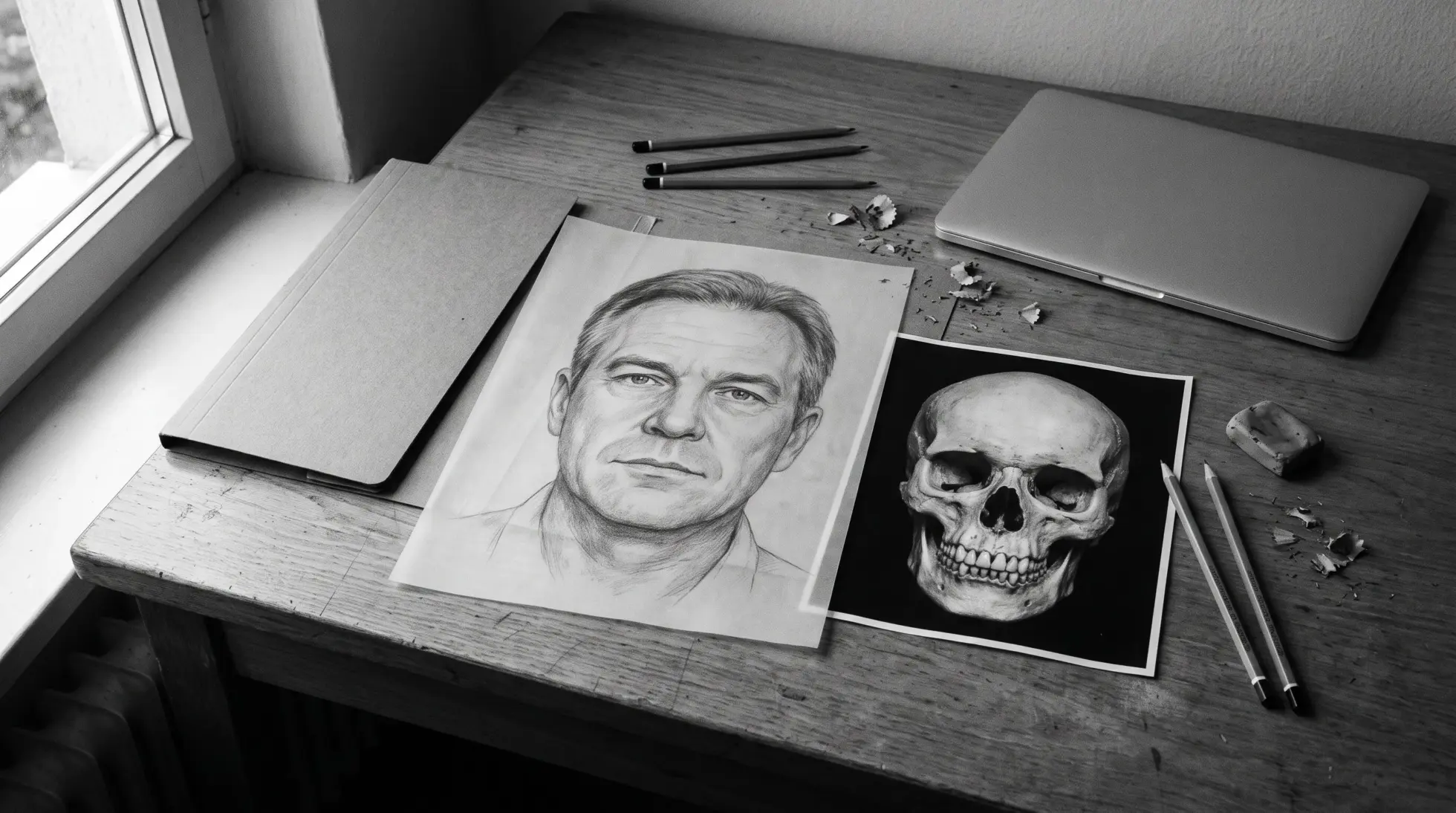
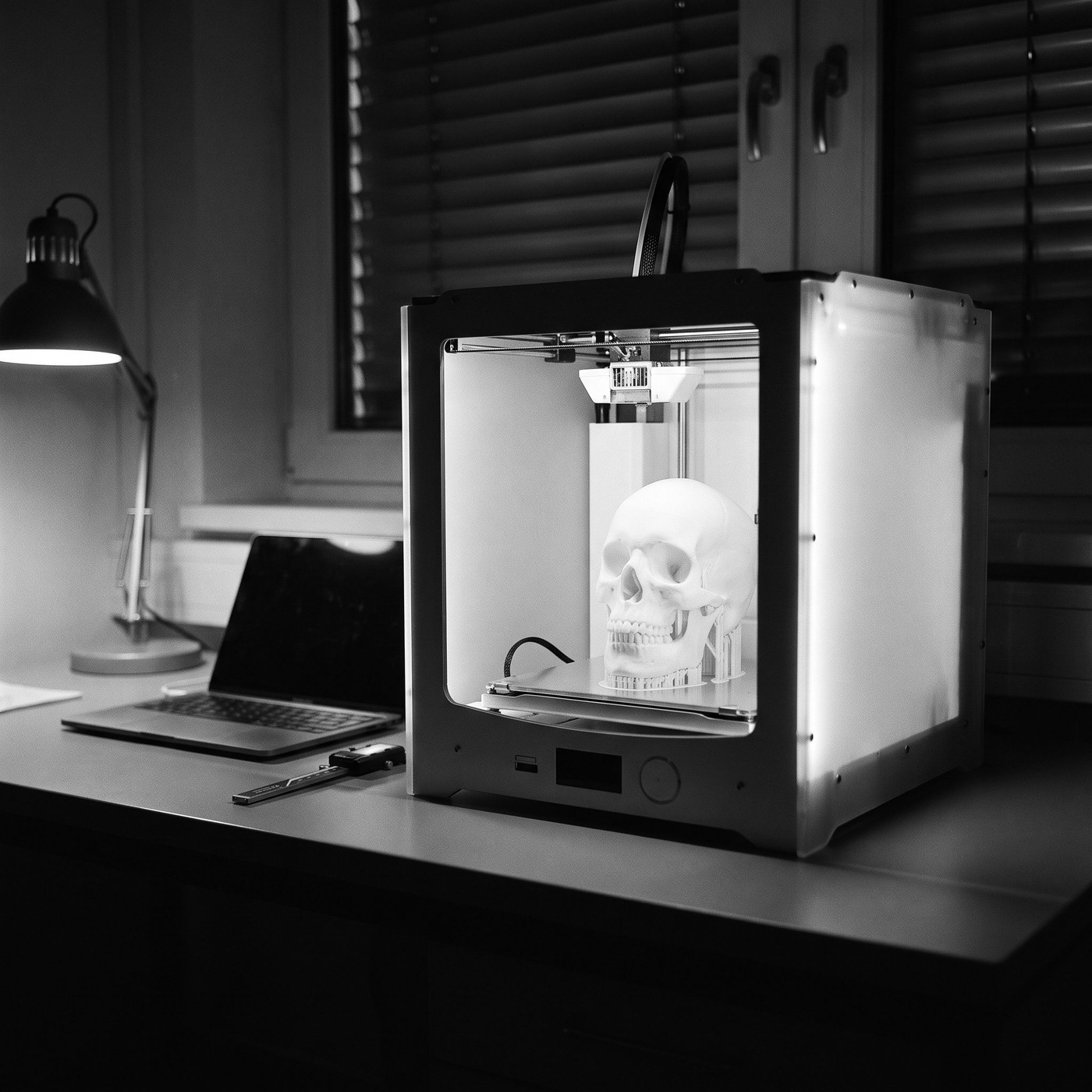
For Two Decades, I’ve Been Giving the Dead Their Faces Back, Using 3D Skull Scans and Photos No One Can Be Shown
About 20 years ago, I cobbled together my first soft-tissue depth markers by cutting cigarette filters to size. Placed at measurement points on the skull, they show how thick the tissue is over the bone at each spot. I laid modeling clay over them, carefully, layer by layer. I set prosthetic eyes in the sockets, and after about 10 days I was looking at the face of someone no one recognized anymore. Funnily enough, cigarette filters are probably the only product the tobacco industry ever made that gave someone a face back instead of taking it away over the years.
Today I can do the same work in a few hours, so starting now I’m officially offering forensic facial reconstruction as a service. I give the dead their faces back when no one recognizes them anymore, and I do it so someone who knew them in life stops short at the sight of that face and reaches for the phone. My image brings in that call; DNA or dental records then confirm the name.
I work in four areas. I reconstruct faces from 3D skull scans. I turn photos of faces so destroyed by scavenging or decomposition that they can’t be shown publicly into an image an agency can release to the public to help identify the person, even when the eyes are missing. I age a face or make it younger, showing roughly what a man looks like at 50 or 60 when the photo I receive shows him at 30, or what someone looked like earlier in life. And if there’s already a suspicion about who the dead person could be, I superimpose the skull on a photo of the missing person.
This work calls for two kinds of knowledge, and both have been part of my forensic work for decades. One is anthropological, the assessment of age, sex, ancestry, and stature from bone, known in the field as the biological profile. The other is facial anatomy, the muscles of facial expression with their origins and insertions and the nerves supplying them. Over the past two decades, I’ve read just about every specialist book and scientific paper I could get my hands on, and I’ve attended every workshop and professional course I could get into. My circle includes former FBI employees and police sketch artists, and over the past 10 years I’ve been in contact with colleagues around the world, soaking up their knowledge, as always, like there was no tomorrow.
From Cigarette Filters to 3D Scans
When I started doing this kind of forensic work, the skull itself lay on my table. Either I worked on the original, which I’d first gone to great lengths to protect so the modeling clay couldn’t damage it, or I made a cast and modeled on the copy while the original lay beside it, showing me where a muscle had attached and where an edge had lost sharpness in the cast.
The setup was just as elaborate, and the work itself followed a fixed sequence. A face made of modeling compound doesn’t happen in one pass. It’s built muscle by muscle, first the large chewing muscles, then the muscles around the mouth and eyes, fat over those, and skin last, and every layer has to match the markers glued to the skull.
I tested dozens of different modeling pastes and clays from all sorts of manufacturers, in every available firmness, because each compound behaves differently when you pull it over a zygomatic arch or set it against the bridge of a nose. The best result depends less on good intentions than on the simple question of whether the compound stays where you put it. Anyone who has ever watched in shock as a freshly modeled cheek slowly slid toward the chin in a warm room knows why I knew more about modeling compounds back then than any supplier who sold them.
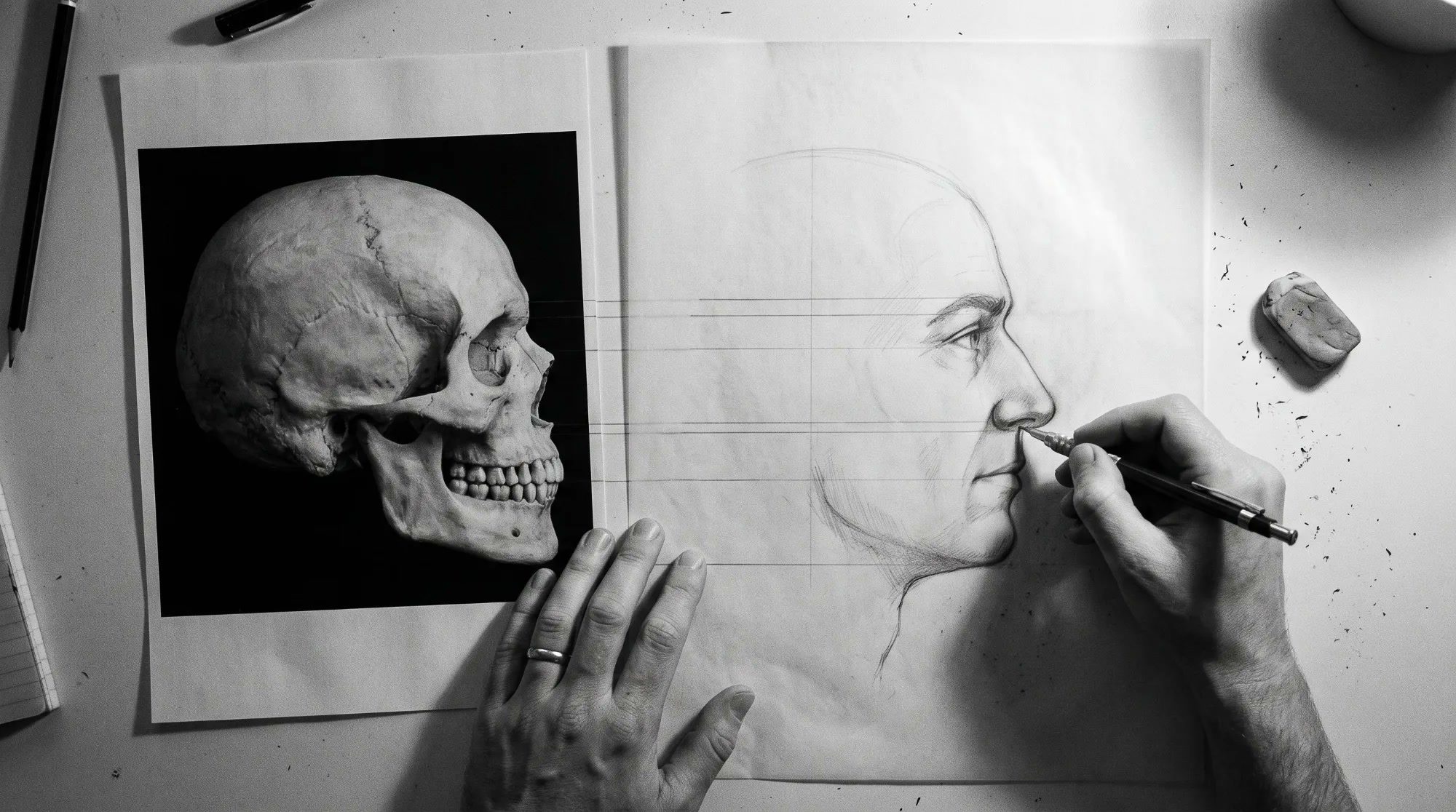
In the two-dimensional method, the face is drawn on drafting vellum beside a side view of the skull, and guide lines carry brow, nose, teeth and chin across. AI-generated illustration.
Comparison taught me the most. I got hold of CT scans of the skulls and photos of the people they had belonged to, which meant the result was already known. I reconstructed the faces and compared my results. A reconstruction artist who never finds out what the person behind the skull really looked like can make the same mistakes for 10 years and consider themselves experienced. I wanted to know where I was off and why, and with every comparison something shifted in my mind until a look at a skull already gave me an inkling of the face that had once covered it.
With the screen came another set of tools. I used Photoshop on photos of partially skeletonized bodies and reconstructed the faces until the images could be used for searches and identification. A few years ago, I added 3D software, which let me work on a digital skull without touching a gram of modeling compound. The principle remained the same as at the table. The markers sit at the same measurement points, the muscles take shape in the same order, but no cheek slides out of place anymore, and every layer can be undone without damaging the one below it. I built the last step myself. I began using artificial intelligence to develop my own software, allowing me to reconstruct a skull in a fraction of the time it once took. Over the past few months, I’ve checked this software’s results against known faces while also programming software that reconstructs a face using large language models and the 3D program Blender. The results have been outstanding.
That’s how 10 days turned into a few hours, and if you still associate facial reconstruction with weeks of plaster and a spatula, you’re thinking of the man I was at that table 20 years ago. But here I have to be honest. Rework is still required, and that still eats up a lot of time, but significantly less than it did five years ago.
What I Read in the Bone Before I Add the First Tissue
A face begins with the question of whose skull this was. Before I model anything, I establish the biological profile, because every finding in it changes the face that emerges. Get the sex wrong or misjudge the age by decades, and you get the wrong face on a perfectly good skull. No program catches that mistake, because it only computes what you feed it.
For age, I read the pelvis, the teeth, and the cranial sutures, plus whatever else the body offers depending on the remains. The sutures in the skull close over the course of life, the teeth wear down, the joint surfaces of the pelvis, above all at the pubic symphysis, change their contours, and together they give me a picture I’d never trust any single feature to provide. I determine sex mainly from the pelvis and the skull itself, the brow ridges, the mastoid process behind the ear, the attachment of the neck muscles at the back of the skull, and the lower jaw. I read ancestry from the shape of the facial skeleton, the nasal opening, the eye sockets, and the palate. If the long bones were recovered too, I use them to estimate stature. I even wrote software for this, Antrometric, which is already used internationally and is available at Antrometric.com (an app is coming soon too). It doesn’t do much for the face itself, but it does a great deal for investigators. Next to the photo on a missing-persons list there’s almost always a height, and a body 1.65 meters tall is ruled out as a match for a missing person 1.90 meters tall before anyone has to compare a single image.
Unfortunately, not every skull arrives complete. If a zygomatic arch or a piece of the lower jaw is missing, I fill it in from the opposite side, because a face is never entirely symmetrical, but it’s symmetrical enough for the surviving half to give the missing half its shape. If the entire lower jaw is missing, the lower third of the face remains the most uncertain area, and I tell the client that before the image is published.
Ancestry determines more than shape. I recognize an African skull, and that means the person’s skin was dark. The same applies to skulls from indigenous populations, whose skin tone I derive from ancestry. Anyone who claims a skull says nothing at all about skin color hasn’t held enough skulls. The bone still doesn’t hand me a specific Pantone value. It shows me the fan of color swatches, and within that fan, experience makes the call.
With these basics in place, I build the anatomy on top. Muscle attachment sites on the bone show me where a muscle sat and how strong it was, and the big chewing muscles determine the fullness at the sides of a face more than anything visible from the front. The eye socket determines where the eyeball sits and at what depth. The bony nasal opening and anterior nasal spine tell me how far the nose projected from the face and how wide it was. The way the teeth sit in relation to one another tells me what I need to know about the lips, and the external auditory canal shows where the ear sat. Each of these relationships is unremarkable on its own. Together they determine whether a face looks like a particular person or like the average of all people. No one recognizes an average, because nobody’s brother or husband was an average.
You don’t see the nerves in the finished face, but they still figure in the work. Anyone who knows which branches of the facial nerve supply which muscles of facial expression, and which muscles therefore work together, understands why a resting face looks the way it does, where the folds around the eyes and mouth run, and why a corner of the mouth droops. A reconstructed face without this knowledge looks like a mask, and no one expects the person they sat with at the kitchen table for years to be behind one.
That’s why I insist on high-resolution photos of the teeth. A blurry overview shot throws away what the teeth could tell me about the lips, and someone who knew the person looks at the eyes and lips first.
Pants Size Tells Me More About the Cheeks Than the Lower Jaw
Whether someone was thin, of normal weight, or overweight changes the face more than almost any other characteristic, and on this, of all things, the bone is almost completely silent. If clothing survives when a body is found, I therefore need the clothing sizes, meaning pants size, shirt size, and whatever else the clothing can tell me about the person’s build. A waist measurement says more about someone’s cheeks than the finest lower jaw, and it’s one of the few situations in my profession where I’d rather read a label than a bone, if the label is still there.
Where the evidence leaves several possibilities open, I build variants, a face with narrow cheeks and one with full cheeks, one with a beard and one without. When the evidence permits several, a single perfectly rendered face throws away some of the chances the case offers.
By the way, people often recognize a relative by something other than the face, by their glasses or by the hideous plaid jacket the uncle wore for decades and considered timeless. Anyone who can send me pieces like these from where the body was found may be sending me the most important part of the image. I build them in so they’ll be seen, just as they looked on the day the person disappeared. Clothing gets reconstructed and cleaned too. People who know me know I don’t do anything halfway.
The Photo You Can’t Show Anyone
Some bodies are found with skin and tissue still covering the bone, but scavengers have gnawed away the face or decomposition has bloated it. No agency can publish an image like that, because it’s too much to ask of anyone and because even the person’s own mother might not recognize her child in that condition. The information the investigator needs is still in the image; it’s just buried under what death and time have done to it. Anyone who thinks pictures like these are horror fodder to treat yourself to in the evening between two episodes of a true-crime series has never seen one that comes back to mind at night, and anyone who thinks professionals grow numb to them confuses silence with indifference. I see these images every day, the faces of young women and the faces of people who had a life before they ended up as remains at a recovery site. And does looking at images like these day after day do something to a person? Yes, it does, and it has changed me.
When an agency sends me photos of a face that has been partially eaten away or badly damaged, I use them to create an image it can release to the public to help identify the person, even when others have given up on the photos. Even when the eyes are gone because the body lay in a field for weeks and birds pecked them out, or when large parts of the face are lost, different imaging programs and my knowledge of the anatomy underneath allow me to reconstruct even the most horrific image so it can be published. The goal is a living person, not a model in an ad. If you smooth a destroyed face until it’s beautiful, you turn it into a stranger, so a scar, a crooked nose, or a mole stays in the picture if it’s still visible in the photo.
Scavenging follows a logic of its own, and a pretty unappetizing one at that. First to disappear are the soft, exposed parts, the eyes, eyelids, lips, tip of the nose, and edges of the ears, the very parts by which someone recognizes a face. The rest is often astonishingly well preserved. From that remainder, from cheek width, forehead shape, hairline, and proportions that still hold, I build the missing parts so they fit what’s preserved and don’t look borrowed from someone else’s face.
The hardest cases are partially skeletonized bodies, with skin still lying in one place and bone already exposed right next to it. And even what’s still lying there lies. After death, tissue loses water, and with the water goes its elasticity. The fat dries out, and the skin tightens over the bone like parchment over a frame. The lips pull back from the teeth, the cheeks cave in, the eyes sink into their sockets, the nose collapses, and someone who has lain in the sun for weeks ends up wearing a face that never belonged to them in life. In those cases, I work with both at once, the photo for what survives and the skull for what’s missing, and I restore to the dried-out tissue the volume that sun and time took away. The art lies in making the seam between the two invisible in the finished picture.
An eye I have to replace sits where the eye socket dictates, at the depth it allows, and with an eyelid opening that fits this person, not some photo from an image database. I reduce swelling and discoloration. Blood, severe injuries, and dirt disappear, the eyes open, the mouth closes, and when I’m done, you see a person who looks as if they were alive a moment ago.
The earlier in the process an image like this is created, the less I have to replace and the closer it comes to the person it’s meant to show.
A Face I Can Age or Make Younger
A man disappeared at 30, and the last photo his family has of him shows him at that age. I show roughly what this man looks like at 50 or 60, and today’s technology can do that well. For missing-person cases that have been open for years, it’s often the only way to get a current picture out to the public.
A face ages according to rules you have to know, and I’ve been working with these rules for decades. Gravity works every day, without a vacation and without mercy. Tissue loses its firmness over time, fat migrates from the cheeks toward the chin, skin gets thinner, and wrinkles dig in right where a person spent a lifetime laughing or furrowing their brow. Even the bone plays along. The eye sockets widen, the upper jaw recedes, and the nose and ears look bigger in old age than they did in youth. In men, the hairline often recedes while the eyebrows get bushier, as if they’d taken over the hair from the head, and in nearly everyone the upper lip drops a little, so less of the upper teeth shows when the person laughs. Anyone who hasn’t mastered these rules turns a 30-year-old not into a 60-year-old but into a 30-year-old with gray hair and pencil-drawn wrinkles.
For good age progression, I need photos of the person from as many phases of life as possible and, where they exist, photos of parents and siblings, preferably at the age the missing person would be today. Family resemblance is part of this work, but it’s a clue, not a blueprint, so I read these photos with an anthropologist’s eye. I know that some children resemble their parents about as much as a tax bill resembles a love letter. To avoid mistakes here too, I ask about lifestyle, because life writes itself into the face. Alcohol leaves a bloated face and fine red veins on the nose and cheeks, smoking carves little wrinkles around the mouth and turns the skin sallow, and anyone who spent their working life outside in the sun ages differently from someone who sat in an office for 30 years. Here, my perfectionism is nonnegotiable.
Sometimes the only photo of someone is from their later years, and I’m looking for someone who knew them as a teenager, a former neighbor or a friend from school. Then I make the face younger, erase the marks of the years, restore the firmness the tissue once had, and show a face that fits the memories of those who knew this person only in an earlier phase of life. After decades of this work, much of it is intuitive now, because the work has rebuilt my brain. It’s called neuroplasticity, and today a few minutes with a skull in my hand are enough for me to see the face that covered it. Crazy as it sounds, it works in reverse too. When I walk through the supermarket, I see the skull beneath every face. The woman in the checkout line has no idea I’m measuring her brow ridges, while the man pushing a cart with a six-pack of beer has no idea I’m compiling a biological profile on him as I pass. Others call it an occupational hazard; I call it a gift.
A person who has been missing for 20 years has eaten during those years, smoked or not, perhaps worked outdoors in the sun or in an office, and all of it leaves traces in the face. What the family can tell me about the person’s habits and living circumstances goes into the work, and where nothing is known, I deliver the variants I consider necessary.
When the Skull and Missing-Person Photo Are Superimposed
If there’s already a suspicion about who the dead person could be, reconstruction is rarely the fastest route. For that situation, I offer craniofacial superimposition, known internationally as “superimposition,” meaning the skull is overlaid with a photo of the missing person. I match the skull to the position and perspective of the head in the photo and check whether the eye sockets, nose, chin, and jaw angles fit the soft tissue in the image. A photo of someone laughing and showing their teeth reveals a great deal, because a gap between the teeth, a crooked canine, or a crown shows up on the skull just as it does on the photo, and then I compare the teeth in the skull with the teeth in the photo. A photo taken at close range with a phone is less helpful, because the lens enlarges the nose and forehead and pushes the ears back, and I have to correct for that distortion before I can overlay anything at all.
Its strength lies in exclusion. If a skull doesn’t match a face, a family that has been waiting for years doesn’t have to pin its hopes on the wrong body, and if it does fit, the suspicion becomes specific enough to make comparing DNA or checking the dentition against dental records worthwhile. For this, I prefer several sharp photos from different angles, ideally from the period just before the disappearance, and a profile shot is worth its weight in gold.
The Same Rules Apply to an Excavation as to a Criminal Case
Archaeologists and universities contact me just as investigators do, but in their cases no one is waiting for a call, because the people who knew these dead have themselves been dead for centuries. Here, I give the find a face so an exhibition or publication can show what this person looked like, someone who until now has been just a catalog number in an inventory.
That changes nothing about the work. I establish the biological profile, read the muscle attachments, and build the face by the same rules as for a police agency, because a person in the Middle Ages had the same chewing muscles we have, and their eyeball sat in the same place in the socket. But the same muscles don’t mean the same strength. Someone who spent a lifetime chewing coarse bread and tough meat has stronger attachment sites at the jaw angle and temple than a present-day office worker, and it shows in the width of the face.
Handling the original is different. Archaeological skulls are often brittle, incomplete, or deformed over centuries, and today I no longer put modeling compound on an original like that, however carefully I protected it in the past. The 3D scan is the only way to leave the find untouched, and I add missing parts on the computer, where every addition can be undone. I discuss hairstyle, beard, and jewelry with the archaeologists, because they know the period and context of the find better than I do. If a find dates from a time when men wore beards, I don’t put a clean-shaven farmer in the display case just because the bone says nothing about the beard. The bone supplies the rest, and the bone of a 12th-century farmer lies no more than that of a dead man found shot in the woods last week.
No Button, No Filter, Just Judgment
Now that anyone with a phone can age their face or turn themselves into a Viking, Otto Sapiens thinks facial reconstruction is a filter in a lab coat: upload skull, press button, download face. I use artificial intelligence myself, I write the software for it myself, and for that very reason I know where it stops and what its limits are.
A language model or a 3D program can generate a face, but it doesn’t (yet) know whether the pelvis in the photo belongs to a woman of 25 or a man of 60, or whether the pants at the scene were a size 48 or 58. Those decisions are mine, and I discard a result that doesn’t fit the evidence, however good it looks. The software has taken the days out of the work. It hasn’t taken the judgment out of it, even though I work almost every day to teach the LLM these distinctions.
An image that looks like a passport photo is also read like a passport photo. If you see bright blue eyes on a reconstruction, you look for a man with blue eyes, and if the dead man had brown ones, his sister may look right past the image that was supposed to give him back to her. So I use only what the evidence provides, and if a hair sample from the scene is available, the image carries its color.
Because I reconstruct in a few hours, I can make adjustments as soon as the file grows, a new finding arrives, or a tip comes in from the public, instead of defending a face I spent 10 days working on.
The software also changes how many variants a client can receive. Every additional hairstyle and every beard used to cost hours of work with modeling compound, so there was usually just one face, because hardly anyone wanted to pay for multiple versions. Today a variant costs a fraction of that, so the case gets the versions the evidence demands, not the ones the budget permits.
What I Need From You to Create a Face
I take inquiries in writing through the contact page, because a facial reconstruction begins with a case file, with photos and findings, and you can’t hand over a case file on the phone. What I need depends on the service and the case, because every recovery site is different.
For a skull-based reconstruction, I need the skull as a 3D scan or the material from which a scan can be obtained. I establish the biological profile myself. That’s part of the work, and depending on the circumstances of the find, I need additional images: photos of where the body was found, photos of the pelvis, good shots of the teeth and cranial sutures, and anything else that can contribute to estimating age. If long bones are present, I need their measurements or photos with a scale so I can also calculate stature and compare it with the missing-persons list. If clothing was recovered, I need photos, sizes, and all information that sheds light on the person’s build, plus glasses and jewelry if available. For a damaged face in a photo, I need the photos at the highest possible resolution and from as many angles as possible, and if available, photos from the scene showing the face in an earlier condition. For age progression or age regression, I need photos of the person from different phases of life and, where available, photos of parents and siblings. For craniofacial superimposition, I need the skull or scan and the best photos of the missing person that exist.
We’ll decide together what you receive when I’m done. Usually it’s a high-resolution image, often with variants for skin, hair, and body weight when the evidence leaves several possibilities open.
How a Job Works When You Hire Me
I read the entire file before touching anything: the photos from the scene, the findings, and the clothing information. Only once I know what’s present and what’s missing do I get back to you with the questions your case still leaves open. If anything I need for a reliable face is missing, I say so before I begin, not once the picture is finished. After the biological profile comes the actual reconstruction, on the scan, in the photo, or across the age series. Where the evidence leaves several possibilities open, I create the variants we discussed beforehand. The agency decides which one to publish, and I tell it which I consider most likely and why. You receive the result in the form we agreed on.
If new tips arrive after publication, such as witness testimony pointing to a beard or a particular hairstyle, I adjust the picture. Because the work now takes hours, that’s an afternoon at the computer and not a new project.
One Price for Everyone and No Numbers Pulled Out of Thin Air
I bill by the hour. The current hourly rate is available on request, and it applies to every client, an agency just as much as a state, a university, or an archaeological excavation. A skull from a criminal case requires the same care as one from an excavation, and I don’t see why one client should subsidize another.
I don’t give an advance estimate of the hours, because every job is different. If someone sends me 50 photos from the scene and an investigative file along with the job, I have to read that file before I know how much work is in it, and a number before reading it would be a guess. Where I used to need days, I now need only a few hours for the best possible result, and that’s significantly less time than most clients expect from this process.
A John Doe From Russia Is Waiting for His Face
I have a skull from an archaeological find in Russia. It belongs to a John Doe in the literal sense, someone whose name no one knows. In English, every unidentified dead person is called that, a name so ordinary-sounding that you forget what it means. It means a person has become so completely disconnected from every other human being that even his name got lost. This is probably the next skull I’ll work on, and the plan is to show the result here later, so anyone thinking about hiring me can see beforehand what they’re getting.
Twenty years ago, this skull would have spent 14 days on my table, with cigarette filters on its cheekbones and prosthetic eyes in its sockets. Today it takes a few hours. The question I ask when I look at every skull has remained the same. Is someone somewhere still alive who would recognize this face if you just showed it to them?
If you have a skull or a photo and the person behind it is still missing, write to me through the contact page. The John Doe from Russia has his place in line, and your case can sit beside his.
Disclaimer: This article reflects the author’s own research and opinion as of the publication date shown above; later findings or legal changes may have overtaken it, so always check that date. Sources are cited for independent verification, and no liability is accepted for third-party studies. This is general information, not medical, legal, or professional advice: for medical questions see a doctor, for legal questions a lawyer, and in an acute crisis contact emergency services or a crisis helpline.
About the header image: it is AI-generated. Cheaper than a photo shoot, and I have made my peace with the age of AI. Everything inside the article is real, the diagrams, the skulls, the findings, and every word. The machine gets the opening shot and not one inch past it.
If you wake up at 3 a.m., you are not sick, you are running on very old software
Waking up at 3 a.m. is not an illness but very old software at work. A forensic scientist…
Ghost DNA and what we cannot know about where we come from
Every person alive carries genetic material from a group of humans of whom not a single bone exists.…
What Is Radiocarbon Dating? Everything About the Method That Decides Between a Murder Case and an Archaeological Find
Radiocarbon dating measures remaining carbon-14 to determine when carbon exchange ended. This article explains the method from atmospheric…