The Forgotten Medicine
What our ancestors knew, and what modern medicine refuses to see
More and more people today are falling ill from conditions that barely existed a generation ago, at least not in the staggering frequency with which we now encounter them everywhere we look: chronic exhaustion that no amount of sleep seems to fix, anxiety that has no concrete cause but simply sits there in your chest like a stone, insomnia that feels like someone left the lights on inside your skull, the inability to concentrate on anything for more than ten minutes, irritability without reason, and that diffuse, hard-to-name feeling that something fundamental has gone wrong, somewhere deep inside, and that the life you are living is somehow running on a system that was not built for this. More often than not, these creeping states end in full-blown diagnosable conditions that can no longer be ignored: burnout, clinical depression, anxiety disorders complete with panic attacks, and in the worst cases, neurodegenerative diseases like Alzheimer's that may have quietly begun their work decades before any doctor thought to look.
Modern medicine's answer to all of this is as simple as it is alarming: a prescription. SSRIs, benzodiazepines, sleep aids, mood stabilizers, antidepressants of the latest generation that suppress symptoms the way a bandage covers a gunshot wound, without doing anything meaningful about what caused the bleeding in the first place. What gets systematically ignored in this process, or perhaps more accurately, what gets deliberately overlooked for reasons that become very clear once you follow the money, are the substances that humanity has known, used, and empirically tested across thousands of years, long before anyone could spell the word placebo or design a double-blind trial.
We are talking about mushrooms. Not just any mushrooms, but two specific species that have held a central place in the traditional medicine of Asia for at least two to four thousand years, that were administered in Buddhist monasteries and imperial palaces alike, and that Western science is only now, with considerable delay and visible surprise, beginning to examine in clinical settings. Lion's mane and reishi. Two mushrooms whose effects our ancestors understood intuitively… and that the modern pharmaceutical industry would very much prefer you never hear about.
Looking East, Where Medicine Was Never Forgotten
While Europe was burning its healers alive, more on that shortly, Asia spent thousands of years developing a medical tradition built on observation, patience, and knowledge passed carefully from one generation to the next. Traditional Chinese medicine, Ayurvedic medicine from India, Kampo medicine from Japan, all of them share a foundational conviction that healing does not come from suppressing symptoms but from restoring a balance the body is fully capable of maintaining on its own, if given the right tools and the time to use them. Mushrooms were not peripheral figures in this world, they were central players in a medical system built on millennia of careful clinical observation, even if no one called it that at the time.
What the people of these traditions could not have known, but somehow felt their way toward through generations of practice and careful attention, neurobiology is now confirming with a precision that is simultaneously impressive and a little embarrassing for the West. These mushrooms work. They work on the nervous system, on the immune system, on neurogenesis, on cortisol regulation, on inflammatory markers, and on the brain's remarkable capacity to repair and reorganize itself. The difference between then and now is not the substance. The difference is that we finally understand the mechanism, and that we are somehow still doing almost nothing about it.
Hericium erinaceus, Lion's Mane
History and Origins
Hericium erinaceus, known in English as lion's mane mushroom, is an edible and medicinal fungus that grows on decaying hardwood trees and whose cascading white spines give it an appearance that does genuinely resemble a lion's mane hanging in the wind. In China it carries the poetic name Hóu Tóu Gū, which translates roughly as monkey head mushroom, while in Japan it is called Yamabushitake, named after the Yamabushi monks, ascetic mountain practitioners of Shugendo Buddhism who used it as a regular part of their diet and spiritual practice and who were, whether they knew it or not, doing something that today's neuroscientists would recognize immediately as deliberate cognitive enhancement.
The earliest documented use reaches back at least two thousand years, and in imperial China the mushroom was considered such a luxury that it was reserved exclusively for the emperor and his innermost circle, while simultaneously being used as medicine for digestive complaints and for the general strengthening of mental clarity. Buddhist monks used it specifically to improve concentration and memory retention during long meditation sessions, a practice that makes complete neurobiological sense today, even though the monks themselves had no idea what a nerve growth factor was and did not need to, because the results they observed over generations were evidence enough.
How It Works in the Body and Brain
Lion's mane contains two unique groups of bioactive compounds found in no other organism on Earth in this particular combination: hericenones, isolated from the fruiting body, and erinacines, derived from the mycelium. Both stimulate the production of NGF, nerve growth factor, a protein that is absolutely essential for the growth, maintenance, and survival of neurons, and whose significance for the aging brain can hardly be overstated. What this means in practical terms is that this mushroom actively supports the brain's ability to form new neural connections and preserve existing ones, a process that neuroscientists call neuroplasticity and that underpins learning, memory, emotional regulation, and cognitive resilience in ways so fundamental that its decline is among the first measurable signs of cognitive aging.
A randomized double-blind trial conducted in Japan demonstrated that older adults who consumed 3g of Hericium extract daily showed significantly better results on cognitive assessments after sixteen weeks than the placebo group, and what is equally striking is that when the study ended and participants stopped taking the extract, their cognitive scores declined again within four weeks, which is about as clear a signal as science can send that the effect was real, specific, and required ongoing exposure to sustain (Mori, K., Inatomi, S., Ouchi, K., Azumi, Y., & Inoue, T., 2009, Improving effects of the mushroom Yamabushitake on mild cognitive impairment: a double-blind placebo-controlled clinical trial, Phytotherapy Research, 23(3), 367-372).
On the subject of anxiety and depression, a separate Japanese clinical study found that perimenopausal women who consumed lion's mane biscuits for four weeks reported significantly less anxiety and fewer concentration problems than the control group, with the underlying mechanism being the inhibition of neuroinflammation combined with NGF stimulation in the hippocampus, the brain region responsible for emotional regulation and memory, and one that is measurably smaller in people suffering from anxiety disorders and depression than in healthy controls (Nagano, M., Shimizu, K., Kondo, R., Hayashi, C., Sato, D., Kitagawa, K., & Ohnuki, K., 2010, Reduction of depression and anxiety by 4 weeks Hericium erinaceus intake, Biomedical Research, 31(4), 231-237).
Why Has It Been Forgotten?
The answer is as mundane as it is maddening: you cannot patent it. Hericium erinaceus grows in the wild, can be cultivated with minimal effort, and costs a few dollars a month as a supplement, and no pharmaceutical company on earth has a financial incentive to fund expensive clinical trials whose conclusion is a freely available fungus that carries no patent protection and whose profit margins cannot remotely compete with those of sertraline or escitalopram. This is not a conspiracy theory, it is simply the predictable behavior of a market that runs on profit and not on health, and that is extraordinarily precise in deciding which knowledge gets funded and which gets quietly left to gather dust.
Ganoderma lucidum, the Mushroom of Immortality
History and Origins
Ganoderma lucidum, known as reishi in Japanese and lingzhi in Chinese, which translates variously as spiritual mushroom or divine mushroom, has a documented medical history stretching back at least four thousand years. The oldest known herbal compendium in the world, the Shennong Bencao Jing, compiled in China somewhere between 2,700 and 3,000 years ago, places it in the highest category of medicinal substances, the category reserved for things that can be consumed daily without harm and that promote vitality and longevity, which is more or less exactly what we would expect from a well-researched adaptogen today.
In imperial China, reishi was considered so precious that it was restricted exclusively to the emperor and his closest circle for centuries, and a person who found a lingzhi mushroom and brought it to the emperor could expect to live comfortably for the rest of their life. Taoist monks regarded it as a key to enlightenment, and in Buddhist iconography it appears repeatedly as a symbol of good fortune, longevity, and divine blessing. The nickname mushroom of immortality was not the product of ancient marketing, it was the result of centuries of careful empirical observation: those who consumed it regularly seemed to live longer, stay mentally sharper, and resist illness more effectively than those who did not… and as we now understand from a pharmacological standpoint, the old Chinese were not wrong.
How It Works in the Body and Brain
Reishi contains over four hundred identified bioactive compounds, including triterpenes, polysaccharides, peptidoglycans, and beta-glucans, and its central mechanisms of action are today well documented. Reishi modulates the HPA axis, the hypothalamic-pituitary-adrenal axis that governs cortisol secretion in response to stress, effectively training the nervous system to respond more calmly to stressors and to bring chronically elevated cortisol levels back down to something approaching normal, which matters enormously because chronically elevated cortisol is one of the primary drivers of sleep disruption, anxiety, rumination, and cognitive exhaustion in modern adults, and it is present in far more people than anyone is currently testing for.
A systematic review documents comprehensively the mushroom's ability to both dampen overactive immune responses and stimulate underactive ones, a paradox that pharmacologists describe as bidirectional immunomodulation and that no synthetic drug currently on the market achieves with the same consistency and without meaningful side effects (Jin, X., Ruiz Beguerie, J., Sze, D.M.Y., & Chan, G.C.F., 2012, Ganoderma lucidum (Reishi mushroom) for cancer treatment, Cochrane Database of Systematic Reviews, 6, CD007731). On the subject of sleep, clinical studies show a significant increase in slow-wave sleep duration with regular reishi consumption, an effect mediated through adenosine receptors and modulation of the serotonergic system, and one that is of immediate practical relevance for anyone who finds themselves wide awake at four in the morning with their thoughts running in circles and no idea how to make them stop.
The antioxidant and anti-inflammatory properties are equally well established, and since chronic inflammation is now understood as a primary driver of aging, cardiovascular disease, neurodegenerative conditions, and cancer, reishi's demonstrated ability to lower inflammatory markers like IL-6 and TNF-alpha to pharmacologically relevant levels, without the side effects of synthetic anti-inflammatories and without the quarterly bloodwork to make sure your liver is still cooperating, deserves considerably more attention than it currently receives.
Why Has It Been Forgotten?
For the same reasons as lion's mane: it grows in nature, it cannot be patented, and its effects unfold slowly and sustainably, which makes it a terrible business model in a society that sells quick fixes and reports earnings quarterly. Add to this a historical trauma in Europe that almost nobody talks about but that has shaped the entire trajectory of Western medicine in ways we are still living with, and the picture becomes a good deal clearer.
What Europe Burned
Europe had its healers too: wise women, herbalists, druids, shamans, people who carried generations of accumulated knowledge about plants, fungi, and natural substances, who knew which preparations lowered fever, which mushrooms eased pain, and which combinations of roots and barks helped with sleeplessness and anxiety. Hildegard of Bingen, writing in the twelfth century, is one of the rare documented examples who survived the Inquisition, partly because she was an abbess and therefore under ecclesiastical protection, and her work Physica offers a window into a body of healing knowledge that was once widespread across Europe, before the Church decided that healing was God's business and not the business of the herbalist at the edge of the forest.
Walburga Hausmannin, a midwife from Dillingen, was executed in 1587 in part because she used herbal preparations to ease the pain of childbirth, which the Church interpreted as an interference with God's design, since the pain of labor was considered divinely ordained and therefore not to be mitigated by anyone with knowledge of plants and their effects. What was being destroyed in cases like hers was not superstition, it was empirical medical knowledge that had developed over generations through observation and careful transmission, exactly the same principle on which traditional Chinese medicine was built and which survived in Asia because nobody there decided to burn the people who held it.
By some estimates, between forty thousand and sixty thousand people were executed as witches and sorcerers in Europe between 1400 and 1700, most of them women, and most of them carriers of healing knowledge that is now gone forever, because the people who held it ended on pyres and their records went with them. What the Catholic Church destroyed in those centuries was the European equivalent of the traditional Chinese pharmacopeia, and we are still paying for it today, without knowing what we lost, because we cannot know what was never written down, or what was written down and then burned.
The Modern Doctor and the Ancient Mushroom
Imagine going to your doctor today. You tell them: I wake up at four in the morning, my thoughts won't stop, I'm not sleeping properly, I can't concentrate, I'm irritable for no good reason, and I'm starting to wonder whether this might be the beginning of something that has a very serious name attached to it. What happens? Your doctor nods sympathetically, types something into a computer, and three minutes later you are holding a prescription: sertraline, escitalopram, mirtazapine, possibly combined with a benzodiazepine for acute episodes, all of them carrying side effects, many of them carrying dependence risk, and none of them accompanied by the reassuring thought that stopping them one day will be simple or uncomplicated.
Our ancestors ate far better than we do, not because they were wiser about nutrition but because they had no other choice. The water still had everything in it, the fruits and plants were full of compounds that our depleted soils no longer produce, and daily contact with mushrooms, herbs, and fermented foods was simply part of how people lived, not a lifestyle choice but a baseline condition of existence. The gut microbiome that we now spend considerable money trying to repair with expensive probiotics was intact because the diet kept it intact, and the cognitive and emotional systems that we now attempt to stabilize with antidepressants were more resilient because the substances that support them were simply present in the food.
Nature has developed effective, safe, and well-tolerated solutions for most of what ails us, solutions tested across millions of years of evolution and refined across thousands of years of human experience. Lion's mane builds nerve growth factor. Reishi regulates cortisol and deepens sleep. Both reduce neuroinflammation, both improve cognitive resilience, and both cost less per month than a single copay. Your doctor will not prescribe them, not because they don't work, but because nobody taught him that they do, because medical school in this country devotes approximately zero hours to mycology as medicine and considerably more time to the pharmacology of substances that have patents, distribution networks, and drug reps who come by once a month with pens and sponsored studies…
You don't have to be a conspiracy theorist to notice that a healthcare system structurally dependent on people taking medications indefinitely does not have a particularly strong incentive for those people to get well by eating a mushroom from the forest. Healthy people don't buy pills, and that is not an accusation, that is arithmetic. Somewhere right now, on a rotting log in a damp forest, a white fungus is growing whose molecules could repair your brain without a prescription, without a co-pay, and without a package insert in six-point type listing twenty side effects. Our ancestors knew that. It might be time for us to remember it.
References
- Ahmad, M. F., Ahmad, F. A., Khan, M. I., Alsayegh, A. A., Wahab, S., Alam, M. I., and Ahmed, F. (2021). Ganoderma lucidum: A potential source to surmount viral infections through beta-glucans immunomodulatory and triterpenoids antiviral properties. International Journal of Biological Macromolecules, 187, 769-779. https://doi.org/10.1016/j.ijbiomac.2021.06.122
- Moncrieff, J., Cooper, R. E., Stockmann, T., Amendola, S., Hengartner, M. P., and Horowitz, M. A. (2022). The serotonin theory of depression: a systematic umbrella review of the evidence. Molecular Psychiatry, 28(8), 3243-3256. https://doi.org/10.1038/s41380-022-01661-0
- Mori, K., Inatomi, S., Ouchi, K., Azumi, Y., and Tuchida, T. (2009). Improving effects of the mushroom Yamabushitake (Hericium erinaceus) on mild cognitive impairment: a double-blind placebo-controlled clinical trial. Phytotherapy Research, 23(3), 367-372. https://doi.org/10.1002/ptr.2634
- Szućko-Kociuba, I., Trzeciak-Ryczek, A., Kupnicka, P., and Chlubek, D. (2023). Neurotrophic and neuroprotective effects of Hericium erinaceus. International Journal of Molecular Sciences, 24(21), 15960. https://doi.org/10.3390/ijms242115960
- Wachtel-Galor, S., Yuen, J., Buswell, J. A., and Benzie, I. F. F. (2011). Ganoderma lucidum (Lingzhi or Reishi). In Herbal Medicine: Biomolecular and Clinical Aspects (2nd ed.). CRC Press, Taylor and Francis. https://www.ncbi.nlm.nih.gov/books/NBK92757/
Disclaimer: This article reflects the author’s own research and opinion as of the publication date shown above; later findings or legal changes may have overtaken it, so always check that date. Sources are cited for independent verification, and no liability is accepted for third-party studies. This is general information, not medical, legal, or professional advice: for medical questions see a doctor, for legal questions a lawyer, and in an acute crisis contact emergency services or a crisis helpline.
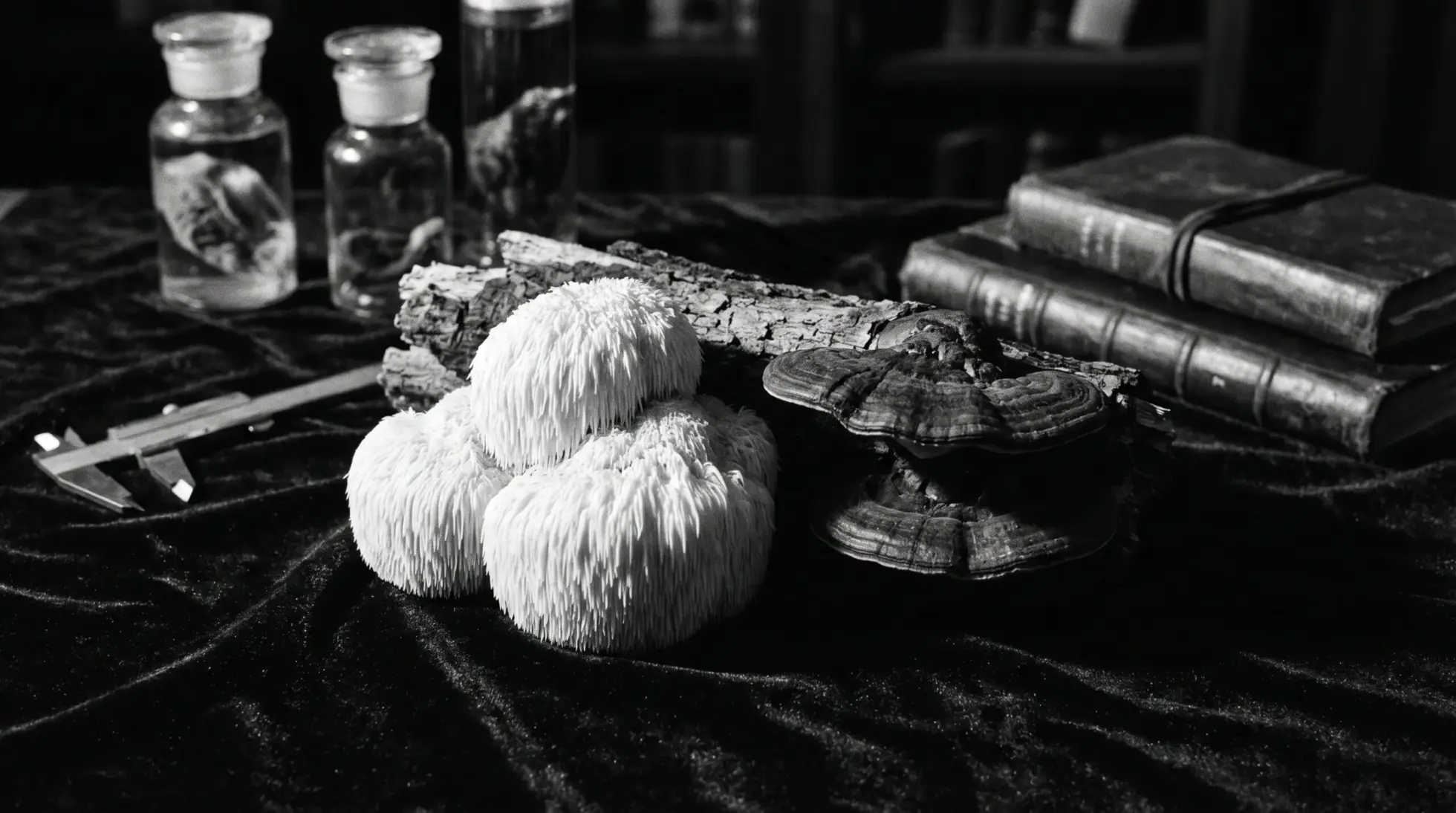
About the header image: it is AI-generated. Cheaper than a photo shoot, and I have made my peace with the age of AI. Everything inside the article is real, the diagrams, the skulls, the findings, and every word. The machine gets the opening shot and not one inch past it.

Six years later: you can take the tinfoil hats off
COVID-19 was not a statistical illusion: 22.1 million excess deaths worldwide and 1,245,272 American death certificates naming it…
The Most Expensive Nothing in the World
In a C30 homeopathic pill not a single molecule of active substance survives. Why homeopathy is arithmetic nothing,…

Houston, I Have a Problem, and It Is in My Glass
A perfectly healthy man quits in the middle of high summer because pure water turns into an accomplice…