Cost of Living, the Most Honest Phrase in the Whole Matrix
Why a single phrase gives away the entire construction, how almost nothing of 100 euros is left for you in the end, and why even a married couple with a small but just-sufficient pension ends up on basic welfare the moment one of the two has to go into a care home.
Let me promise you one thing before this really gets going. It will get political. Maybe it is about the tax office, it is certainly about the hamster wheel, and here and there you will laugh out loud and notice in the same breath that the laugh should really be sticking in your throat. That is exactly how I am going to write it, with as much humor as the subject can bear, and that is not a stylistic device, that is self-defense. Without the jokes this material would be almost unbearable, for you and for me both. On social media you get knocked around for nearly every sentence anyway, so I have no appetite for censoring myself on top of it. Here it is different. Here I am the sheriff. I decide what gets written and how it gets written, and today the accounts get settled, in the most literal sense this country knows.
There are phrases that reveal more than the person using them ever intended. Cost of living is one of them. We say it every day, completely in passing, as if it were the most natural thing in the world, and nobody stops and listens closely. I do that out of long habit, I listen for what hums underneath a phrase, and this one has snagged me for years. A cost is what you pay to keep something running. The upkeep on a building you do not want to tear down. The maintenance on a machine that has to keep turning. The support for a marriage that is only being administered now. A cost is what you spend to keep something functioning, without loving it anymore. And we put exactly that word in front of life.
Nobody says cost of joy. Nobody says I go to work in order to live. We say I cover my cost of living, and mean, without noticing it, the operating expenses of staying just barely operational. If I were a believer, I would look up at this point and ask what that is supposed to be, a life whose declared purpose is to keep itself running. I am not a believer. So I ask the tax office instead.
And one more thing up front, so that nobody feels wrongly singled out. This time, by way of exception, it is only about Germany, because I have neither the time nor the desire to tally the various hamster farms of this world against one another here. But one thing I can and want to tell you. It differs completely from country to country, and there are genuinely, genuinely intelligent countries that are doing genuinely well, that got a great deal right, and in which a human being is still allowed to be happy.
What the tax office answers is not a sermon and not a philosophy, it is a table, and tables do not lie. The numbers that follow hold more truth about the state of this country than any Sunday speech. I will go through them in order, calmly, without foaming at the mouth, because the outrage that belongs here does not have to be added. It already sits inside the figures. You only have to be able to read them, and that has been my craft for as long as I can think.
A Word That Gives Itself Away
Look at the path a person takes in this country. He is born, and the clock starts. He is schooled, for years, and the word for it is tellingly precise, because we call it training. Someone is being trained here, shaped, cut to fit, and not for a life but for a function. Whoever is different in this process, too slow, too fast, too much his own, gets corrected, graded, sorted out, until he fits the grid or breaks on it. At the end stands a finished specimen, fit for its place in the machinery, and that place has a name we are too polite to use. We say profession. We mean the wheel.
I know that sounds harsh, and it is meant to sound harsh, but it is not an exaggeration, it is a sober description of the sequence. We send children into an institution we call school for 12 years and longer, and what gets trained there most thoroughly is not knowledge, you forget that anyway, but obedience to a foreign rhythm. Be on time. Sit still. Switch your activity on a signal. Raise your hand before you speak. These are not lessons, they are operating instructions for a later life on the assembly line or at the desk, and in the end they sit so deep that the grown person mistakes them for his own character.
Then he runs. 40 years, 45, and the goal keeps moving while he runs. A few decades ago the wheel ended at 60. Then it became 65, then 67, and right now, in the spring of 2026, a pension commission has recommended raising it step by step to 70, for everyone who is in their mid-thirties or younger today. So far that is only a recommendation, not a law, and that belongs to the honesty here. But the direction is fixed, and it points backward. The wheel does not get shorter, it gets longer, and at the end the person leaves it, run out in the literal sense, and drops out of the system that timed him his whole life. Some never cope with that again. Some do not even reach the end.
I have seen enough people just short of this finish line to know that for many of them it is a mirage. Someone works 40 years toward the promise that at the end a calm stretch arrives, in which he is finally allowed to be himself, and then, a few years before the goal, the body gives out, or the heart, or the mind, and the golden years turn into a waiting room. The wheel does not only take the years he runs. It also takes the years he ran for, because it pushed them so far back that almost nothing is left at the end that you could call retirement.
Cost of living. The phrase admitted the whole thing long before we put down the first number. It tells us that we do not work in order to live, but live in order to be able to work, and that the wage at the end is merely the operating supplies with which we maintain ourselves for the next lap. I do not throw this in as a lament, I am not a romantic wishing the Middle Ages back. I am only dissecting what lies in front of us. And what lies in front of us is expressed, from here on, in percentages.
I like percentages, they have the advantage that they do not argue. A person can tell you the system is fair or unfair, hard or necessary, and you can grab each other by the hair over it until midnight. A number does not do that. It sits there, cool, checkable, and it is either right or wrong. That is why I build this text not on opinion but on values anyone can look up, in the law, in the official tables, in the reports of the insurance funds. Whoever wants to contradict me does not have to attack my stance, that would be easy. He has to refute the numbers, and that will be hard, because I did not invent them.
Out of 100 Euros, Before You Ever See Them
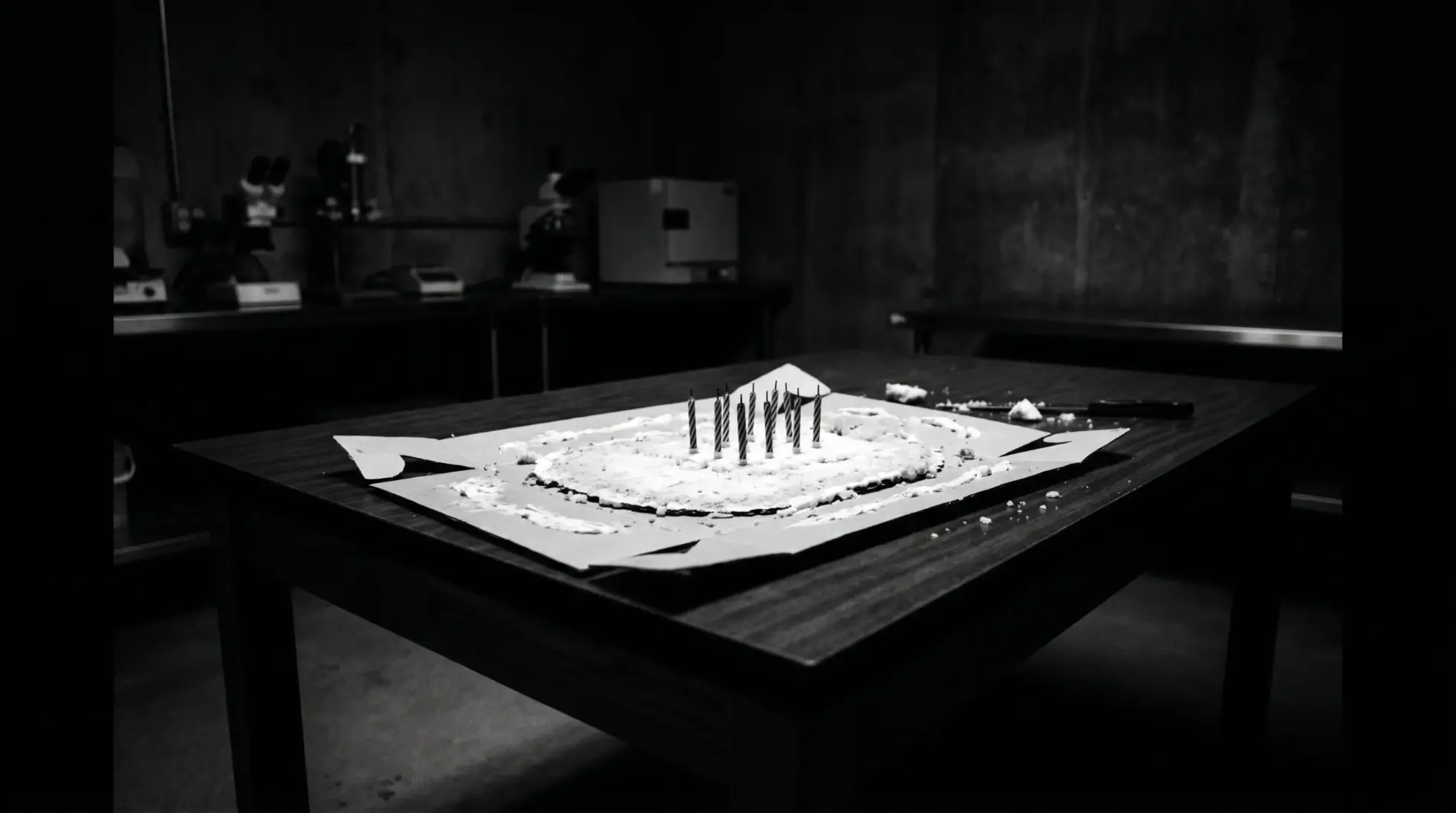
Picture it. It is your birthday, and there is a cake. A big one, a beautiful one, you paid for it yourself, you set it on the table yourself, it is yours. Now the guests arrive. The first one cuts himself a slice before you have even lit the candles, that is the physicians’ pension fund, 18 percent, smack, gone. The second one helps himself too, a solid piece, the health insurance, it is for your health after all, you say nothing. Then long-term care insurance. And then comes the one with the biggest appetite of them all, the tax office, and it does not settle for a slice, it first takes a calm look at what the others left behind, thinks for a moment and then says, good, of the rest I would like 42 percent. You think the trouble is over now. It is not. Now the church comes around the corner, taps you on the shoulder and says, I will take another 8 percent of what the tax office already took, a slice of the slice, and wishes you God’s blessing while it does. What stands in front of you at the end, on your own birthday, is the bare cardboard from the bottom of the cake with a smear of cream on it. And everyone sings happy birthday. And while you are still staring in disbelief at your cardboard, someone leans over to you and whispers that you will of course have to pay tax on it too, because cardboard with cream counts in this country as a benefit in kind.
That is roughly how it goes for every invoice over 100 euros that our doctor writes, except that before any of this, his 100 still has to cover the practice, the equipment, the rent, the staff, the software, because what gets taxed is only what is left after all of that. Out of 100 make 35, that is the rule of thumb, and it still counts as cheap as long as he earns well. Whoever earns little pays proportionally less income tax, but the compulsory contributions bite almost as hard, and at the very bottom the share that goes for bare survival grows larger still.
And while we are on the subject of value added tax, a lovely detail most people do not know, one that clears up a mistake I fell for myself for a long time. The healing treatment itself is exempt from VAT, the state considers the medical service too holy to slap another 19 percent on top. Sounds like a gift. It is the trap. Because whoever collects no VAT is allowed to reclaim none either. So the doctor pays his dutiful 19 percent on every ultrasound machine, every chair, every box of gloves, every software license, and unlike the baker, the lawyer or the advertising guy next door, he gets back not a single cent of it. The value added tax hits him twice in the end, it just hides better. It does not sit on the invoice he writes, it sits on every invoice he pays himself.
Before any of that, by the way, there is the part he cannot escape at all. As a doctor in private practice he pays compulsorily into the physicians’ pension fund, and that is no small gesture. For the self-employed that is 18 percent of pure professional income up to the contribution ceiling, which in 2026 sits at 8,450 euros a month, and another 7 percent on every part of the income above it. Whoever earns really well lands at the maximum compulsory contribution, and in 2026 that comes to 3,142.50 euros a month, which is 37,710 euros a year, and anyone who wishes may top it up voluntarily to as much as 3,928.50 euros a month. There is no getting out of this duty, it is chained to his profession like a shadow. And now the cold part, the one that sits between the lines in the pension fund’s own paperwork. The full rate of 18 percent applies only to income up to the ceiling. Everything he earns above it, and for a thriving doctor that is the lion’s share, flows into his provision at a mere 7 percent. So his pension grows nowhere near the way his income would suggest, it flattens off at the top the more he earns. The result is that many doctors are honestly surprised how little comes out at the end, measured against what they paid in across a whole working life. And when even the high earner, who shouldered the maximum contribution for decades, ends up puzzled by a strikingly meager pension, you can guess how it goes for the one who had less to begin with. To this comes the health and long-term care insurance, which he as a self-employed person shoulders entirely alone, with no employer to cover half.
And From the Rest, the Moment You Spend It
Say he survived what the first chain took from him and finally holds his share in his hand. Now he wants to buy something with it, and the moment he does, the next tax is already there. On almost everything you push across a shop counter in this country sits 19 percent value added tax. On food it is at least only 7, the reduced rate, a small act of mercy for the daily bread. If he takes out an insurance policy, any of them, he pays 19 percent insurance tax on top. If he drives, the energy tax waits at the pump. If he heats, he pays a tax of its own on the electricity.
There is a tax on coffee in this country. On coffee. I say it twice on purpose, because you have to hear it twice to believe it. 2.19 euros the state takes on every kilo of roasted beans, and on the instant kind even 4.78, presumably as a surcharge for bad taste. Picture it concretely. You stand in the kitchen in the morning, half awake, and brew exactly the substance that puts you in any condition to go to work at all, so that you can pay taxes. And the state is already standing in your kitchen, charging you for the fact that you are about to drag yourself voluntarily into the wheel. It is as if someone set your alarm in the morning and then, in the afternoon, mailed you an invoice for the wake-up call. And the loveliest part is that this tax comes from an age in which coffee was real luxury, a few centuries ago, and it has since outlived every ruler who ever decreed it. Because a tax is the only thing on this planet that never dies. Every crisis throws up a new one, every lost war, every hole in the budget, and once the emergency is over the state thinks, ah, we will keep that one, it cannot hurt. And so, across the centuries, more than 40 kinds of tax have piled up, one on top of the other, and the tax code by now looks like the cellar of someone who has thrown nothing out for 40 years, because you never know. The real load is carried in the end by only 2 of them anyway, income tax and value added tax, together around 60 percent of the take. The whole exotic remainder, the coffee, the sparkling wine, the flying, is fiscally almost decoration, and only the most honest part, because it shows openly that this apparatus taxes everything it can reach, simply because it can.
Suppose there is still something left at the end of the month, and he is sensible and saves it, then the next hand is already waiting. On the returns of that saving, on interest and capital gains, falls the capital gains tax of 25 percent, right at the source, plus the surcharge, plus possibly church tax, effectively around 26 to 28. So he saves money that was already taxed, and the state taxes the fruit of that saving once more. And right at the end, when he dies and leaves the small remainder to his child, the remainder he pressed through all these sieves several times, the inheritance tax arrives, staggered up to 50 percent. If he gives it away while alive, to avoid exactly that, the gift tax comes, the same rates. You cannot even die untaxed in this country anymore.
Hold for a moment what is happening here. The same money is taxed again and again on its way through your life, at every station once more. First when you earn it, then when you spend it, then when you let the little you managed to save bear fruit, and at the end, when you pass it on to your own child. It is not that the state takes its cut once and then leaves you alone. It accompanies every euro through your whole existence and reaches in again at every transformation, from the first wage to the grave. Whoever sees this once as a motion and not as separate assessments understands why, at the end of a hard-working life, so little so often remains.
And before anyone objects that all of this is legal and in order, yes, of course it is, and that is exactly the sore point. It is not a scandal hidden somewhere that only has to be uncovered, it is the openly valid, democratically decided, perfectly regular system. Nobody breaks a rule here. The law is the trap. That is precisely why no uncovering helps, no complaint, no outraged article, because there is nothing to uncover that is not already in the federal law gazette. You cannot expose this machine, you can only see it, and the seeing is more uncomfortable than any conspiracy, because there is no one you would be allowed to hate for it.
The Tax on the Value You Create
Let us finally talk about the tax that gives its own name away, exactly like cost of living at the very start. It is called value added tax, and most people believe it comes into being at the till, where you pay it. It does not. At the till it merely falls due. It is born much earlier, in the moment a person sits down and works. The carpenter takes a board worth almost nothing and turns it into a table worth something. The difference between the board and the table, that is the added value. The worth that nobody saw before, because it did not exist, and that the carpenter brought into the world with his own hands. And on exactly that difference, on the thing added, the state lays its hand. It named its levy after the very thing it taxes, after the value a human being creates through work. No tax law has ever confessed itself more openly.
And now the part that makes the thing so cold. The same person who creates the value also has to collect the tax on it himself. The carpenter adds the 19 percent to his invoice, draws it in from the customer, files it, transfers it, and is liable for getting the figure right. He is the source and the tax collector in one person. He brings the added value into being, and in the same breath he gathers in the levy on it himself and passes it upward. For this second job he is not paid. The state has raised itself an unpaid field force, millions of self-employed people who calculate its tax, collect it and prefinance it, with their own software, their own adviser and their own lifetime on top, and the only wage for it is the threat of what happens if you miscalculate.
But the real sentence, the one this is about, is a different one, and it is so plain that you almost miss it. Without the work there is no tax. The state has no source of its own. It produces nothing, it creates no added value, it has only the hamster that does something. Only when the carpenter saws, only when the doctor treats, only when somebody somewhere puts a value into the world, does the taxable event come into being at all. The whole magnificent machine, all the offices, the assessments, the more than 40 kinds of tax, hangs on this one thin tendon, that the hamster runs. And that raises a question the apparatus had better not ask itself in a quiet minute. What exactly happens in the moment the hamster simply stops.
Picture the carpenter Hans, who has understood precisely that. He reads these lines, sets the plane aside, stands beside his wheel for one afternoon and does nothing. No table, no invoice, no added value. And in exactly that moment the unthinkable happens. The state is missing 19 percent of a table that does not exist. A hole in the coffers, torn open by a piece of furniture that never was. Somewhere in an office a clerk flinches as if he had a phantom pain, and the phantom pain has a file number.
And now picture the crisis meeting. Big table, bad light, lukewarm coffee on which coffee tax has of course been paid, 2.19 euros a kilo, in case Hans asks. A problem has been identified. Hans is standing beside the wheel. And if Hans stands beside the wheel, then maybe Müller sees it, and then Müller stands beside the wheel too, and in the end all the hamsters stand beside their wheels and contemplate this peculiar peace, and then, ladies and gentlemen, then the whole thing collapses. Something must be done, at once.
So it is born, that very night, in pain and with a beautifully long name, the 41st tax. Let us call it the Rest-at-the-Wheel Compensatory Levy Act. A tax not on work, that would be yesterday’s idea, but on its absence. Whoever does not produce is after all withdrawing added value from the state, and withdrawn value is almost as bad as concealed value. The basis of assessment is the hypothetical table Hans could have built, valued at the locally customary average, taxed at 19 percent, plus a solidarity surcharge on the table that never was. Hans gets a letter. The letterhead states that it has been determined he could reasonably have produced more, and asks for his understanding.
And this is the spot where the sandwich falls out of your hand, because you laugh and grasp in the same instant that the joke only works because it grazes the truth so closely. A system that taxes its only creator of value has a problem the moment that creator pauses. It cannot force him, it can only make standing still more expensive for him. And while Hans reads his assessment and wonders whether doing nothing is even worth it anymore, beside him his empty wheel slowly spins down, and for the first time in years it makes no sound at all.
The Civil Servant, the State’s Own Hamster
Now a question you do not laugh at but think about. What does the state pay all of this from? The answer is uncomfortably plain. It pays for it precisely out of these levies, out of what it pulls from the doctor, the employee, the worker at every stage of the chain. And a not small part of this money flows to the people who work for the state itself. Think it through calmly, what a civil servant actually is, beyond the reflex to envy or despise him.
I say this without spite, because the civil servant is not the enemy in this story. He did not build the system. He runs in the same wheel as everyone else, he gets up just as unwillingly in the morning, he counts the years to the end just the same. The only difference is that his cage is better heated. He has the secure pension, the protection from dismissal, the fixed seat, and in return he keeps running the apparatus that takes everyone else’s money, the money his own security is paid from. It is a closed circle, almost elegant. The state pulls the feed from the hamsters in the free part of the wheel and passes a portion of it to the hamsters who run the wheel for it. Nobody in this circle is evil. They are all just running, each in his own lane, and none of them can stop without falling.
What distinguishes the civil servant from the other hamsters is not the running, but the certainty at the end. While the doctor does not know whether his provision will survive inflation, and the employee watches his pension level sink, the civil servant has his pension guaranteed by law, calculated from his last salary, financed out of the current budget, which is to say out of everyone else’s taxes. That is no reproach to him, he did not write the rules. But it explains why, of all groups, the one that administers the apparatus sits most securely inside it. A system reliably rewards those who keep it running, and that is not malice, it is the plain self-preservation of any structure ever built.
This is the point at which most people start to curse, at those up top, at the lazy, at the rich, at the politicians. I consider that wasted energy. There is no face you could blame, because no face decides here, but a structure that maintains itself. And yes, the politician too is in the end only a hamster, his wheel is merely gilded and stands one floor higher. He promises during the campaign to turn the wheel more slowly, and after the election discovers that the crank has long since been turning him. Anger at the individual, whether civil servant, rich man or minister, is like anger at the single cog. The cog turns because the gearbox turns, and the gearbox turns because we all get up in the morning and drive it.
That is why every anger runs dry that looks for an enemy image. The rich, the politician, the civil servant, the corporation, they all serve as lightning rods, and they are offered up for exactly that purpose, from all sides, to taste. As long as you point at a group, you are not pointing at the construction, and it stays untouched while the hamsters blame one another. It is the oldest trick in the book, bread and circuses in the variant of outrage, and it gives the anger a vent without harming the wheel. I do not fall for it anymore.
Until 70, If You Even Live to See It
Let us return to the end of the wheel, because that is where the arithmetic turns especially cold. The statutory retirement age today is 67, in full for everyone born in 1964 or later. The pension commission’s recommendation to move to 70 I have already mentioned, and alongside it the pension level is to fall after 2031 from 48 to 46 percent. Both together make a simple message. You are to run longer and get less for it at the end.
Both are politically intended and are nonetheless presented as a natural event, a demographic inevitability one simply has to submit to. That is power’s favorite mask, to dress up as weather. A decision passed off as a constraint of nature no longer needs justifying, you can protest against it as little as against the rain. But the retirement age is not rain. It is a decision, taken by people in halls, with names and signatures, and everything that was decided could also be decided differently. That it stays as it is, is itself a decision, only one that nobody makes out loud.
How little comes out at the end is shown by a look across the border. The net replacement rate, meaning the share of your last working income that the statutory pension replaces, sits in Germany at around 52.9 percent. In Italy it is 74.6, in Austria a good 74. We work in one of the richest countries in the world, and at the end we get roughly half, while neighbors with less pathos about their economic strength secure almost three quarters. The actual average retirement age in 2024 was already around 64.7 years, not because people are allowed to leave so early, but because many bodies simply do not last to 67. Whoever is still on the building site or pulling night shifts in care at 67 is not the exception who endures, but the exception, full stop.
Behind it sits a cold calculation nobody says out loud. The later people are allowed to retire, the shorter they draw on average, and the less the pension costs the system. Raising the retirement age is, soberly viewed, a benefit cut that does not feel like one, because it is sold as a reasonable expectation and not as a deletion. They do not openly take something from you. They only move the line behind which there is anything at all so far back that a portion of people never reach it. That is more elegant than any cut, because the affected person in the end believes he himself failed, because he did not hold out.
And while they explain to you that you simply have to work longer, because people are living ever older, they leave out the other half of the truth. What gets older is the statistical average, carried above all by those who sit in clean offices and eat well. The bricklayer, the care worker, the parcel driver do not get older to the same degree, and they are the ones who endure the extra years least of all. So the raising of the retirement age hits hardest exactly those who already live shortest and wear out earliest. It is a cut that picks out the weakest and sells itself as progress. That is the if you even live to see it in the subheading, and it is meant literally, not cynically. The human being is not built to run 5 decades in a row. The wheel is.
And Then Your Pension Gets Taxed Too
Now comes the part where even hard-boiled people briefly hold their breath. You paid in for 40 years, out of money that was already burdened, into a pension you were promised was yours. And then, when it finally flows, the tax office holds out its hand once more. The pension gets taxed. Whoever first retires in 2026 has to tax 84 percent of his statutory pension, only 16 percent stays tax-free. And this holds not only for the statutory pension, it holds just the same for the payouts from the physicians’ pension fund, which expressly points its own members to these 84 percent. This is the deferred taxation, introduced in 2005, and it climbs, year by year, by half a percentage point, until it reaches the full 100 percent in 2058. Whoever retires then taxes everything.
Picture ordering a pizza. A whole one, you paid for it, it is yours. And then you wait for the delivery. Not 30 minutes. 40 years. For a whole working life you wait for this one pizza, you pay in every month, dutifully, and you were firmly promised that at the end it arrives, hot, complete, and belongs entirely to you. Finally the bell rings. The driver stands at the door, flips open the box, and eats 84 percent of the pizza in front of you first. Chewing. Then he hands you the rest and says, here, your pizza, enjoy. And while you are still speechless at the few slices he left you, he mentions on his way out, quite casually, by the way, next year I will eat a little more, and the year after that again, and so on until 2058, when the whole pizza is mine. That is deferred taxation of the pension, in one image. You pay in for 40 years, and on the day you finally get it, it is eaten away again right in front of your nose. It began in 2005 at 50 percent, harmless, almost friendly, then a little more each year, first 2 points, then 1, now half a point per cohort, so finely dosed that no generation cries out loudly enough to warn the next.
And there is one more twist that almost nobody knows. The tax-free share is fixed once, in euros, in the first full pension year, and then frozen, for life. If the pension later rises through an adjustment, that increase is taxable at 100 percent. The annual pension raise, sold as good news, pushes you bit by bit deeper into the tax. True, the tax only falls due once your entire income climbs above the basic allowance of 12,348 euros, double that for couples, but it is precisely this line that more and more pensioners cross with every adjustment. Millions of people who paid in all their lives pay again in old age, on the money they earned out of money already taxed. If you are looking for a cleaner definition of double taxation, I do not have one.
What is actually instructive about pension taxation is how noiselessly it works. Nobody gets a letter saying your pension is now being taxed. It happens through a table, through cohorts, through a percentage that climbs imperceptibly by half a point each year, and through an allowance that simply stays put while everything else gets more expensive. So the state reclaims over time what it once granted as an incentive, and it does so slowly enough that no single cohort screams loudly enough. The method is always the same. Change nothing all at once, change everything a little each year, and after 20 years a different world stands there, without there ever having been a single day on which you could have protested.
Let Us Say There Is a Married Couple
And now the image where all the cold arithmetic suddenly gets a face, even though I am keeping it deliberately anonymous. Let us say there is a married couple, both old, both having worked a whole life. They have no large pension, but one that is enough, just barely, for the small apartment, the groceries, a modest living for the two of them. They managed it, got themselves through, fell as a burden on no one. And then the thing happens that no life plan provides for, because you cannot provide for it. One of the two has to go into a care home.
The moment that sentence falls, everything changes, and the treacherous part is that the fewest people are prepared for it. You plan for retirement, you sometimes even plan for your own death, but hardly anyone plans for the years in between, in which you are neither healthy nor dead but in need of care, and precisely these years are the most expensive of the whole life. Nobody tells you in time, and when you find out, it is mostly too late to arrange anything. You stand in the middle of it, with a sick person you love and a bill larger than the entire pension, and you have to make decisions in days that a lifetime was not enough to prepare for.
From that day the math no longer adds up. The average personal share in a care home in 2026 sits at 3,245 euros a month, in the first year alone, and that is up another 9 percent on 2025. The total cost of a place lies on average well above 4,400 euros. From a normal pension that cannot be paid, not nearly. So social law takes hold, and it takes hold in a sequence that is relentless. First your own income is drawn on, then your own assets, and then, here it turns bitter, also the assets of the healthy partner who stays at home, down to a small protected sum. Often the house has to be sold, the house you saved up for from your own mouth. What belonged to the two of them together is consumed to feed the place in the home, month after month.
True, the care-related share sinks over the years, the law has built in a supplement here, which in the first year covers 15 percent, in the second 30, in the third 50, from the fourth 75. That sounds like relief until you do the math, because even after several years an average of over 2,000 euros a month remains for someone to pay, and depending on the region it runs from the start between 2,500 and over 3,700. Around a third of all home residents end up dependent on social assistance. That is not the fate of a few unlucky souls, that is the normal case, the one most people have simply not met yet, because they are still young enough to push it away.
Only when nothing is left does the welfare office step in with assistance toward care, and the one who had to go into the home is granted a personal cash allowance to live on that is so small I will write it down here, so that it stands still for a moment. 152 euros a month. That is what remains, as freely available money, to a person at the end of an entire working life, the rest flows into the care. And the healthy partner who stays behind at home often stands there with nothing left and lands on basic welfare himself, exactly where a life full of work was never supposed to bring him. 2 people who did everything right, paid in for a whole life, into the same system that now sweeps them out down to the last euro the moment life runs off plan once. The children, by the way, are only touched from a yearly income of 100,000 euros upward, since 2020 at least. The couple itself is touched in full.
And the bitterest thing is not even the number. The bitterest thing is the inversion of the promise. All their lives these people were told they should provide, save, build a little house, set something aside for the children, and that is exactly what they did. In the moment of needing care this saved money becomes not protection but a pool of available funds. Whoever has nothing gets help from the welfare office at once. Whoever saved has to use it all up first, until he arrives at the same point, only later and after a long, humiliating consumption of his own life’s work. In the end the system punishes not the spendthrift but the thrifty, and it does so with the look of pure logic.
Hamster Farms Exist Everywhere, But
Now someone might say this is the same everywhere, the human being has to work after all, and at heart he is right. Hamster wheels and hamster farms exist all over the world, in every society somebody runs for somebody else. The question is only not whether there is a wheel, but how hard the operator cranks the handle. And there Germany now stands remarkably far up front. A country like Cyprus leaves its citizens the first 22,000 euros a year completely tax-free, knows no inheritance, no gift, and no wealth tax, and the top rate only bites above 72,000 euros. You do not have to consider this model paradise to see that it simply pulls less out of people.
And when the German state runs out of money, what does it do then? You and I, we would do what sensible people do when the account runs tight. We would spend less. There would be potatoes with quark instead of a restaurant, the old car would last another year, the holiday would turn out smaller. The state does not arrive at this idea. It takes on debt and raises taxes, because it has its hamsters after all, who plug the hole afterward, and these hamsters are being squeezed a little more thoroughly in Germany year by year. I sometimes sit in front of these numbers, read them for the third time, and ask myself in all seriousness whether I am in the wrong film. Because one thing is certain. Something here is running badly off the rails, and hardly anyone seems willing to notice it.
Why Are You Still Running?
Now I ask the question that brought me to this whole text, and I ask it without the shelter of irony. Why are you still running? Why do millions of people get up every morning and step into a wheel that takes from them from the first earning to beyond death, that has them run longer and gives less at the end, and that in the worst case spits them out onto basic welfare after milking them their whole lives? I throw the question into the room, I do not claim to have the one answer.
Part of the answer is fear, and it is justified. Another part is habit, the worse of the two, because it feels like peace. The human being can get used to almost anything, that is his greatest strength and his most dangerous weakness at once. He gets used to the noise beside the motorway, to the pain in his back, to the boss who keeps him small, and he gets used, too, to a wheel that takes something from him with every turn. At some point he holds the condition for normal, because he knows no other anymore, and from that point the system needs no walls. The accustomed one guards himself.
But I have another part of the answer. We keep running because the exit is punished more harshly than staying. The wheel is cleverly built, it leaves just enough slack that stopping feels more expensive than running on. Whoever steps out falls not into freedom but into a smaller, colder cell of the same building, into basic welfare, into dependence, into a scarcity even tighter than the wheel. And so each one runs on, not because he loves the wheel, but because he fears the alternative. This is no conspiracy of the tinfoil-hat crowd, no secret club in a back room that cooked it up. It is far more banal and far more powerful. It is a system that no one designed as a whole and that nonetheless maintains itself perfectly, because each individual in it only does what is reasonable for him right now.
That is exactly where the perfection of the construction lies. It needs no villain to hold it together, it needs only the sum of countless reasonable individual decisions. Everyone pays his tax, because the alternative means trouble. Everyone goes to work, because otherwise the rent is not covered. Everyone stays quiet, because rebelling is exhausting and seems pointless. And out of millions of such small, each for itself perfectly reasonable decisions, a structure arises that as a whole nobody would have chosen if you had asked him beforehand. A conspiracy would almost be comforting, because you could blow it open. This is worse, it is an equilibrium that feeds on the reason of us all.
Braking, the Only Lever You Really Have
Here it gets practical, and I give you a tip no tax advisor will give you, because there is nothing in it for him. You cannot stop the wheel, but you can run slower, and the lever for that lies not at the tax office but in your shopping cart. Do you really need a new phone every year, even though the old one works flawlessly? Does it have to be the big car that mostly just stands expensively in front of the door? Does there have to be a holiday every year that wants to be paid for before it has even begun? Every one of these items forces you to earn more, and earning more means running faster. Whoever spends less has to earn less, and whoever has to earn less may walk more slowly in the wheel. That is not esoterics, that is simple arithmetic, only calculated in the other direction.
Picture the one day on which you lie in bed and let your life pass in review. On that day you will not think, good thing I took the bigger model. You will wish for more time, nothing else. And then ask yourself honestly what actually becomes of all the things you ran so fast for. Do you take the house with you? What happens to the car in front of the door, to the watch on your wrist you saved so long for? None of it comes along, not a single piece, and deep down you have known that for a long time. And still you keep running, because consumption promises you day after day that the next thing fills the gap the last one did not fill.
And there lies the trick the whole thing works on, and it is almost too transparent. The dopamine does not come with the possession, it comes with the purchase, with the click, with the moment of ordering. Half an hour later it has evaporated, the thing sits on the shelf and is never looked at again, and you already need the next one to feel the kick once more. The nighttime visit to a large online shop in a bad mood is therefore not a reward but a trap with free shipping. Whoever has observed this once on himself, cold and honest, buys differently afterward. Not out of stinginess, but out of clarity.
That is why my real advice, and it sounds harmless but is the sharpest thing in this whole text, is this. Sabotage the system by stopping to consume what you do not need. It is the only strike for which you need no permission, that no one can forbid you, and that takes effect at once, on yourself. Every euro you do not spend is a euro you do not first have to earn through the whole chain, and with it a piece of time that belongs to you instead of to the wheel. It is your life, not mine, and I prescribe you nothing. But for me one thing here stands clear and plain.
At this point I have to warn you against 2 false conclusions, because both lie close. The first is bitterness, the cold rage that declares everything lost and reads every tax assessment as a personal attack. It only poisons the one who carries it, and leaves the system entirely untouched. The second is the flight into illegality, the thought that you could simply steal yourself out with tricks or undeclared cash. Let it be. Whoever tries to cheat the wheel mostly ends up only in a tighter part of it, and I expressly do not call for evading taxes. There is an irony I admit openly. I myself do not pay into the pension fund, I simply have no pension and work until I drop. Whether that is a clever idea, I leave open. My taxes, on the other hand, I pay, every single item, because the open fight against the machine is fought on the wrong front. You do not defeat a structure by wearing yourself out alone inside it. You strip from it the one power it really has over you, the belief that it is without alternative.
I Already Stand With One Foot Elsewhere
And yes, I step beside the wheel too, as often as I can. I am 56, and I want to live, not to maintain myself. A pension I do not have, that is a settled matter, so I run until my final day, and no pretty sentence changes that. Fine. It is just that most of the time I stand beside it and watch the wheel turn, and this standing beside it is not a retreat, it is the only place from which you see the whole construction at all. Inside the wheel you see only the next rung. Beside it you see the wheel.
I am not paying off a house, I do not drive a car whose name is the surname of a Swabian engineering family, I buy staple foods, which are called that because they are the base and not the status symbol. I bake my own bread, rice costs almost nothing, I drink filtered water, and anyone who has read me for a while knows all of this already. I rent, I do not own the walls, and I do it deliberately far away from the regions where a person spends an entire career inside the wheel just to be allowed to fall asleep in his own flat in the evening. And I never had, thank heaven, the foolish idea of taking out a loan for a house of my own, which in the end would only cost me taxes again :xD.
Look at the rent index of a town like Starnberg, and it whispers something soothing into your ear about 18 to 20 euros a square meter. Then look at what is actually available, and the soothing is gone. For 1,900 euros you get a 2-room flat there, no more, which is over 30 euros a square meter, almost double the pretty official average. A family looking for a terraced house plays in an entirely different league, and for the places with a view of the water the asking rents start at a level where 4,000 is only the entry point. The rent index is the table that glosses over. The free market is the truth, and it costs an entire career before you have so much as had breakfast once in your own kitchen. Housing shortage, in the end, is nothing but the dearly rented parking space for the hamster.
And it does not stop at the private side with me, my company does exactly the same. It cancels what it does not need and buys only what it truly needs. The big creative software subscription from America that debits dutifully every month whether you use it or not, gone. The mobile contract that does the same thing for half the price, switched. New cabinets, because the old ones supposedly no longer impress after 5 years, no. Software I can write myself, I write myself. Every one of these items is revenue for some other hamster, and every bit of revenue I cut is 19 percent of value added tax that never comes into being. Does that make me a saboteur of the system?
The honest answer is no, and it is more uncomfortable than a yes would be. I sabotage nothing, I merely stop feeding it voluntarily. A saboteur breaks a rule, I keep every single one and simply buy less. Whoever does that is not arrested, he just becomes, for a moment, invisible to the machine.
And since we are on the subject of speed, a word about how I work myself, because it belongs inseparably to all of this. My phone is switched off most of the time. My friends have gotten used to it, my customers know exactly how to reach me, and when I briefly climb into the wheel, I read the messages once and climb back out. That is it. No 24/7, no constant availability, the ultra-hamster in me is gone. I offer reliability and quality at the highest level, but that instant thing, that I-need-it-yesterday, does not exist with me. Good things take their while, a phrase older than any productivity apostle and one that will outlive every last one of them.
When a subject grabs me, I eat my way into its structure until I have truly understood it, and sometimes that means I sit down and program for 20 hours straight, to the point of total exhaustion, and then nobody sees me for a few days. I cannot help it, I am built this way. And by understanding I mean exactly that, the real grasping, not the memorizing that the professor-hamster tries to beat into his students’ heads. Most of them learn the material by heart without ever having grasped it, and there he stands again, the Otto Sapiens, practicing a profession he does not remotely understand. And in case you are wondering why I am so terribly careful around doctors, now you know :xD.
And that brings us to the country you do not understand on your first visit. Order a craftsman in Italy, a carpenter say, and he does not come. Not today at least, maybe in 2 weeks, maybe whenever it happens to suit him. The hamsters there have long since raised standing beside the wheel to an art form. If you need something from the authorities, from the office-hamsters, then as a German ultra-hamster you are first deeply disappointed, because nothing arrives, nothing through official channels at any rate. Something else counts here, here it matters whom you know, the short line to the mayor, to the police chief, to his secretary if it comes to that. Sounds like chaos, and part of it is.
But, and this is the punch line no German grasps right away, the bureaucratic hammer does not come either. Not the typical one that catches you on a Friday afternoon, exactly when you want to start your weekend, and pulls your feet out from under you with an official letter. Picture this, a large share of these people do not even have a house number to which such a hammer could be delivered at all. The system there is slower, sloppier, less predictable, and that is precisely why it lets you breathe. It takes less from you because it gets less of a grip.
And yes, my years in this German wheel are numbered, that is the most honest sentence in this entire text. That country in the south won my heart without asking my permission first, where the light is softer and the clocks run differently. I will name it, Italy, and I will say no more, because where exactly I one day pull my second foot across is nobody’s business but mine.
The Day the Hamster Goes on Strike
Go back once more to the beginning, to the phrase it all began with. Cost of living. It stands differently now than before, I find. It is no longer a neutral phrase for earning money, it is a confession we make to each other every day without listening. We maintain our life the way you maintain a heating system, a contract, a facade, and we do it up to that image from the middle of this text, 2 old people who did everything right, and to whom the system in the end grants the cash allowance of 152 euros and takes the rest.
And now really picture the one day I spoke of, the great hamster strike. The hamster wakes up in the morning, looks at his wheel, and for the first time in his life simply says no. And because he says it, they all say it, because the courage of the one is the permission of the other. Picture the morning after. The baker stays in bed, so there are no rolls, which nobody notices, because the one who would have bought them did not get up either. The traffic lights keep dutifully switching from red to green, completely in vain, for an empty intersection, with the unshakable loyalty of a machine that has not registered that its audience went home.
And now comes the part where it gets truly funny, provided you look at it coldly enough. The state of course wants to intervene at once, end the strike, herd the hamsters back into the wheel. Only it finds that the official who would have to forbid the strike is himself on strike. The form with which one declares the state of emergency lies in an office whose doorman is likewise sitting at home, sleeping in. The stamp that would make the whole thing valid rests in a drawer, and the only person with the matching key is hamster number such-and-such, who today, for the first time in 30 years, does not show up for work. A society that has cut every single person so perfectly to his function discovers on this morning that it cannot even administer its own collapse, because administering the collapse was also just a job in the wheel, and the man who does it has the day off. It is the only revolution in world history that fails over a missing stamp.
But the strike does not come, and the reason is more sobering than any missing stamp. It does not come because the freedom at the end of the wheel has no choreography. The hamster spent his whole life learning to run in a circle, and when the wheel suddenly stands still he does not know where to put himself, where to stand, what to do with a day that prescribes him nothing. He fears the empty wheel more than the full one. To that comes the sober mechanics I already named. The rich hamsters are long gone, quietly and in droves, their house stands abroad, the suitcases are basically packed. The state knows this exactly, it knows that only the poor are truly bound, and whoever owns a house he is still paying off cannot get away anyhow, because the debt holds him to the floor like a chain.
Because that is the last thought I give you, and it is older than any tax. The plot of land, the house, the whole proud possession does not belong to us at all. We possess it only for the span in which we live, and that span is often terrifyingly short. We rent it from time, not from the state, and the state merely collects the fee for the illusion that it is really ours. Whoever once looks at it from this side sees the frantic accumulating with different eyes. You run through the wheel to hold on to something that was never yours and that you, like the watch and the car from the chapter before, will most certainly leave behind on the last day.
I have sold no solution here, because I have none that fits into a single sentence. That is exactly why I am writing a whole book about it, Das Hamsterrad, the hamster wheel, and much of what stands here is drawn from it, a glimpse that turned out almost too deep when I read it back in peace. The book will be different, it looks into the past, compares the systems that humans have built for themselves over the centuries, and offers above all the thing this text deliberately lacks, namely ways back to a healthy, happy life, by learning to stand beside the wheel, at least part of the time.
What remains is the refusal to keep holding all of this for granted, and this refusal is the beginning of everything. The wheel keeps turning whether you run or not. The only question is whether you one day look at it from the outside, instead of always only driving it from within. And before you can do that, you have to understand why your own head has kept you inside it for years. That is exactly what the next piece is about, in which I explain your brain to you.
References
- Alterseinkünftegesetz. (2004). Gesetz zur Neuordnung der einkommensteuerrechtlichen Behandlung von Altersvorsorgeaufwendungen und Altersbezügen.
- Angehörigen-Entlastungsgesetz. (2020). Gesetz zur Entlastung unterhaltsverpflichteter Angehöriger in der Sozialhilfe und in der Eingliederungshilfe.
- Bayerische Ärzteversorgung. (2026). Kenngrößen für das Jahr 2026.
- Bundesministerium der Finanzen. (2026). Einkommensteuertarif und Grundfreibetrag 2026.
- Deutsche Rentenversicherung. (2026). Steueranteil für Neu-Rentner liegt 2026 bei 84 Prozent.
- Sovereign Group. (2026). Cyprus brings comprehensive tax reform into force.
- Sozialgesetzbuch (SGB) XI, Paragraph 43c. Leistungszuschlag zur pflegebedingten Eigenbeteiligung.
- Sozialgesetzbuch (SGB) XII. Hilfe zur Pflege.
- Verband der Ersatzkassen. (2026). Durchschnittlicher Eigenanteil in der vollstationären Pflege.
Disclaimer: This article reflects the author’s own research and opinion as of the publication date shown above; later findings or legal changes may have overtaken it, so always check that date. Sources are cited for independent verification, and no liability is accepted for third-party studies. This is general information, not medical, legal, or professional advice: for medical questions see a doctor, for legal questions a lawyer, and in an acute crisis contact emergency services or a crisis helpline.
About the header image: it is AI-generated. Cheaper than a photo shoot, and I have made my peace with the age of AI. Everything inside the article is real, the diagrams, the skulls, the findings, and every word. The machine gets the opening shot and not one inch past it.
Where the 1.43 trillion goes, and why the state cannot fully account for its distribution by nationality
Germany's social budget reached 1,430.95 billion euros in 2025, which works out to 45,375 euros per second. For…
Stupidity would be forgivable, ignorance is not
In 2025 Germany took in 2,140.2 billion euros in taxes and social contributions, ended the year 119.1 billion…
Murphy’s law was the answer to the question of why nobody died
Murphy's law is not a shrug: it is why a physician on a rocket sled could tell a…