The Quiet Relief Before the End, and Why We Almost Never See It Coming
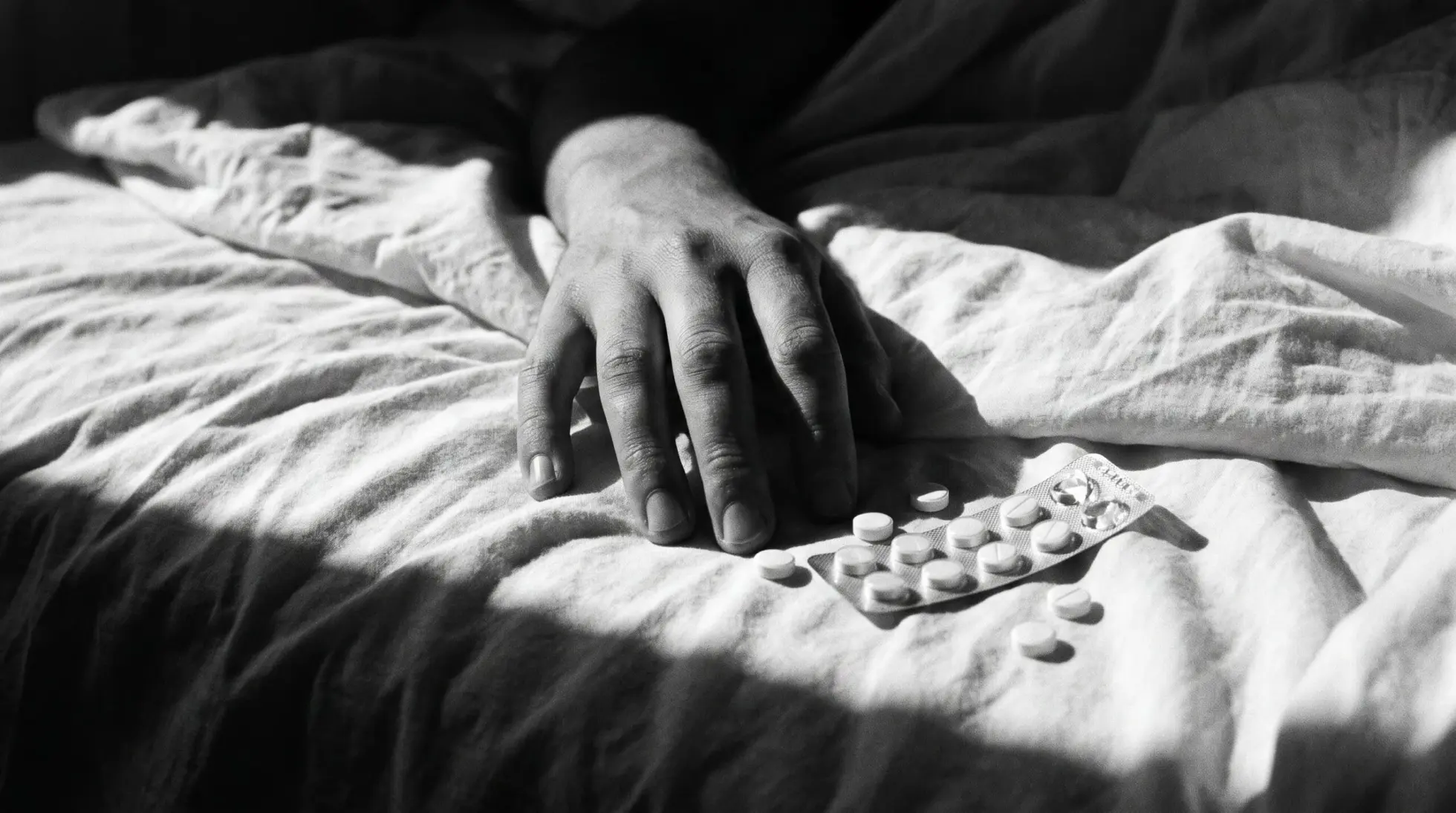
About a hunter who ate one more good meal before he went, about the deceptive calm that suicide prevention counts as a warning sign and that we mistake for improvement, and about the question of whether we too quickly call an impulse as old as humankind a disease
Last week I stood talking with a hunter, and he told me about another hunter from the same area where I live, a man who took his own life a few weeks ago. What has not left my head since is a small thing, almost a footnote, and yet it carries this whole piece. Shortly before, the man had eaten one more real meal, plenty of it and with obvious pleasure, so heartily that someone at the table asked him in passing, „you’re not supposed to eat that with your blood sugar”. He only smiled and kept eating. A few days later he was dead, and the people who had known him all said the same sentence afterward, that he had seemed to be doing better toward the end.
That exact sentence is the dangerous one, and it is the reason I am writing this piece. Because this seeming improvement, this sudden calm, is not a good sign in suicide prevention, it is one of the most serious warning signs there is. A sudden calmness after a long stretch of despair can mean that a person has already made the decision, and that the inner struggle has therefore stopped. The people around them see the calm and breathe out. In truth it is the moment when looking closely matters most, and the moment when we look closely least.
Suicide almost never announces itself loudly. The dangerous thing is the quiet we mistake for recovery, because we read it wrong. I have lived through exactly this quiet more than once, and I misread it every single time, even with the person who was closest to me. That is why I am writing this, not as a statistic and not as a lecture from above, but because I believe it is spoken of far too little, and far too quietly. Suicide is one of the last great taboos, because we talk more openly today about cancer, about money and about dying itself, than about the people who take their own lives, and this particular silence is no accident, it is an old inheritance, as will become clear in a moment.
I am not writing this out of theory. In decades of forensic work I have come as close to death as one can come, and suicide was often enough the thing in front of me. I have seen what it leaves behind, in fresh cases and on skull finds that are many centuries old, and I have even watched it happen on a few recordings. I do not say that to shock you, I say it so you know how close to it I have been. And I say the most important thing right at the start, so no doubt remains. I give no instructions here. I have been working for some time on a scientific publication on this subject, but it will appear on other platforms and never here, because certain knowledge belongs in a different place and would only do harm in this one.
What I carry with me
In the past year 2 very good acquaintances of mine took their own lives. Both had broken down in the same wheel so many of us run in, until the strength gives out, and for both of them it was that collapse that finally drove them into a corner. One of them had lost his house shortly before, which is to say exactly the thing he had worked for his whole life, the one fixed point around which everything else was built. For me this is not a number in a survey, these are 2 faces I knew, 2 voices I still hear, and 2 gaps that no one fills again. With both of them I asked myself afterward, for a long time, whether there were signs I simply ran past in the rush of my own wheel, and I fear the honest answer is yes. You see the other person running, the way you run yourself, and you think nothing of it, it will somehow go on, until one day for him it simply does not go on.
And then there is Hans. I use his first name here, because I am expressly allowed to and because he deserves to be remembered. In 2000 Hans was a colleague of mine, he worked with the police, and in a shootout he was seriously wounded. He survived physically, but he never really came to terms with the aftermath, neither the aftermath in his body nor the one in his head. On the day his wife left him, he took his own life. Since then I have carried a weight with me, and at its core it is a single question that never quite falls silent. Could I have prevented it?
For a long time I believed I must have missed a signal, a loud cry for help, some clear sign that I only failed to want to see. Today I know that back then I was searching for the wrong thing. Because with Hans, too, it had gone quiet toward the end, strikingly quiet, almost settled, and I took that quiet for a good sign. That was the real mistake, and I will not make it a second time, whatever it costs me. In the weeks before, we had still talked, about trivial things, about work and about the weather, and none of it sounded like a goodbye, because the goodbye had long since taken place inside him, where I could not see it. Whoever loses a person this way learns a bitter lesson about his own perception, and that lesson is the true drive behind every line that now follows. I dug deep into the subject in the months afterward, the way I dig into everything that gives me no peace, and the more I understood, the clearer it became that almost all these deaths have a backstory one could have read. Not always, but far more often than we care to admit.
How long the human being has been taking his own life
Whoever thinks suicide is a phenomenon of our overheated present is badly mistaken. It is as old as recorded history, and the way a society dealt with it almost always reveals more about the society than about the dead person. So it is worth laying this out from the beginning, calmly and without hurry, because only the long view shows how young our present interpretation really is. Whoever knows the history stops treating suicide as a pure sign of our time, and begins to understand that over the millennia mostly the explanations have changed, while the despair beneath them has stayed remarkably the same.
In antiquity the verdict was strikingly ambiguous. The social and legal reaction swung between acceptance and punishment depending on the circumstance, and the two sometimes lay close together. The Stoic philosophers in particular saw self-chosen death, under certain conditions, as a dignified way out, and in Roman thinking there was a social acceptance in narrowly defined cases. The loss of honor or an unbearable physical or mental pain could justify such a step in the eyes of contemporaries, and men like Socrates or Cato remained highly respected afterward. Where a besieged city fell, group suicides of the trapped occurred again and again, a pattern that later sociology gave a name of its own. When a besieged fortress in the east of the Roman Empire fell, thousands of its inhabitants, according to tradition, took their own lives together rather than fall into the hands of the victors. For the Stoics what counted was not the mere length of a life but its quality, and to leave a life in dignity was in their eyes at times more honorable than a long, slow decline. One does not have to share that stance, and I expressly do not share it, but it shows that the handling of voluntary death was never as clear-cut as our present likes to believe.
It is remarkable that for a long time there was no neutral word for the act at all. The modern term, the Latin suicidium and its offshoots in the European languages, established itself only in the 17th century. For centuries the language had only paraphrases and condemnations ready for self-chosen death, but no sober noun with which one could name it without also passing judgment. That is no linguistic accident, because an act for which there is no word of its own is an act one cannot think about, only condemn.
With Christianity the verdict then tipped into the opposite. Augustine in the 5th century condemned suicide as a violation of the commandment not to kill, and the Church followed with full rigor. A council in the 6th century denied those who died by suicide the rites of church burial, and what followed was cold and methodical. The corpses were dishonored, first out of custom, then written into law, and the property of the dead often passed to the authorities. The dead person was punished because the living one could no longer be reached, and this logic reaches right into our language when we still speak of guilt today where there was really only despair. Whoever took his own life was in many places not buried in the cemetery but at the edge, outside the consecrated ground, and the family carried the shame across generations.
This severity held on for a remarkably long time. In large parts of the West attempted suicide remained a crime well into the 20th century, in some places until the 1970s. Only afterward did the diagnosis take the place of the punishment, and this is exactly where it gets interesting for me. Because the idea that suicide is the result of a disease is itself still young. It arose in the 19th century, and it arose not from a new medical finding but from a legal and social shift in how guilt and responsibility were handled. When science finally took the subject over entirely, Émile Durkheim in 1897 shaped modern research with his work on suicide and divided it into types that still echo today. He distinguished several basic forms, depending on whether a person was too weakly or too strongly bound into his community, and even this division shows that he never understood suicide as pure inner life, but always also as a symptom of the conditions. Exactly this thought, that the circumstances share in the decision, reaches right into this piece. For thousands of years, then, suicide was sin, crime or act of honor, and only in the last roughly 200 years did it slowly become a diagnosis. The shift from punishment to diagnosis was progress, because it took the shame from the dead and the fear of the judge from the living. But every step forward has its price, and the price here was that we have since tended to file every form of despair in the same medical drawer.
Is a person at the end of his story sick?
Before I go on, I have to separate something that is constantly lumped together.
And now comes an opinion that will hurt a few people, and I say it expressly as my opinion. We have only been categorizing for a few decades the way we do today, and yet we presume to declare an impulse a disease that is as old as the human being himself. Yes, there is the depression that grows out of lasting strain, out of a hormonal or metabolic disorder, and that one is real and belongs in expert hands, I draw that line clearly here. But when an 85-year-old loses his wife after 70 shared years and no longer wants to live, then that is not a metabolic disorder and not a disturbed brain chemistry, it is a person at the end of his story, and to declare him a patient does not do him justice.
The human being is around 300,000 years old, and I simply throw the question into the room. Did suicide already exist 300,000 years ago, or did it arise only with the hamster wheel? I do not answer that here, I let the question stand, because it reveals more about us than any quick answer.
And so that this lands wrong at no point, I say it plainly and without detour. I am talking no one out of their treatment. Whoever is in expert care stays in it, and whoever needs care should get it. I only push back against the reflex with which we immediately declare every deep despair a fault in the brain and lose sight of the person behind it. Between the depression that needs treatment and the ancient human despair there lies a difference, and whoever levels it helps neither of them in the end. I say this with care, because I have seen enough people whose life was saved by good treatment, and I have seen enough who were dismissed with a label instead of being listened to. Both are true, and both have to be allowed to stand side by side in an honest text, without the one canceling out the other.
How a person falls out of the wheel
The ordinary person does not even notice that he is running in a wheel. He runs and runs, he stumbles, he falls out, he climbs back in, and he takes the whole thing for life itself. Picture a man whom it hits exactly this way, and I am deliberately compressing several fates into a single figure here, so that no one recognizes himself concretely and yet everyone sees something of himself in it. He runs faithfully in the wheel for 30 years, gives everything every day, functions, carries his load. Then his wife leaves him, then the children drift away one by one, then the house has to be sold, and at 60 he stands there with nothing left, no property, no purpose, no person at his side. That is the point where it gets dangerous, and it is not the loud drama that brings him there, but the empty balance sheet of a life that has only been running. And the treacherous thing is that this man looks entirely normal from the outside for a long time. He gets up in the morning, he goes to work, he greets the neighbors, and no one suspects that beneath the surface everything has long since caved in. Only when he goes quiet, when he begins to put his affairs in order and to say his goodbyes softly, does the real alarm level begin for those paying attention.
Research distinguishes different forms, and the differences matter if you want to understand what is actually happening. There is the extended suicide, in which a person takes others with him into death, because in his distorted logic he does not want to leave them behind alone and unprotected. There is the impulsive suicide, which happens out of a sudden, overwhelming surge of emotion, without long preparation, in a single dark moment. And there is the planned suicide, which ripens quietly over weeks, and which is the hardest to recognize from the outside, because after the decision the person often seems calmer, not more desperate. This last form is the one that occupies me most, because it escapes the simple notion that a suicidal person is always a visibly desperate person. Often the exact opposite is the case, and that is where the real danger lies.
And then there is the announced suicide, and here I clear away a dangerous misbelief. Many people say at some point the sentence, „then I’ll just kill myself”, sometimes to put a partner under pressure, sometimes out of pure exhaustion. There is the convenient answer to that, that whoever talks about it will not do it anyway. That sentence is false, and it costs human lives. Suicide prevention is in agreement that every such statement has to be taken seriously, and that it is precisely the open question that plants no idea in anyone, but on the contrary opens a door through which a person can finally speak. I am not one of those who wave off such an announcement as a triviality. Exceptions prove no rule here, they only show how little we truly know in the end.
The signs we can learn to read
When I look back at the people I have lost, I keep finding the same structure. They close things off within themselves. They settle what is left to settle, they give away things they were never really attached to, they say their goodbyes without you noticing, in the moment, that they are goodbyes, and then that calm settles over them, the calm that so relieves everyone around them. Exactly these preparations, the ordering of affairs and the quiet goodbye, count in prevention as warning signs, when no other harmless reason can be found for them. With Hans it was so, with the hunter it was so, and the more often I see it, the less I ever again take this calm for a good sign. What one can do is simpler than most believe, and at the same time harder than it sounds. One can ask, directly and without detour, whether a person is thinking right now of harming himself, and one need not fear planting the idea in his head, because that very fear is itself a myth. Whoever asks plants nothing, but gives a person the rare permission to answer truthfully.
Around 15 years ago I had an acquaintance whose name I do not write here. She was very ill and very helpless, and in the end she rented a hotel room in order to be alone. During what then followed, and I will not shy away from calling it her death struggle, she wrote one more very long, very dense goodbye letter, across several pages. I deliberately do not write here how she did it, because that helps no one and could harm some. What remains is that letter, the long wrestling for words at the end of a life, and the loneliness of a person who believed to the last that there was no other way out anymore. And yet, this is the bitter part, there would have been a way out at several points, if only someone had asked the right question in time. Not because a single sentence saves a person single-handedly, but because it opens the door a crack, through which help can even come in at all.
And here stands the most important sentence of this whole piece, and it does not come from me, but from suicide prevention. The vast majority of people who want to take their own lives do not want death. They want the pain to stop. That is an enormous difference, because the pain can sometimes be eased, and the person who carries it is reachable to the very end, if only someone reaches him in time. Whoever grasps this stops seeing in suicide a decision against life, and begins to see in it a desperate attempt to end an unbearable suffering.
The system that looks away
It is rarely a single cause. Most of the time it is a whole bundle, and the threads run together until the person can no longer tell them apart. There is post-traumatic stress disorder, often in former soldiers who have seen more in a single deployment than a human being can process. There is the loss of the purpose that gave a person a reason to get up in the morning at all. There is financial hardship, all the way to hunger, and that of all times in an age with more billionaires in the world than ever before. And over all of it lies the hard, for many simply blocked access to truly competent help. Once loneliness is added to that, the feeling of not wanting to be a burden to anyone anymore, the circle closes. The person withdraws, gets in touch less often, cancels plans, and the people around him read it as a need for rest, when it is often the quiet beginning of a retreat from which some no longer find their way back.
Look at the United States, and you see it in full clarity. According to the figures of the U.S. Department of Veterans Affairs, on average roughly 17 to 18 former soldiers there take their own lives per day, and of those who died in 2023, the majority were no longer receiving its care in the last year of their life. A person serves half his life, often with his own body on the line, and afterward he is left alone, in a country in which health insurance is not mandatory and truly competent help remains simply unaffordable for many. That is the lowest blow I can imagine, and in Germany it is at its core no different. The hamster runs faithfully in the wheel for 30 years, then he collapses, and then there is simply no net there to catch him. I find no mild word for it, because whoever uses a person as long as he is strong, and drops him the moment he grows weak, has betrayed the core of what holds a community together at all.
Worldwide the World Health Organization counts around 727,000 suicides for the year 2021, and the number of unrecorded cases is considered high, the true figure most likely lies well above it. This number is so large that it becomes unreal, and that is exactly why you have to picture it, just once, for what it truly is. That is almost as many people as live in a major city, in a city the size of Frankfurt, and you have to imagine this whole city erasing itself year after year, quietly, without a headline and without a single flag at half-mast. And behind every single one of these numbers stands not a data point but a person who had hope and fear, who loved and despaired, a whole life that broke at a single point. About a number of this magnitude, strikingly little is still said, so little as if the silence itself were already a part of the problem. We talk about everything, about stock prices and about the weather, but about the people who fall quietly out of the wheel we would rather not talk at all. And I am convinced that in an age like ours it has to be possible to step in, before a person even reaches that edge.
And now comes my opinion, marked clearly as such. I accuse a system that squeezes its people so long that they break under the burden, and that then looks away at their breaking. Not for every single despair, that is always many-layered and has many roots, I said that above and I take back not one word of it. But for the conditions under which mere exhaustion turns into hopelessness, those who create and administer these conditions carry a share of the responsibility. And I do not only indict the state, that would be too easy for me. I also indict the people who could have seen it, and who chose to look at their phone instead of the person right in front of them. And before anyone accuses me of making it too easy for myself, no, I do not claim the state kills people. I claim that a society which first squeezes the individual and then overlooks him has no right to be surprised when more and more people lose their footing. And I say it quite personally, as what it is, my opinion. Were I a billionaire, there would be no hunger and no want left in my country, because too many of the truly rich seriously believe they can take their wealth with them in the end. And were I chancellor, a good deal would run differently here, and my country would get back what it lost somewhere along the way, a heart.
The stranger at the checkout
I am writing the last lines of this piece in line at a supermarket checkout, and that is no accident, because it is right here, in the most everyday of places, that most of it is decided. In front of me stands a person with an empty look, and I mean that one particular kind of look that I recognize at once, because I am one of those sensitive people who read between the lines whether they want to or not. Once you would have spoken to someone like that, just like that, about the weather or about nothing. Today everyone looks at his phone, myself included on bad days, and the person with the empty look is left standing there alone in his own silence.
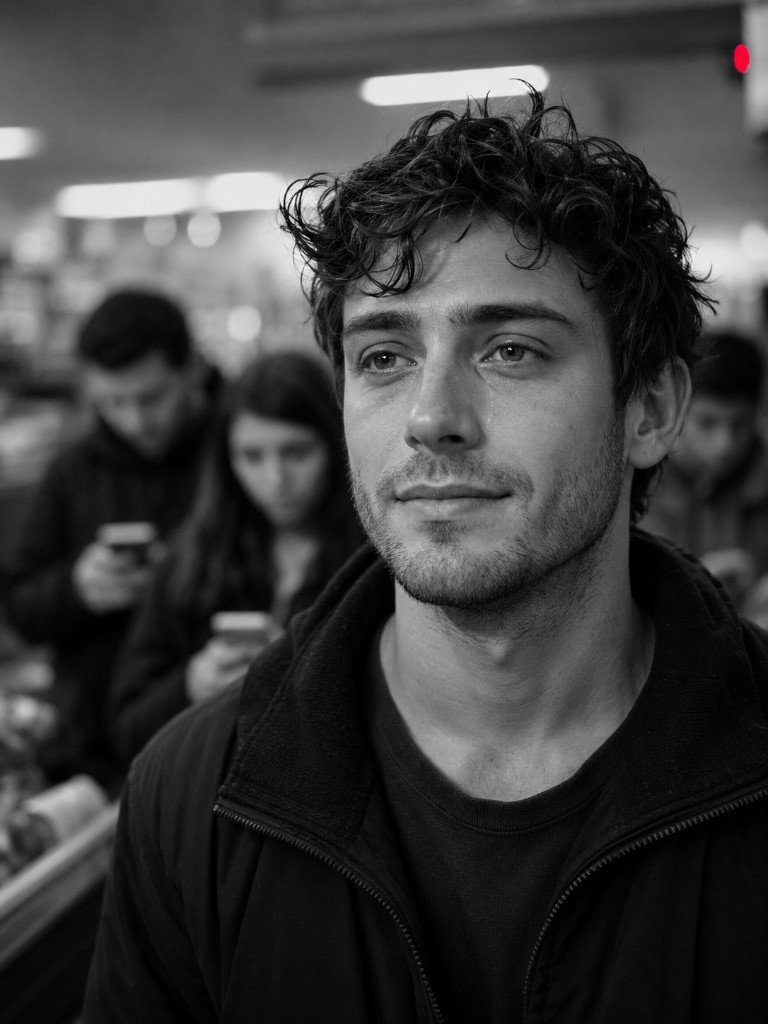
We have unlearned how to speak to strangers. We have unlearned the simple sentence, „hey, are you okay, can I maybe help you”. I do not condemn the people who fall out of the wheel, not with a single word, and I do not pity them either, because pity makes them small and misses what they really need. What I feel is something else entirely, it is a cold anger at a world in which we live packed tightly together and are still so lonely that a person right next to us can break apart without anyone raising his head. We have become a society of people running side by side, each in his own little wheel, and in the process we have unlearned the simplest human ability there is, namely to truly see another person and to let him feel that he is seen.
And if you are reading this right now and stand at that edge yourself, then this piece tells you the exact opposite of what the exhaustion whispers to you. You do not want death, you want the pain to stop, and the pain is not the end of your story, even if it feels that way right now. Talk to a person about it, to any person, and if no one comes to mind right now, then in the United States you can reach the 988 Suicide and Crisis Lifeline around the clock, by call or text to 988, free and confidential. It costs nothing to say the simple sentence, except the brief discomfort of stepping out of your own wheel for a moment. And perhaps that is exactly the only contribution most of us can really make, not the great rescue, but the small glance that shows a person he is not invisible.
I will keep looking, that is all I can promise. I will speak to the stranger at the checkout, even when it is uncomfortable, even when he turns me away, because the one time that does not turn me away can change everything. For Hans I came too late. For the person ahead of me in line perhaps not, and that is why I raise my head now and ask.
References
- Durkheim, É. (1897). Le suicide: Étude de sociologie. Félix Alcan.
- HelpGuide. (2025). Suicide prevention: How to help someone who is suicidal.
- Mayo Clinic Health System. (2024). 8 common myths about suicide.
- Psychiatric Times. (2025). A „sickness of our time”: How suicide first became a research question.
- Substance Abuse and Mental Health Services Administration. (2025). 988 Suicide and Crisis Lifeline.
- U.S. Department of Veterans Affairs. (2024). National Veteran Suicide Prevention Annual Report. Office of Mental Health and Suicide Prevention.
- World Health Organization. (2025). Suicide worldwide in 2021: Global Health estimates. World Health Organization.
Disclaimer: This article reflects the author’s own research and opinion as of the publication date shown above; later findings or legal changes may have overtaken it, so always check that date. Sources are cited for independent verification, and no liability is accepted for third-party studies. This is general information, not medical, legal, or professional advice: for medical questions see a doctor, for legal questions a lawyer, and in an acute crisis contact emergency services or a crisis helpline.
About the header image: it is AI-generated. Cheaper than a photo shoot, and I have made my peace with the age of AI. Everything inside the article is real, the diagrams, the skulls, the findings, and every word. The machine gets the opening shot and not one inch past it.

Where the 1.43 trillion goes, and why the state cannot fully account for its distribution by nationality
Germany's social budget reached 1,430.95 billion euros in 2025, which works out to 45,375 euros per second. For…
Stupidity would be forgivable, ignorance is not
In 2025 Germany took in 2,140.2 billion euros in taxes and social contributions, ended the year 119.1 billion…
Murphy’s law was the answer to the question of why nobody died
Murphy's law is not a shrug: it is why a physician on a rocket sled could tell a…