I have never been afraid of the gun
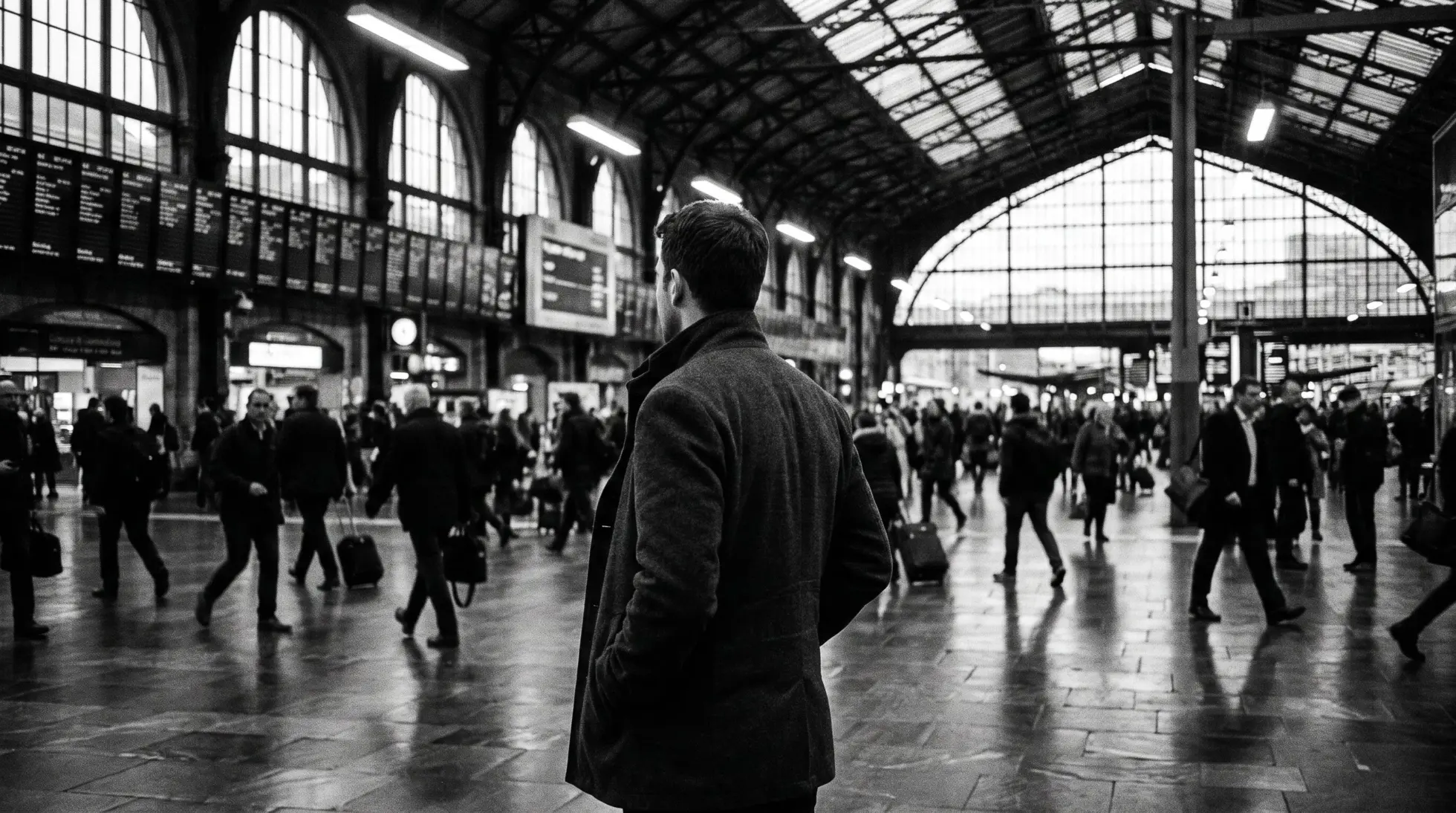

A forensic expert on the weapon that makes no sound, the artery a teenager had never heard of, and why a 6.4-meter head start decides everything
Munich central station has a particular quality of air in the early evening. Not the smell, though that is its own subject, but the way people hold themselves. There is a frequency to a crowd that has stopped assuming it is safe, and you can hear it if you have spent enough years listening for it. Shoulders sit a little higher. People walk with their bags on the inside arm. Groups form and dissolve faster than they would in a shopping street, and the eye contact lasts either too long or not at all.
I went there on purpose. I wanted to see the current security situation with my own eyes rather than read about it, because reading about it produces opinions and looking at it produces observations, and I have built an entire working life on the difference between those two things. I walked the length of the concourse, through the underpass, out into the streets on the western side, and back. It took maybe 40 minutes.
I have felt that same frequency in Berlin and in Frankfurt. I felt it in Aachen a few years ago, on my way to a court date in an attempted murder case, standing on a platform with a case file under my arm and nothing much to do for 20 minutes except watch people. It is not fear exactly, and it is certainly not panic. It is a low, distributed alertness that a population develops when something has changed and nobody has quite agreed on what.
Although in Aachen it was not only the crowd. I will come back to that, because it took me a long time to admit what I was actually doing on that platform.
And walking through that station, I noticed something about my own alertness that I want to put down in writing, because it runs against almost everything the public conversation assumes.
I was not scanning for a gun.
It is not that firearms are unfamiliar to me. I have spent a working lifetime reading what they do to a human body, in autopsy reports written by pathologists who had the body on the table, and I can tell you what a 9 mm round does to bone and what it does to soft tissue and why those two answers are so different. I know the German weapons code well enough to have been questioned on it under oath. None of that expertise was what I was drawing on while I walked that concourse. What I was watching for was a hand that stayed in a pocket a beat too long, a jacket held closed on a warm evening, a forearm pressed against a thigh in the particular way a person holds something rigid they do not want to drop.
Because the thing that frightens me in a crowd is not the pistol, it is the knife, and that blade makes no sound, it gives no warning, and by the time anyone in that station understood what was happening, it would already be finished.
That sentence is the thesis of this piece, and I want to defend it properly rather than assert it, because it is the kind of claim that sounds like gun lobby rhetoric if you state it and walk away, and that is not what this is. Two thirds of what follows is going to complicate my own position, including one set of numbers that cuts directly against me. But I have been carrying this observation around for weeks now, and a station concourse is a bad place to think, so I sat down and did what I always do when something will not leave me alone. I went to the sources.
What the case files actually looked like
A word about where I am speaking from, because this is a field where everyone has an opinion and very few people have a caseload.
For decades the courts appointed me in three separate fields, which in practice kept running into each other. Court-appointed expert in digital forensics, where the question is what a machine did and who told it to. Court-appointed expert in identification, where the question is whether the person in the recording is the person in the room. And court-appointed expert in forensic anthropology, where the question is what a skeleton can tell you when there is nobody left to ask.
That last one requires a sentence of explanation for readers outside the field, because it is routinely misunderstood. Forensic pathology and forensic anthropology are not the same discipline and they are not ranked one above the other. A pathologist works on soft tissue, cause of death, toxicology and the body as it presents on the table, and is far better at that than I will ever be. Bone is a different specialization with different training, and it is precisely why courts appoint a separate expert in forensic anthropology for it. When the material is skeletal, or when the question is what a healed injury or a bone surface can establish, the pathology report and my report answer different questions, and mine is not the junior document.
The work the courts called on most often was the image: surveillance footage, camera systems, the identification of a person from material that was usually too dark, too compressed, and shot from exactly the wrong angle. Somebody commits an act in front of six cameras owned by four different companies, and my job was to establish whether the man in frame at 23:41:07 is the man sitting in the dock. That work put me in courtrooms in a great many proceedings, and it put the rest of the case file on my desk along with the video, because you cannot interpret a movement in a frame without knowing what the movement produced. Which means I read a large number of forensic pathology reports, and read them properly, checking the reasoning rather than accepting the conclusion, because that is what one appointed expert is supposed to do with another appointed expert’s work.
Here is the thing that struck me only in retrospect, once I stopped and counted.
The overwhelming majority of the homicides and attempted homicides that crossed my desk were committed with knives.
There were firearms cases in that caseload as well, and I worked on armed robberies where a security transport driver was shot and severely injured, cases that made national news at the time, and I am deliberately not naming anyone, because the names add nothing and because some of the people involved are still serving their sentences. But those were the exceptions. The ordinary, recurring, week-after-week violent death in the German casework I saw came from a blade, and not the kind of blade a reader tends to picture. It was usually the sort of folding knife a teenager carries in his trouser pocket, bought for 20 euros, carried for months without a thought, and present in the situation long before there was a situation.
That is a personal sample, not a statistic, and I want to be precise about the difference. It reflects the courts that appointed me, the offense types that involve surveillance footage, and the region I worked in. A colleague in a different specialty would report something else. But the pattern was consistent enough, over enough years, that it changed what I look at when I walk through a crowd, and it took me a long time to notice that it had.
What nobody in this profession talks about
There is a part of this work that never appears in any professional journal, that came up in exactly zero of the continuing education seminars I attended, and that I have never once heard a colleague raise in a room with more than two people in it.
The defendant knows you are coming.
He knows your name, because it is in the file. He knows what you do, because your report is the reason the prosecution has a case at all. In a proceeding built on identification from surveillance footage, the expert is frequently the entire evidentiary spine, and everyone in that courtroom understands it, including the man in the dock and including whoever is sitting behind him in the public gallery. He knows the date of the hearing, because he was summoned to it. He knows the approximate time. And if he has any sense at all, he knows roughly how a person gets from where I live to that particular courthouse, because there are only so many trains.
So you stand on a platform in Aachen at 8 in the morning with a file under your arm, and you read the crowd. Not because you are a professional who notices things. Because you are the reason a man is going to prison, and the mathematics of that are not complicated.
Nobody tells you this before your first case. There is no briefing, no protocol, no number to call. In Germany a witness under acute threat can be given protective measures, and they exist and they are used, but the threshold is high and the process is slow, and an expert who says he feels uneasy walking to a train station is not going to clear it. What you get instead is an appointment letter and a form for your travel expenses.
Aachen was the day I understood that properly.
It was an organized crime proceeding, and the defendant had already served a life sentence once before, released after a period that struck me as remarkably short for what the file contained, for reasons I was never told and did not ask about. Preventive detention was on the table this time. The public gallery was full, and not with journalists. It was full of family, of friends, of associates, sitting in rows and watching every person who took the stand.
I gave my evidence, I was released by the presiding judge, and I walked out through that gallery.
There was hissing, not shouting, because shouting would have been dealt with, and nothing anyone could have written down and acted on. A low sustained sound from a bench full of people as I passed, the kind that is deniable by design, and every person in that room including the bench understood exactly what it meant.
Then the doors closed behind me and I was outside on the courthouse steps. It was late afternoon in winter and the light was already going. There was no escort, no car, no offer of one, and no reason there should have been, because on paper nothing whatsoever had happened. I had a file under my arm and a train to catch, and the walk to the station was 15 minutes through a city I did not know, in the dark, having just been watched out of a room by 30 people with a direct interest in the outcome.
I made that walk without incident, the way I made every other walk. But something recalibrated on that pavement, and it never went back. It was the first time in my career that I thought seriously about my own safety, and it was not a dramatic thought. It was closer to plain arithmetic.
I want to be careful and fair here, so let me say plainly that I was never attacked. I have no incident to report and I am not claiming victimhood, and I would not want a reader to think I am asking for sympathy for a job I chose and did willingly for a very long time. Most of the people I helped convict had no interest in me whatsoever, and a great many defendants accept an adverse verdict and serve their time and never think about the expert again.
But the case mix changes what that reassurance is worth. When the charge is murder, the man across the room is not facing a fine. He is facing a life sentence, and a German life sentence is not the American arrangement where a number gets attached to it. Under section 57a of the Criminal Code the earliest a court may even consider release is after 15 years, there is no entitlement to it, and where the court has found particular gravity of guilt the minimum stretches well beyond that with no upper figure defined in the statute. Where preventive detention has been ordered under section 66, it begins only after the sentence has been served in full. I am holding the piece of paper that starts that clock.
So the comforting sentence I just wrote has a hole in it, and I would rather point at the hole myself. A number of the men whose convictions I contributed to are not walking around having moved on with their lives. They are in prison right now, this evening, while I write this, and some of them will be for a very long time.
That produces something I can only describe as a permanent low-grade calculation running underneath everything else, and it concerns where the exits are, who is standing too close, and which seat in a room lets you see the door.
It never switches off afterward, either. A trial ends, an appeal fails, and the calculation keeps running because it was never attached to a specific person in the first place. It attached to a category, and the category does not expire.
And here is the part that I find genuinely strange after all these years. In a profession organized around risk, in which we assess danger for a living, this is simply not discussed. Judges do not raise it. Prosecutors do not raise it. The professional associations do not raise it. Colleagues do not raise it with each other, and I include myself in that, because the first time I have written it down is now.
Which means that when I tell you I stood in Munich central station reading a crowd, I am not describing professional curiosity. I am describing a habit that was installed on a courthouse pavement in Aachen and that outlived the occupation that installed it.
What I did about it afterward is not something I intend to detail here, for reasons that should be obvious from everything above. It is enough to say that I live in one place and work in another, that my address does not appear in registers where addresses usually appear, and that a person who wants to find me has to want it considerably more than most people want anything. I learned to be invisible, and I learned it because of a 15-minute walk in the dark.
He aimed for the shoulder
There is one case I have never fully put down.
Bavaria, a subway station, years ago. A young man, a minor at the time but old enough to be criminally responsible under German law, decided to stab someone in the back, though not to kill him, because that was never the plan, and everything about the case supported that. It was the kind of decision a certain type of adolescent makes in about a second and a half: a grievance, an audience, a knife, and the thought that you can put a blade into somebody’s back and teach him a lesson and everyone goes home.
That is the mental model a person without anatomical training carries around, which holds that the back is simply meat. You poke a hole in it, there is blood and pain and a hospital visit, and the story ends there. It is completely wrong, and almost nobody knows it is wrong.
The blade went in below the shoulder, high and slightly lateral, and it found the axillary artery.
If you have never had reason to learn where that vessel sits, it runs from beneath the clavicle down through the armpit, where it becomes the brachial artery of the upper arm. It is the main arterial supply to the entire arm. It sits close enough to the surface that a blade of very ordinary length reaches it without difficulty, and it is large enough that an injury to it is a genuine emergency measured in minutes. The victim came very close to bleeding to death. He survived, and the charge moved from dangerous bodily harm under section 224 of the German Criminal Code, which is the aggravated offense that applies whenever a weapon or other dangerous instrument is used, to attempted manslaughter, because a court is required to consider what actually happened and not merely what a 16-year-old intended when he reached into his jacket.
My part of the case was the footage. I analyzed the video frame by frame, and the whole question in that courtroom came down to a span of time you would need a slow-motion replay to perceive at all.
Because in my assessment the offender had aimed at the shoulder. The trajectory of his arm, the angle of approach, the point where his hand crossed the victim’s silhouette, all of it pointed at the shoulder mass, which is exactly where you would aim if you believed the back is meat. What put the blade into the artery instead was the victim. In that same fraction of a second, for reasons that had nothing to do with the attack, he raised his right arm. And when a person raises the arm, the entire architecture underneath changes. The vessel that sits protected in the adducted position rotates upward and forward and presents itself, and what would have been a deep muscle wound became an arterial injury.
That is what the case turned on. Not intent, not planning, not anatomy. A raised arm and a few milliseconds.
And the thing I carried around with me through every day of that trial had nothing to do with the verdict.
Ask an average adult to point at his own shoulder blade and he will indicate an area roughly twice its actual size. That is the mental image most people have: a broad plate of bone across the whole upper back, armor, something you could hit without consequence. The scapula is nowhere near that large, it sits higher and more medially than people place it, and the region below and to the side of it, exactly where an adolescent would aim if he wanted to make a point rather than a corpse, has no bony protection at all. Almost nobody knows this, and there is no reason they should. Anatomy is not taught to the general population in any form that survives past the age of 16.
The same gap runs through everything. Most people have no idea what a single punch to the wrong part of the head can do. The temple region is the thinnest part of the skull and an artery runs directly beneath it, and a bleed there can develop under a person who is walking and talking and apparently fine, until he is not. A shove that drops someone onto a curb produces the same result by a different route. These are not exotic mechanisms, they are among the most common findings in the reports I read, and the man who caused them almost never intended anything of the kind.
Which is why the defendants in these proceedings so often look the way they do. There is a particular expression on a person who came to court expecting a charge of dangerous bodily harm and is sitting in a manslaughter trial, and it is not calculation and it is not remorse in the performed sense, it is plain incomprehension. In a great many of these cases I would say the offender is more shocked by what happened than anyone else in the room, and that is not an argument for leniency. It is an observation about how thin the line is between a stupid decision and a body, and about how few people know where that line runs.
I have no idea how the proceeding ended. That is not an evasion, it is simply true, and it is true of most of the cases I worked. An expert delivers a report and answers questions, and then the trial continues without him and reaches a verdict that has nothing to do with him. I never followed up, and I never wanted to. My neutrality was the only thing I actually owned in that room, and anyone who has worked with me knows how seriously I took it. The moment you start caring how it comes out, you have stopped being useful to either side.
But the finding stayed with me, and it is the single most important thing I know about knives.
The lethality of a stab wound has almost nothing to do with the knowledge of the person holding the knife.
The beer belly that saved a man in Nuremberg
Now the opposite case, because a single anecdote proves nothing and two anecdotes that point in opposite directions prove the actual point.
Nuremberg, outside a discotheque, late. An argument that had been building inside came out onto the pavement the way those arguments do, and one man drove a knife into another man’s abdomen. Full commitment, no hesitation in the movement, and on the video it looks exactly like what a homicide looks like.
The victim needed a few sutures and a dressing.
The blade was too short. And the man it went into was carrying what a Bavarian would describe with some affection as a well-developed beer belly, a substantial layer of subcutaneous fat over the abdominal wall, and that layer absorbed the blade before it reached anything that mattered. The knife stopped in tissue whose only function that night was to be in the way.
I will admit I smiled when I read the report. It is a grotesque thing to smile at, and I am aware of that, but there is a particular kind of gallows humor that accumulates in this profession and it is not cruelty, it is pressure release. A lifetime of dietary advice reversed itself in a single evening outside a Nuremberg nightclub.
And then the humor drains out of it, because the counterfactual is not funny at all. Put that same blade into a lean, athletic man with almost no body fat and the identical movement, the identical force, the identical angle reaches the bowel or the abdominal aorta. Same offender, same knife, same intent, and a completely different charge and a possible death.
My assignment in that case was the same as always. Identify the offender from the surveillance system, which I managed to do. There is a small epilogue that I still find telling. I traveled to Nuremberg the evening before the hearing, checked into a hotel, and the next morning the court called to say I was no longer needed. The matter had resolved itself. Confronted with the material, the offender had admitted the act.
That happens more often than the public imagines. Video evidence, properly analyzed and clearly presented, ends a considerable number of proceedings before they begin.
But hold the two cases next to each other, because together they say something that neither says alone.
In Bavaria, an offender who wanted to injure very nearly killed. In Nuremberg, an offender who wanted to kill barely injured. In both cases the outcome was determined by factors entirely outside the offender’s knowledge, intention, or control: an arm that happened to rise, a body that happened to be padded, a blade that happened to be a couple of centimeters too short.
That is the nature of edged-weapon violence, and precision has nothing to do with it. The whole thing is a lottery with a very unfavorable prize structure, and the person holding the ticket usually has no idea what he has bought.
Why a stab wound is not a scratch
The medical literature backs this up with numbers, and the numbers are more interesting than the headline version.
Start with the comparison everyone reaches for. In a study of 4,122 penetrating trauma patients treated at eight trauma centers in Philadelphia between 2003 and 2007, mortality for gunshot wounds was 33.0 percent, while mortality for stab wounds was 7.7 percent. A national analysis from Johns Hopkins covering 437,398 penetrating trauma cases between 2007 and 2014 found that among the 36,297 patients who died, gunshot wounds accounted for 88 percent of deaths and stab wounds for 12 percent.
Read quickly, those figures say the knife is the lesser weapon, and I am not going to pretend otherwise. Per victim, per wound, a firearm is drastically more lethal, and anyone who tells you differently is selling something.
But look at what 7.7 percent actually means before you file it under harmless.
It means that roughly one in every 13 people who arrive at a trauma center with a stab wound does not leave it alive. These are people who survived long enough to be found, long enough for someone to call, long enough for a transport, long enough to reach a facility staffed to handle penetrating trauma. Everyone who did not clear those hurdles is outside the sample entirely. The Johns Hopkins group flagged exactly this problem: over their study period, the likelihood of dying before reaching a trauma center rose sharply for both weapon types.
Which brings us to the mechanism, and the mechanism is the part of this that the public conversation gets wrong.
A stab wound kills through hemorrhage, and hemorrhage is a race against a clock that starts the moment the blade comes out. What determines the outcome is not the offender’s skill. It is whether a large vessel was involved, whether anyone applied effective pressure, and how many minutes passed before a surgeon could get inside the body. The medical variables are bleeding control and prehospital time, and both of them are entirely outside the offender’s influence and largely outside the victim’s.
Everything I said about the Bavarian case is the clinical version of the same statement. The offender’s ignorance of anatomy did not protect his victim. It simply meant that nobody at the scene, including the man doing the stabbing, understood what had just happened.
There is a German clinical detail worth adding, because it says something about how rarely medicine here encounters this. A recent hospital series notes that stab injuries remain comparatively uncommon in German emergency departments, with data from Schleswig-Holstein showing consistently low incidence between 2020 and 2024, of which roughly 30 percent involved thoracic injuries. The same publication reports 1,373 recorded knife offenses in Saxony alone in 2023, an incidence of 33.6 per 100,000 inhabitants, and notes something that will come up repeatedly in this piece: the criminal investigation offices of the individual German states do not collect this data uniformly.
So the clinical picture is a paradox. Individually survivable, frequently in the statistics, poorly recorded, and lethal in a manner that no one involved can predict at the moment of the act.
6.4 meters
Some time in the 1980s I saw a training film that I have never been able to forget, and for years I remembered it as FBI material. That attribution is wrong, and I checked it, because a memory that feels certain is exactly the kind that turns out to be wrong, and this one was.
The origin is an article by Dennis Tueller, a training officer with the Salt Lake City Police Department, published in SWAT Magazine in March 1983 under the title “How Close Is Too Close?” A trainee had asked him a question he could not answer well, so he went out with a stopwatch and measured it. There was an accompanying police training video of the same title, and that video circulated through law enforcement instruction across Europe for decades, which is almost certainly why so many of us who saw it in a classroom filed it under FBI.
The setup was simple to the point of crudeness. A man with a rubber knife at one end. A man with a holstered handgun at the other. The distance between them was 21 feet, which is 6.4 meters, chosen for the entirely mundane reason that officers already trained at seven yards.
The man with the rubber knife got there first.
Tueller found that an average adult could cover that distance in roughly 1.5 seconds, which was about the same time a competent trainee needed to draw and place two aimed shots. Meaning that at 6.4 meters, with a loaded pistol on your hip and full awareness of the threat, you and the man with the knife arrive at the same moment.
I remember the reaction when I first saw it. What went through that classroom was not fear, it was a kind of offended disbelief, because every person sitting there had spent years absorbing the assumption that a firearm settles the question of who has the advantage, and the film demonstrated in under 2 seconds that at conversational distance it settles nothing at all.
Tueller himself has spent 40 years objecting to what happened to his work. The phrase “21-foot rule” was not his, he has said plainly that he has more than a mild disagreement with the term, and his article was about recognizing a danger zone and using obstacles and cover, not about establishing a magic radius.
And in 2020 the concept finally got the treatment it should have had from the start. A team from the ALERRT Center at Texas State University published a four-phase study in Police Practice and Research, and the results are considerably worse than the legend.
Phase one timed 76 subjects covering 21 feet and confirmed Tueller’s 1.5 seconds. Phase two measured 152 police officers drawing and firing a single shot at a silhouette under no stress: mean 1.80 seconds, median 1.73, range 1.03 to 3.40, and only 86 percent of them hit the target at all. Phase three added a charging attacker to introduce stress, and the hit rate fell to 76 percent. Comparing draw times against run times, the authors concluded that for 95 percent of officers to fire before a random attacker reached them, the gap would have to be roughly 32 feet, which is just under 10 meters.
A fourth phase examined what movement does. With 137 subjects playing the attacker from 21 feet, an officer who stood still was reached 33 percent of the time, an officer who backed away 8 percent, and an officer who stepped off the line of attack at 90 degrees 5 percent.
I did not need the study to believe it, because I had already run it myself.
Years ago, with colleagues, I set the scenario up and we worked through it repeatedly. I should say what I brought to that, since it matters for how much weight the result carries, and I am going to say it without decorating it.
Military close-combat training is not self-defense. It is instruction in how to render another human being incapable of continuing, and where an edged weapon is involved that means what it sounds like it means. Nobody who has been through it describes it any other way unless he wants it to sound nicer than it was. That is where I started, and I am not going to pretend it was a course in personal safety.
Police training came later and points the other way, because there the objective is to survive an encounter and bring a person in, which is a genuinely different problem with different answers. Part of that instruction came from members of the special operations unit of the Bavarian state police (SEK), which is the closest German equivalent to an American SWAT team. Those are people who go through doors for a living, and their teaching has a particular quality, because none of it is theoretical and all of it has been paid for somewhere. Then years of jiu jitsu on top of both. So where knives are concerned I am not a curious amateur working from documentaries, I have handled the question from both ends of it, and that is precisely why I am so careful about what I put in writing.
So back to those runs, and the outcome of them was not close and never in doubt. Not one of the people facing me had enough time to draw and fire, not a single one of them. In the space of a few seconds a trained person inflicts multiple injuries that are lethal in their effect, and he does it without needing a clean or committed strike, because contact alone is sufficient at the places that matter.
I know exactly where those places are. I am not going to write them down.
That is a deliberate omission and I want it noticed rather than assumed. You can find that material without difficulty, in books sold openly online and in videos on the usual platforms, presented as instruction and monetized accordingly. My refusing to add to it does not remove a single one of them from the internet. It does mean this article is not one of them, which is the only part of the problem I control.
What I will say is the conclusion, because the conclusion is the point of the whole section. Standing there unarmed, without the training that almost nobody has, against someone who even half knows what he is doing with a knife, I would not give myself a chance. And I am telling you that as a person who was trained in it from both directions.
A separate 2026 study in The Police Journal closes the last gap in the picture. Researchers had 74 subjects perform concealed knife attacks from 8 feet, and recorded mean attack times of 1.43 to 1.60 seconds depending on the movement, with the fastest single attempt at 1.04 seconds. The knives were concealed, the distance was 8 feet, and 8 feet is how close strangers stand to each other on a station platform.
So hold the research and my own runs together, because they say the same thing. The measured finding is that a defender facing an edged weapon has no meaningful time, only a fraction of a second in which the single variable that demonstrably matters is whether he moved. What I saw with my colleagues was that finding without the stopwatch.
What the law expects you to do in that second
Now overlay the legal framework on those numbers, because this is where a German reader and an American reader are standing in completely different places.
German law is contained in section 32 of the Criminal Code, and it is short. Self-defense is the defensive action necessary to avert a present unlawful attack on oneself or on another. The inclusion of “or on another” matters: German law expressly protects coming to a stranger’s aid, which is why the bystander who intervenes at a station is acting within the law and not despite it.
What German law does not contain, contrary to widespread belief, is a general duty to retreat. You are not obliged to run. What limits the defense instead are two requirements: the action must be necessary, meaning the mildest of the effective means available, and it must not be grossly disproportionate in a narrow set of circumstances the courts have carved out.
Hold that next to the timing data and the problem announces itself. “The mildest of the effective means” is a judgment that a court will make over the course of months, with photographs, expert reports, and unlimited opportunity to consider alternatives. The person on the platform has 1.4 seconds and no information at all. He does not know whether the object is a knife or a phone, whether the man is coming at him or past him, or whether stepping back solves it. He is being asked to make a proportionality assessment inside a window shorter than his own reaction time.
American law took a different road, and the contrast is instructive rather than flattering to either side.
The traditional common law position was a duty to retreat: if you can withdraw in complete safety, you must do so before using deadly force. The castle doctrine carved out the home, and it now applies in roughly 45 states. Then in 2005 Florida passed the first modern stand-your-ground statute, removing the duty to retreat anywhere a person is lawfully present, and most other states followed within a few years, some by statute and some through their courts. Roughly a dozen states plus the District of Columbia still impose a duty to retreat in public. The exact count depends on whether you count case law alongside statute, and the sources genuinely disagree, so treat any precise number you see with suspicion.
Here is what makes the comparison worth drawing. Both systems are attempting to regulate a decision that neither system’s timeline can actually reach. German proportionality asks for a graduated response in a window where graduated responses do not exist. American stand-your-ground removes the retreat question but leaves every other element of justification intact, and those elements are just as slow.
The law arrives afterward, always. And the honest conclusion for a reader in either country is that the legal framework governing an edged-weapon encounter is not a set of instructions you can follow in the moment. It is a set of criteria by which you will be judged later, and the gap between those two things is exactly the 1.4 seconds the research measured.
Which leaves the practical question, and since I have spent a great deal of time learning to handle both knives and firearms, I am going to answer it plainly. There is one thing I want to warn you about explicitly before I do.
Do not learn any of this from the self-appointed self-defense instructors on social media. Those videos are worthless and worse than worthless, because they build confidence that has nothing behind it. Watch what actually happens in them if you look closely. The defender’s hand goes into the blade, every single time, in demonstration after demonstration presented as a success. And that celebrated move where the defender takes the weapon away from the attacker works reliably in exactly one environment, which is a video where the attacker knows what is supposed to happen next and cooperates.
So here is what I would tell someone I cared about. If you ever find yourself in that situation, do not be the hero. Keep your head, look for the way out, and if there is any way out at all, run. Run as fast as you are able and do not stop to see what is happening behind you. You will come off worse in that encounter, whoever you are and whatever you have watched, and there is no version of the arithmetic in which you come off better.
A dead hero is forgotten remarkably quickly. I have seen a good many dead heroes.
The alarm that never sounds
Everything so far concerns a single victim. The next part concerns everyone else in the room, and it is the argument I consider the strongest in this piece, partly because it is the one almost nobody makes.
A gunshot is a public alarm.
That is not a metaphor. A shot fired indoors is audible through walls and floors, it is audible across a station concourse, it is audible to several hundred people simultaneously, and every one of them knows within a second what they heard even if they have never heard one before. The physiological response is involuntary and it is fast. People drop, people run, people call. A firearm attack broadcasts its own beginning to everyone in range, and it starts the emergency response at the same instant it starts the attack.
A knife attack broadcasts nothing.
The offender makes no noise. The victim frequently makes very little, because a person who has just been stabbed often does not understand what has happened to him and the classic reaction is confusion rather than a scream. Bystanders 20 meters away see two people close together and then one of them sitting down. In a crowd, an edged-weapon attack can continue for a considerable time before anyone forms the correct interpretation of what they are looking at, and the interpretation is the bottleneck, not the visibility.
Now extend the same logic past the moment of the act, because this is where my own casework kept pointing.
When a homicide is committed with a firearm, someone almost always knows the time. Neighbors heard it, a witness reported it, a camera captured the reaction of a crowd. That produces a timestamp, and a timestamp is the spine of the entire subsequent investigation. Time of death fixes alibi windows. It tells the pathologist where to look. It tells the investigator which recordings to pull and which cell-site data to request.
An unwitnessed stabbing produces no timestamp at all. And if the victim is a person nobody misses for a while, someone living alone, someone without regular contact, someone whose absence produces no phone call, then the body is found days or weeks or months later. Everything an investigation runs on degrades on that timeline: the estimate of time of death loses precision, trace evidence deteriorates, video retention periods expire, and witness memory of an ordinary evening becomes unrecoverable.
The research supports the intuition. Work on body recovery timing finds that later recovery correlates with degraded forensic evidence and reduced solvability, and the older NIJ literature on homicide investigation identified delay in reaching the scene as a solvability factor in its own right.
There is a counterintuitive statistical wrinkle here that I want to include because leaving it out would be dishonest. In American research, knife homicides tend to have higher clearance rates than firearm homicides, and the explanation is not that knives are easier to trace. It is that knife killings are more often domestic and between people who knew each other, which makes the offender easier to identify, while shootings skew toward stranger and gang contexts. German clearance for homicide sits around 90 percent or above, considerably higher than the American figure of roughly 60 to 65 percent, which reflects different case mixes and different police resourcing more than anything about weapons.
So the honest version of the detection argument is narrower than the headline. Knife homicides in general are not harder to solve. But the specific combination that worries me, an unwitnessed killing of an isolated victim discovered long after the fact, only becomes possible when the weapon makes no sound. That case is not in the clearance statistics in any useful way, because a homicide that is never recognized as a homicide never enters them.
The proportion of unrecognized killings is genuinely unknown, and the estimates that exist are extrapolations rather than counts. What can be said is that the recording systems in both Germany and the United States were built around events that announce themselves.
The attacks that nobody saw coming
Which brings me to the events that made me start reading in the first place. Before I list them, one editorial rule, because it will be visible in what follows and I would rather explain it than have it noticed.
In the cases I worked on myself, I give no nationality, no name, no city where a city would identify someone, and no detail that would let a reader reconstruct who was involved. Those files were entrusted to me in a professional capacity, a number of the people in them are in prison as I write this, and none of them consented to appearing in an article. The Bavarian teenager and the man outside the Nuremberg discotheque get their anatomy described and nothing else, and that is a rule I will keep in every piece I write.
In the documented attacks below, the opposite applies. These are matters of public record, prosecuted in open court, reported by named news organizations, and cited here with sources at the end. Withholding an established fact from a documented case is not neutrality, it is editing, and there is a specific reason I refuse to do it.
Southport is that reason, and the sequence there is worth setting out properly.
In the hours after 3 girls were killed at a children’s dance workshop on 29 July 2024, British police released almost nothing, because the suspect was a minor and the law restricted what could be published. Into that vacuum ran a fabricated identity. Social media accounts, some with hundreds of thousands of followers, asserted that the attacker was an asylum seeker who had recently arrived by boat, and circulated an invented name to go with it. That claim produced riots across multiple British cities, attacks on mosques and on hotels housing asylum seekers, and roughly 1,500 arrests.
The attacker was Axel Rudakubana, 17 years old, born in Cardiff, a British citizen, the son of parents who had come from Rwanda, and from a family described locally as heavily involved with their church. Every element of the story that burned down parts of several cities was false. On 1 August 2024 a judge lifted the anonymity order specifically because withholding the name was allowing others to fill the vacuum with invention.
That is what silence buys you. A verified fact, stated plainly with a source attached, is the only thing that has ever competed with a rumor, and a writer who suppresses a documented detail because it is politically awkward has handed the field to whoever is willing to make one up.
So the rule is not about avoiding a category of fact. It is about where the fact comes from. My own case files stay anonymous because they are mine and because the people in them have a right to be left alone. Public cases get reported as the record has them.
What I will not do in either category is draw a conclusion from it. I have no interest in politics. I published 2 pieces recently on the economic situation in Germany, and those were the last political pieces anyone will read here. This article is about anatomy, timing, statistics and law, and the axillary artery does not check a passport.
On 1 March 2014, five attackers with long knives and cleavers entered Kunming railway station in Yunnan, China, and began attacking passengers at random. They killed 31 civilians and wounded more than 140. Chinese authorities attributed the attack to Xinjiang separatists, and 4 people were later convicted. The station was full of travelers heading home after the New Year. It ended when police shot four of the attackers. China has almost no civilian firearms, and the attack produced a casualty count that exceeds the great majority of mass shootings anywhere.
On 26 July 2016, Satoshi Uematsu, a 26 year old former employee, entered a residential care facility for disabled people in Sagamihara, Japan, and killed 19 residents and injured 26, 13 of them seriously. He had written to a politician months earlier setting out his belief that disabled people should be killed, he was carrying knives, and his victims were asleep and largely unable to defend themselves or to flee. It remains the deadliest mass killing in postwar Japan, carried out by one man with no firearm at all, in the country with the strictest gun laws in the developed world.
On 13 April 2024, Joel Cauchi, a 40 year old Australian man whom the subsequent coronial inquest found to have been floridly psychotic and untreated, walked into the Westfield shopping center at Bondi Junction in Sydney with a large knife and killed 6 people. He was stopped when a single police inspector, who had arrived alone, shot him roughly six minutes after it began. Five of the six people he killed were women.
Southport I have already described. The prosecution set out a long-standing obsession with violence and killing, the police did not treat it as terrorism, and he was sentenced to life with a minimum term of 52 years.
On 23 August 2024, at a city festival in Solingen, Germany, 3 people were killed and 8 injured by Issa al-Hassan, a 26 year old Syrian national who was subject to a deportation order that had not been enforced, and whose attack was claimed by the Islamic State. He was convicted and sentenced to life. That attack is the direct reason German knife law changed, and I will come back to what it actually changed.
Now the part that cuts against me, and I am going to give it more space than my argument strictly requires, because a piece that only presents its own side is propaganda regardless of how well sourced it is.
Research by Jason Silva, published through the Rockefeller Institute of Government and underpinned by peer-reviewed work in Homicide Studies, examined public mass killings worldwide. Between 2000 and 2022 there were 52 public mass shootings with 10 or more fatalities. In the same period there were 5 public mass stabbings at that fatality level.
That is 52 against 5, and the ratio is not close.
If your model of the world is that knives produce more mass-casualty events than guns, that number ends the discussion, and it should. On the specific question of high-fatality public attacks, firearms dominate, and they dominate by an order of magnitude. My own position has to survive that finding or be abandoned.
There is a second number from the same body of work that goes further. On 14 December 2012, two attacks on schoolchildren occurred on the same day. At Sandy Hook Elementary School in Connecticut, an attacker with a rifle killed 26 people. In Chenpeng Village in Henan, China, an attacker with a kitchen knife wounded 24 people, 23 of them children. Every child in Chenpeng survived. The only person who died was an elderly woman.
The same day, a comparable number of victims attacked, comparable ages, and one weapon left 26 dead and the other left the children alive.
I do not know of a cleaner natural experiment on weapon lethality, and there is no way to read it that supports the claim that the choice of weapon does not matter, because it matters enormously.
So let me state my own position more precisely than I did at the station, because the data has forced me to narrow it.
I am not claiming that knives are more dangerous than firearms. Per attack, per victim, per event, they are not, and the evidence on that is one-sided. What I am claiming is that the specific configuration in which an edged weapon becomes catastrophic is one that our regulation, our statistics, and our public imagination are all structured to miss: an attacker whose weapon requires no permission to obtain, against victims who cannot flee or do not yet understand what is happening, in a setting where nothing sounds an alarm.
Kunming, Sagamihara, Southport and Bondi Junction all share that pattern. In every one of them, the victims were people who could not run: passengers pressed into a station crowd, disabled residents asleep in their beds, small children in a dance class, shoppers in an enclosed mall. That is the pattern, and it is not a rare one.
What it takes to buy a pistol, and what it takes to buy a blade
Here is the asymmetry that made me want to write this in the first place.
To legally acquire a handgun in Germany, a citizen must demonstrate a recognized need, which in practice means years of documented sport shooting under an approved association or a hunting license. He must pass a proficiency examination covering law, ballistics, and handling. He must pass a reliability review that now includes mandatory consultation of the domestic intelligence service. He must satisfy a personal aptitude requirement. He must meet a minimum age, wait out a multi-stage permit process, and buy and install certified secure storage. Every weapon he owns is entered into the National Firearms Register. And then the recurring checks begin. Under section 4 subsection 3 of the Weapons Act the authority must re-examine his reliability and personal aptitude at intervals of no more than 3 years, which means fresh inquiries to the federal criminal register, the prosecution service register and his local police. Under subsection 4 it must separately re-examine every 5 years whether his need still exists, which for a sport shooter means documenting that he still actually shoots.
That is not a formality. It is one of the most sustained vetting regimes applied to any group of citizens in Germany, and it runs for as long as the person owns a firearm.
To acquire a fixed-blade knife of any length in Germany, an adult walks into a shop, or opens a browser, and buys one.
There is no need to demonstrate, no proficiency examination, no reliability review, no aptitude assessment, no waiting period, no storage requirement, no registration, and no five-year review of anything. A small number of designs are prohibited outright under Annex 2 of the Weapons Act, specifically switchblades, push daggers, and butterfly knives. Everything else, including every product marketed under the words “tactical” or “combat,” is an ordinary consumer good.
I want to be careful here, because there is an obvious response and it is a good one. A knife is a tool. Every kitchen in the country contains several, every workshop contains more, and the idea of licensing them is not merely impractical, it is absurd. Nobody sensible proposes it, and I am not proposing it either.
But that is precisely the point I am making, and it is a point about attention rather than about policy. Supply-side regulation is structurally impossible for the weapon that is used in the majority of the violent deaths I encountered in my working life, and entirely possible for the one used in a minority of them. So we regulate what can be regulated, and then we tell ourselves a story in which what we regulated is the problem.
Who a carrying ban actually reaches
German law responded to Solingen quickly. The security package that came into force at the end of October 2024 extended the carrying prohibition to knives of any blade length at public events, festivals, markets, and on public transport, and tightened the rules on switchblades further.
Read that again, because the crucial word is carrying.
Section 42a of the Weapons Act has for years prohibited carrying one-hand-opening locking knives and fixed blades over 12 centimeters in public. What it does not touch, and what the 2024 reform also did not touch, is acquisition. Anyone may still buy the knife. What changed is where he may have it on his person, in a country that already prohibited carrying it in most of those places.
So the question I keep coming back to is who that reaches.
It is worth setting two people side by side.
The first works Monday to Friday, has a mortgage, perhaps holds a hunting license, and has never been in trouble in his life. He has a great deal to lose and no margin at all in which to lose it. If a carrying prohibition applies to a place he is going, the knife stays at home. He is not weighing anything. He complies automatically, because a person in that position does not gamble a clean record against the convenience of having a folding knife in his pocket on a train.
The second has a criminal record with multiple entries. He has been to prison and knows exactly what it is. A further six months does not represent a catastrophe to him, it represents a familiar interruption. When the police stop him and find a knife, the resulting charge is, from his position, an administrative nuisance attached to a life that already contains many of them.
A carrying prohibition changes the behavior of the first man completely and the behavior of the second not at all. It is aimed at everyone and lands on the compliant, which is the characteristic failure mode of any rule whose only enforcement mechanism is a penalty that the target does not fear.
And I want to be honest about the limits of that argument too, because it is a favorite of the shooting community and it is frequently overstated. A carrying prohibition is not only about deterrence. It also creates a lawful basis for a stop, and a stop that produces a knife takes that specific knife out of circulation on that specific evening. That is a real effect and it is not nothing. Whether it is proportionate to the constraint imposed on everyone else is a political question, and I am not going to pretend that my answer to it is a finding rather than an opinion.
What I will say as a finding is this. Neither the Solingen attacker nor the Southport attacker nor the man in Sagamihara was deterred by a rule about where a knife may be carried, and in each case the weapon was legally obtainable regardless.
The numbers we keep and the numbers we do not
If you want to see how badly the recording systems fit the problem, look at what each country counts.
Germany began systematically recording knife attacks in the criminal statistics only recently. In the 2024 reporting year, the police statistics recorded a knife attack in 29,014 offenses. Of those, 54.3 percent fell under violent crime, 43.3 percent were threats, and 2.4 percent were other offenses. Recorded knife attacks within the category of dangerous and serious bodily harm rose 10.8 percent against the previous year.
The definition itself deserves attention here. A knife attack in these statistics requires that an attack with a knife was threatened or carried out against a person. Carrying alone does not count. And the individual German states collect this data by methods that are not uniform, which means the state-level figures cannot simply be added together, a limitation that the clinical literature has also flagged.
Now the omission that matters most. The German police statistics do not distinguish between legally and illegally owned firearms.
Think about what that means for every political argument built on those numbers. When firearm offenses rise, the statistic cannot tell you whether the weapons came from registered owners or from an entirely separate illegal stock, and therefore it cannot support any conclusion about whether tightening the rules for registered owners would have prevented anything. Yet those numbers are cited in exactly that debate, year after year.
The scale of that blind spot is difficult to state honestly, and I am going to state it honestly rather than usefully.
The National Firearms Register records roughly 5 million legal firearms held by somewhere in the region of a million registered owners. The Small Arms Survey modeled a total civilian stock in Germany, legal and illegal combined, of about 15.8 million as of 2017. Subtracting one from the other suggests something on the order of 10 million unregistered firearms, and I want to flag clearly that this is arithmetic performed on an estimate, not a measurement.
You will also see a figure of 20 million illegal weapons quoted regularly. It traces back to police union estimates and a specialist journal article from the mid-2000s, which themselves rest on earlier estimates, and it has been criticized for having essentially no empirical foundation. I am including it only to say that I do not believe it should be used, and neither should the confident numbers on weapons arriving from the former Yugoslavia or from Ukraine, which are real concerns expressed by law enforcement rather than quantities anyone has counted.
For England and Wales the picture is better documented and worse in substance. Around 54,000 knife-enabled offenses were recorded in the year to December 2024. In the year to March 2024, 262 homicides were committed with a sharp instrument, which is roughly 43 to 44 percent of all homicides in that jurisdiction. In the United States the inverse holds: roughly 78 percent of homicides involve firearms and roughly 8 percent involve knives or cutting instruments, with the FBI recording around 1,562 knife homicide victims in 2023.
Three countries, three completely different weapon profiles, and three sets of definitions that cannot be compared directly with each other. That is not a footnote. It is the reason this debate never converges.
Where restriction works, and where it does not
I said I would complicate my own position, so here is the last complication and it is the one I find hardest.
The research on restricting access to lethal means is among the more robust bodies of evidence in prevention science. When a commonly used and highly lethal method becomes unavailable, deaths fall, and they fall by amounts that have been described in the range of 30 to 50 percent in national natural experiments. The removal of carbon monoxide from the British domestic gas supply and the restriction of certain pesticides in Sri Lanka are the standard examples, and neither produced anything like full substitution to other methods.
That finding is real, and anyone in the firearms community who dismisses it is choosing comfort over evidence.
But its scope is narrower than it is usually presented, and the distinction is the whole argument.
Means restriction works powerfully against impulsive acts. A crisis that lasts minutes, an argument that escalates in a kitchen, a decision made in a state that will not persist until morning. In those situations a barrier of any kind, including the mere absence of a weapon in the room, changes the outcome, and it changes it a great deal.
It works far less well against a determined, planned attack. A person who has decided months in advance, who has read about previous attacks, who has selected a target and a time, will substitute. Kunming and Sagamihara are what substitution looks like in countries where firearms are genuinely unavailable, and the resulting death tolls are not small.
And yet Chenpeng sits in the middle of that argument and refuses to be moved, because substitution happened there as well. The attacker had a knife because he could not have a rifle. And 23 children went home.
So the honest synthesis, the one I would defend in a courtroom, is this. Restricting access to firearms does not prevent determined attackers from attacking. It reduces how many people they kill when they do. Both halves of that sentence are true, and almost everyone in this debate insists on only one of them.
What follows for edged weapons is uncomfortable, because it means that the tool that works for firearms does not transfer. You cannot gate the supply of knives, and therefore knife policy can only ever be about carrying, detection, intervention, and the speed of emergency medicine. Those are all weaker instruments than supply control, and pretending otherwise by passing another carrying prohibition every time something happens is not policy, it is a press release with a legal citation.
The man at the next table
I finished the reading for this piece over a plate of pasta, at a place I have been going to for years, at the corner table where I can see the door. I did not choose that seat consciously. I have sat that way for as long as I can remember, and until this week I would have told you it was about the light.
The owner brought me a bottle of mineral water without being asked, because I have not had a drink in years and he stopped offering a long time ago. Two tables over, a family was arguing about whether the youngest was allowed dessert. Behind them, a man in a work jacket was eating alone and reading something on his phone, and I caught myself noting the shape of his jacket pocket and then noting that I had noted it.
That is what decades of case files do to a person, and I am not entirely sure it is a cost worth paying. There is a version of this alertness that is professional competence and a version that is simply damage, and I have never been confident about where the line falls. My guess is that it moved without telling me, some time around the third or fourth homicide file, and that nobody was watching the moment it did.
My appointment as a court expert ended some time ago. The habit did not end with it. I still take the corner seat, I still count the exits, and I still know, without deciding to, which of the people in this room could reach me before I could stand up. That is the bill for a career spent identifying men from surveillance footage, and it arrives long after the last hearing.
What I do know is what that habit is not, and it is not the fear of a man with a gun.
At Munich central station I walked past several hundred people in 40 minutes, and the statistical likelihood of any one of them being armed with a firearm was somewhere near zero. The likelihood that a considerable number of them had a knife in a bag or a pocket is high, and there is nothing sinister in that, because most of them work with their hands or bought one for a purpose that has nothing to do with anyone else.
The weapon that worries me is the one that requires no permission, makes no sound, gives its victim no warning, gives a bystander no reason to look up, and turns on a raised arm or a layer of body fat or two centimeters of blade length. It is the weapon that killed most of the people whose files came across my desk, and it is the weapon that appears in almost none of the debates about how to keep people safe.
We spent 20 years building a vetting apparatus around 5 million registered firearms and their roughly 1 million owners, all of them checked, licensed, examined, re-vetted every 3 years and re-justified every 5. We built it because it was buildable.
And the object that did the killing in the cases I actually worked was on a shelf in a shop, next to the corkscrews, for 30 euros, with no questions asked and no record kept of who bought it.
I am not asking for that to change, because I do not think it can. I am asking that we stop mistaking the thing we can measure for the thing that is happening.
The bill came, I paid it, and I walked back to the car past a hardware store that was still open. In the window, under a small handwritten sign about a summer discount, there was a display of knives.
References
- Band, R. A., Salhi, R. A., Holena, D. N., Powell, E., Branas, C. C., & Carr, B. G. (2014). Severity-adjusted mortality in trauma patients transported by police. Annals of Emergency Medicine, 63(5), 608–614.
- Barber, C. W., & Miller, M. J. (2014). Reducing a suicidal person’s access to lethal means of suicide: A research agenda. American Journal of Preventive Medicine, 47(3S2), S264–S272.
- Bundeskriminalamt. (2025). Polizeiliche Kriminalstatistik 2024 [Police crime statistics 2024]. Wiesbaden.
- Cook, P. J., Braga, A. A., Turner, B. S., & Barao, L. M. (2019). Why do gun murders have a higher clearance rate than gunshot assaults? Criminology & Public Policy, 18(3), 525–551.
- Federal Bureau of Investigation. (2024). Crime in the United States, 2023: Expanded homicide data. Washington, DC.
- Kantor, M. A., Bleetman, A., Tenbrink, J., & Garg, H. (2026). Close-quarter concealed knife attacks: How much time do you have? The Police Journal. https://doi.org/10.1177/0032258X251340171
- Office for National Statistics. (2025). Crime in England and Wales: Year ending December 2024. London.
- Sakran, J. V., Mehta, A., Fransman, R., Nathens, A. B., Joseph, B., Kent, A., Haut, E. R., & Efron, D. T. (2018). Nationwide trends in mortality following penetrating trauma: Are we up for the challenge? Journal of Trauma and Acute Care Surgery, 85(1), 160–166.
- Sandel, W. L., Martaindale, M. H., & Blair, J. P. (2020). A scientific examination of the 21-foot rule. Police Practice and Research, 22(3), 1314–1329.
- Silva, J. R. (2024). Public mass shootings around the world: Prevalence, context, and prevention. Rockefeller Institute of Government.
- Silva, J. R. (2026). Advancing understanding of global mass murder: A comparison of public mass stabbings and shootings. Homicide Studies. https://doi.org/10.1177/10887679231189514
- Small Arms Survey. (2018). Estimating global civilian-held firearms numbers (Briefing Paper). Geneva.
- Tueller, D. (1983, March). How close is too close? SWAT Magazine.
- Waffengesetz [Weapons Act], § 42a and Annex 2, as amended by the Gesetz zur Verbesserung der inneren Sicherheit und des Asylsystems [Act to Improve Internal Security and the Asylum System], BGBl. 2024 I No. 332 (Germany).
Disclaimer: This article reflects the author’s own research and opinion as of the publication date shown above; later findings or legal changes may have overtaken it, so always check that date. Sources are cited for independent verification, and no liability is accepted for third-party studies. This is general information, not medical, legal, or professional advice: for medical questions see a doctor, for legal questions a lawyer, and in an acute crisis contact emergency services or a crisis helpline.
About the header image: it is AI-generated. Cheaper than a photo shoot, and I have made my peace with the age of AI. Everything inside the article is real, the diagrams, the skulls, the findings, and every word. The machine gets the opening shot and not one inch past it.
The Sketch That Sat Unused for Ten Months
A large manhunt in Louisiana chased a white suspect for ten months while a survivor's sketch of the…
Cognitive Bias in Forensic Experts: How to Minimize It
The file arrives. 78 documents, 3 interrogation transcripts, the investigative report, photographs, a prior criminal record, 2 press…
The Killer Is Not a Monster. He Is the Proof That None Has to Exist.
What a former FBI profiler taught me about killing, what neuroscience does with it, and why 668 people…